Let's be real — you know that feeling when you finally read something and think, "wait, that's exactly what happened to me"? That's the power of women's stories. One sentence, and suddenly you don't feel so alone. Here's the thing: you've probably had a story you kept to yourself for years. Maybe you still do. (Yes, I'm speaking from experience here.) You've wondered if anyone would understand, or if it even mattered enough to say out loud. It does. It always does. This is about why women's stories matter, why sharing them changes more than we realize, and how you might find the courage to share your own.
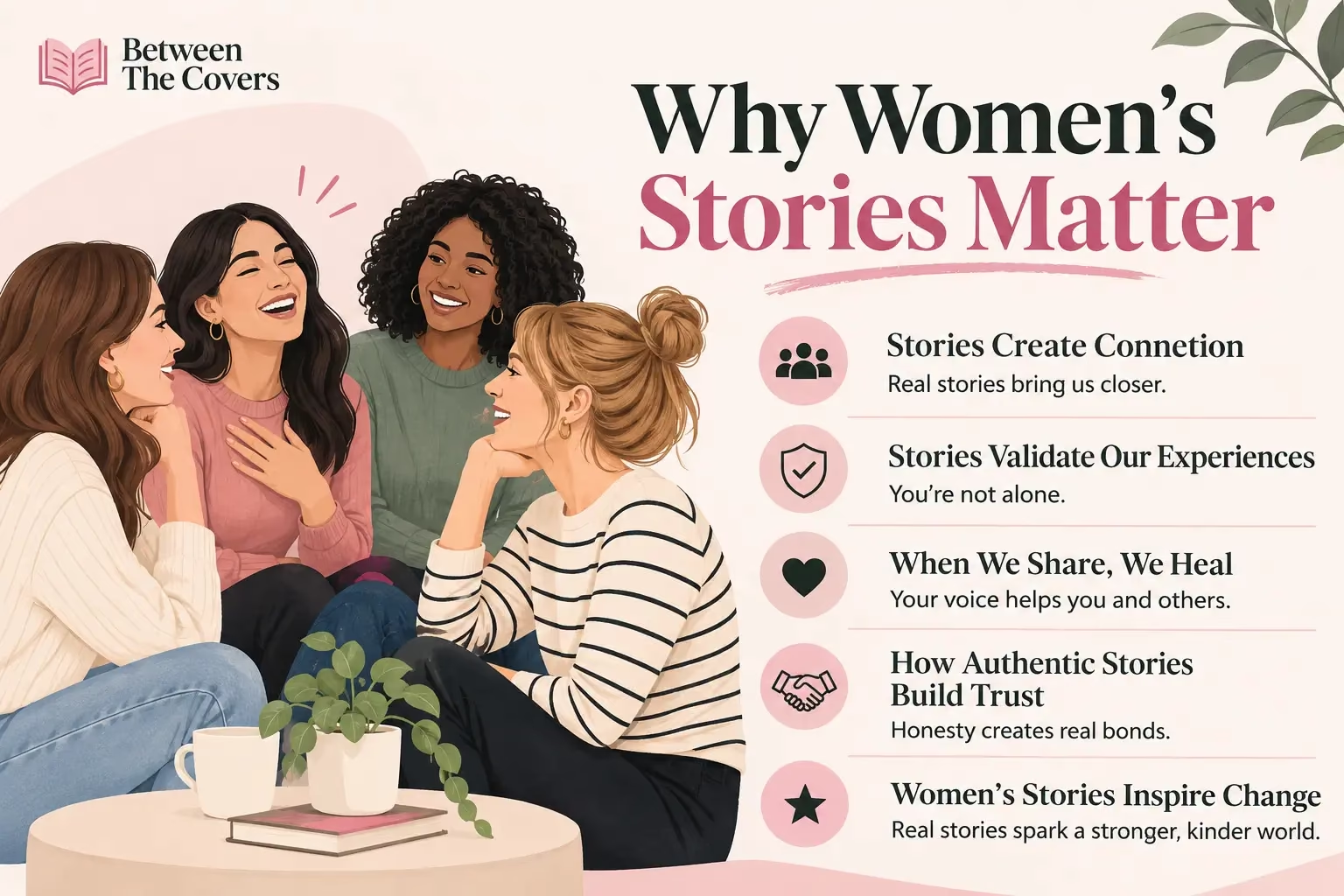
Why Women's Stories Matter
Stories Create Connection
You know that moment when someone shares something so honest it makes the whole room go quiet? That's connection. Real, immediate, no small talk required. Women's stories do that. They cut through the surface-level stuff and get straight to what actually matters — the fear, the joy, the mess in between. Ever been there, hearing a stranger's story and thinking, "that could be my sister"?
Stories Validate Our Experiences
Truth is, so many of us have spent years wondering if what we went through was "normal." A friend of mine once told me she didn't realize her experience had a name until she read someone else's story about it. That's what women's experiences shared out loud can do. They tell you: you weren't imagining it. You weren't overreacting. You were just living something real that nobody had put into words yet.
The Power of Authentic Voices
When We Share, We Heal
I remember the first time I told a hard story publicly. My hands were shaking. Honestly? I almost didn't hit publish. But something happens when you finally say the thing — it loosens its grip on you, just a little. Authentic voices, the messy and unfiltered kind, don't just help the person reading. They help the person telling the story too.
How Authentic Stories Build Trust
Here's what nobody tells you: polished, perfect stories rarely stick with us. It's the honest ones — the ones with the awkward parts left in — that build real trust between the storyteller and everyone listening. When women share their actual lived experiences instead of the highlight reel, something shifts. People lean in. They believe you. They start sharing back.
Breaking the Silence — Stories That Need to Be Told
The Stories We Don't Hear Enough
Some stories get told all the time. Others barely make it into the room at all. Women over 40 navigating reinvention. Women rebuilding after loss. Women quietly carrying more than anyone realizes. Sound familiar? These stories deserve just as much space as the loud, viral ones.
BIPOC Women's Voices
BIPOC women's voices have carried entire communities for generations, often without recognition, credit, or even a place to be heard. Their storytelling holds history, resistance, joy, and wisdom all at once. Making room for these stories isn't optional — it's essential to any honest conversation about women's stories as a whole.
How Sharing Women's Stories Builds Community
Finding Your People Through Stories
Here's the deal — you don't find your people through small talk. You find them through the story that makes someone across the room say, "wait, me too." That's community building in its simplest form.
The Ripple Effect of Sharing
One story shared honestly tends to open the door for the next person. And the next. A friend of mine started sharing her own journey online, hesitantly at first, and within weeks other women were sharing theirs in the comments. That's the ripple effect. It rarely stays contained to just one voice.
The Canadian Perspective — Women's Stories from Coast to Coast
Indigenous Women's Voices
Indigenous women's voices carry storytelling traditions that stretch back long before written history, rooted in land, language, and generations of lived experience. Canadian media still has real work to do in making space for these voices to lead, not just be included.
Immigrant Women's Stories
Immigrant women's stories often hold entire histories inside them — the leaving, the arriving, the rebuilding. My own family's story includes pieces I only learned as an adult, sitting at my grandmother's kitchen table. These women's journeys, stitched together from two countries, two languages, and two versions of home, deserve to be told with the full weight they carry.
How to Share Your Own Story
Start Where You Are
You don't need the perfect opening line. Start with what's true right now — a memory, a feeling, a moment that's been sitting with you. That's enough to begin.
You Don't Need to Be a Writer
Honestly? Some of the most powerful storytelling I've ever read wasn't polished at all. It was just honest. You don't need perfect grammar or a fancy structure — you just need to tell the truth as you know it.
Your Voice Matters
Whatever you're carrying, however small it feels, it matters. Your story might be exactly the words someone else has been waiting to read. That's the quiet power of authentic voices — you never know who needs yours.
Conclusion
Women's stories hold more power than we usually give them credit for. They connect us, validate us, and quietly build community one honest moment at a time.
So if you've been sitting on a story, wondering if it matters — it does. Your voice, your journey, your truth. All of it counts.
Want more storytelling that feels like a real conversation? Subscribe to BTC Magazine for the voices, journeys, and community we think deserve to be heard.









Comments
No comments yet
No comments to show yet. Subscribe to join the conversation.
Log in or subscribe to comment on this article.