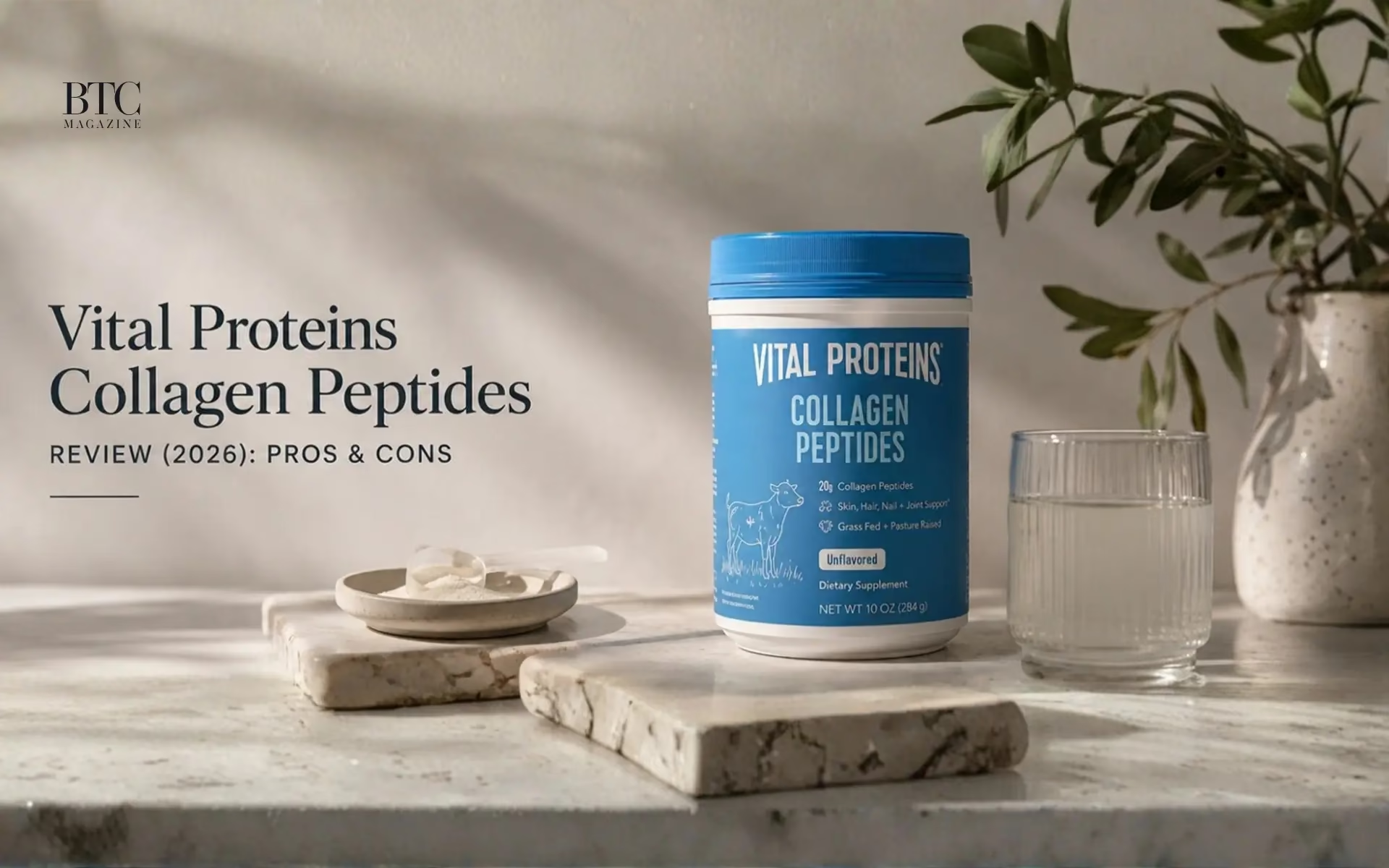
Chances are you’ve seen the blue canister. Maybe it was on a friend’s kitchen counter, in the background of a wellness influencer’s morning routine, or stacked on an endcap at Costco. Vital Proteins Collagen Peptides has become one of the most recognizable supplement products in North America, and the questions people ask about it go far beyond “where can I buy it?”
This guide breaks down exactly what’s in the canister, what the clinical research actually supports, where the evidence falls short, and what matters most if you’re a woman over 40 navigating collagen loss alongside hormonal shifts.
For more evidence-based wellness coverage, explore our health and wellness articles.
What Are Vital Proteins Collagen Peptides?
At its core, the product is remarkably simple. Vital Proteins Collagen Peptides contain a single ingredient: hydrolyzed collagen sourced from bovine (cow) hides. These hides come from grass-fed, pasture-raised cattle, though the company acknowledges it cannot guarantee 100% grass-fed sourcing because cattle may eat a diversified diet when housed indoors.
The cattle are not raised for collagen. Vital Proteins repurposes animal byproducts, specifically skins and hides, that would otherwise go to waste in the meat industry. The company has committed to a deforestation-free primary supply chain by 2025.
Key product specs:
20 grams of collagen per serving (two scoops)
18 grams of total protein
70 calories, zero sugar, zero carbs
Contains 18 essential and non-essential amino acids, including glycine, hydroxyproline, proline, and leucine
No artificial sweeteners, colors, or flavors
Free from dairy and gluten
Paleo and keto friendly
Types I and III collagen
The brand also sells an Advanced formulation that adds hyaluronic acid and vitamin C to the base collagen. There’s a marine collagen option sourced from fish for those avoiding bovine products. But the flagship product, the one in the blue canister, is that single-ingredient bovine collagen.
Why Types I and III Matter
Type I collagen is the most abundant type in the human body. It’s the primary structural protein in skin, hair, nails, tendons, organs, and bones. When people talk about “anti-aging” collagen, they’re mostly talking about Type I.
Type III collagen is typically found in reticular fibers, such as those in bone marrow. In the body, it almost always appears alongside Type I. Together, these two types cover the majority of collagen-related functions that matter for daily health.
Notably absent from Vital Proteins’ standard product is Type II collagen, which is found primarily in cartilage. Some competing products specifically target Type II for joint health, so this is worth knowing if cartilage support is your primary goal.
Collagen Peptides vs. Collagen: Key Terms Defined
The terminology around collagen supplements is confusing on purpose (it makes products sound more scientific). Here’s what you actually need to know.
Collagen is the most abundant protein in the human body, making up about 30% of your total protein content. Think of it as the structural scaffolding that holds your skin, joints, bones, and connective tissue together.
Collagen peptides are simply collagen that has been broken down through a process called hydrolysis. This is why you’ll also see the terms “hydrolyzed collagen” and “collagen hydrolysate” on labels. All three terms describe the same thing.
The size difference matters enormously. Whole collagen molecules can be 300,000 daltons (a unit of molecular weight) or larger. Collagen peptides typically range from 2,000 to 5,000 daltons. That’s roughly a 60-fold reduction in molecular size. Research indicates that collagen peptides achieve an absorption rate of approximately 90%, compared to just 10 to 15% for whole collagen supplements. This is the entire reason hydrolyzed collagen dominates the supplement market.
Bioavailability, in simple terms, is how much of what you swallow actually gets absorbed and used by your body. Higher bioavailability means less waste. The small molecular size of collagen peptides is what gives them their absorption advantage.
What the Research Actually Says
This is where things get genuinely interesting, and genuinely complicated.

The Supporting Evidence
A 2025 meta-analysis published in The American Journal of Medicine analyzed 23 randomized controlled trials involving 1,474 participants. The conclusion: collagen supplements significantly improved skin hydration, elasticity, and wrinkles across the pooled data.
A 2024 double-blind, placebo-controlled study assigned 112 women to receive either 10 grams of hydrolyzed collagen peptides or a placebo daily for eight weeks. The collagen group showed statistically significant improvements in skin elasticity (p = 0.009), skin hydration (p ranged from 0.003 to less than 0.001), and skin roughness.
For joint health, a meta-analysis of four trials involving 507 patients with knee osteoarthritis found significant pain relief in the collagen peptide group compared to placebo.
The general consensus across the research: benefits appear with consistent intake of 2.5 to 15 grams daily, sustained for 8 to 12 weeks minimum. Vital Proteins delivers 20 grams per serving, which covers and exceeds all clinical dose ranges studied.
The Limitations (And They’re Real)
Here’s the part most collagen marketing leaves out.
The MD Anderson Cancer Center notes that studies on collagen supplement safety and effectiveness are limited, and most were funded by the supplement industry, creating concerns about bias. Scientific evidence supporting its efficacy in anti-aging and regenerative applications remains inconsistent across the broader literature.
Collagen peptides also differ from complete protein sources in their amino acid composition. They do not stimulate muscle protein synthesis to the same extent as higher-quality dietary proteins like whey or pea protein. This is a critical distinction that gets lost in marketing.
And because collagen supplements are not regulated by the FDA, the purity of active ingredients is not standardized. More on this below.
Why It Matters for Women Over 40
Natural collagen production begins declining by approximately 1% per year starting around age 25 to 30. By 40, you’ve already lost a meaningful percentage of the collagen your body once produced on its own. But the story gets more specific for women entering perimenopause.
Declining estrogen directly accelerates collagen loss beyond that baseline 1% per year. The practical implications show up in skin elasticity, joint stiffness, bone density changes, and slower recovery from physical activity. These aren’t cosmetic concerns. They affect how you move, how you feel, and how your body handles the physical demands of daily life.
The research is strongest for skin elasticity and joint comfort with consistent daily intake of at least 10 grams over 8 to 12 weeks. If you’re navigating hormonal shifts, our piece on what perimenopause actually feels like explores that lived experience with honesty and humor.
The Vitamin C Connection
This point is critically under-discussed. Vitamin C is a cofactor for collagen synthesis, meaning your body needs it to actually use the collagen you’re consuming. Research suggests that combining 10 to 20 grams of collagen with vitamin C can help improve tendon, ligament, joint, and muscle health, especially when consumed 30 to 60 minutes before exercise.
The standard Vital Proteins Collagen Peptides product does not contain vitamin C. The Advanced version does. If you’re using the standard version, pair it with a vitamin C source: an orange, a kiwi, a glass of juice, or a separate supplement. Without adequate vitamin C, you may be reducing the product’s effectiveness.
You’ll find more on pairing supplements with the right foods in our food and culture section.
What Real Users Report (The Honest Version)
Clinical trials are one thing. What people actually experience at home is another. Practitioners on Reddit’s r/Supplements community have debated Vital Proteins Collagen Peptides extensively, and the consensus lands somewhere between enthusiasm and healthy skepticism.
The Reddit consensus, as synthesized by reviewers who tracked these discussions: “It works, but maybe not $50-a-month works.” The most believable user reports mention specific, unglamorous details rather than sweeping transformations.
Timeline of Results Based on User Reports
Nails: Improvements by week 3 to 4 (stronger, less brittle, faster growth)
Joints: Reduced clicking and stiffness by month 2
Skin: Visible changes in hydration and elasticity by month 3
One Walmart reviewer shared that they used the collagen powder in hot tea each morning during post-chemotherapy recovery, noting it dissolved quickly with no taste and helped with hair regrowth and skin healing. That’s a single anecdote, not clinical evidence, but it illustrates how people are using the product in real, sometimes serious, health contexts.
Side Effects to Expect
Some people report feeling bloated during the first week or two. A smaller number develop skin breakouts early on. The theory is that collagen boosts skin cell turnover, pushing impurities to the surface. Both effects tend to resolve within two weeks for most users.
Taste and Mixability
The powder dissolves in both hot and cold liquids. Most users report it’s essentially tasteless in coffee. In plain water or tea, some detect a faint meaty undertone. It does not mix well with carbonated drinks.
Price Reality
At roughly $47 per canister for the standard size (approximately 28 servings), the cost works out to about $1.64 per serving. Smaller canisters run closer to $2.14 per serving. One reviewer on a supplement comparison site put it bluntly: “At $47 per container, you’re paying for brand recognition and Instagram aesthetics over verified quality.”
Whether that premium is justified depends on what you value. The single-ingredient simplicity, widespread availability, and consistent dissolvability are genuine advantages. The brand recognition tax is real though.
What to Watch Out For
No honest assessment of Vital Proteins Collagen Peptides skips this section.
Heavy Metals in Collagen Supplements
The Organic Consumers Association and Clean Label Project tested 28 of the top-selling collagen supplement brands. The results: 64% tested positive for measurable levels of arsenic, 37% for lead, 34% for mercury, and 17% for cadmium. These are not Vital Proteins-specific numbers, but industry-wide findings that apply to the category.
Vital Proteins has faced Prop 65 lawsuits related to heavy metal content and now includes warnings on packaging. Heavy metals can accumulate in the body over time, which is why these findings matter even at low per-serving levels.
Third-Party Testing vs. NSF Certification
Vital Proteins states that its Collagen Peptides are third-party tested, and it holds GMP (Good Manufacturing Practices) certification. But GMP certification ensures that the facility follows quality control processes during manufacturing. It does not confirm the final product’s purity or ingredient accuracy.
The gold standard for supplement testing is NSF Certified for Sport or USP Verification. Vital Proteins has neither. This is a meaningful gap, especially for a market-leading brand at a premium price point.
The Nestlé Factor
Nestlé Health Science completed its full acquisition of Vital Proteins in February 2022, having initially acquired a majority stake in 2020. Vital Proteins is described as “America’s number one collagen brand.”
The Nestlé ownership draws mixed reactions. Community members on health forums, including Mayo Clinic Connect, have raised concerns about Nestlé’s broader track record on consumer health. A holistic pharmacist who previously carried the brand publicly noted concerns about decreasing transparency following the acquisition.
Whether corporate ownership affects product quality is debatable. That it affects brand trust for a segment of health-conscious consumers is not.
The Incomplete Protein Problem
This is the single most important nutritional fact most marketing ignores. Vital Proteins Collagen Peptides contain 18 or 19 amino acids (sources vary slightly), but the product lacks tryptophan, one of the nine essential amino acids.
This means collagen is not a complete protein. It should not replace whey, pea, or other complete protein sources, especially for anyone relying on it for muscle maintenance or post-workout recovery. The 20 grams of collagen per serving looks impressive on the label, but it does not function the same way as 20 grams of whey protein in terms of muscle protein synthesis.
How to Take Vital Proteins Collagen Peptides
Dosing
The recommended range is 10 to 20 grams per day, which translates to one to two scoops (two to four tablespoons) of Vital Proteins Collagen Peptides. Most clinical studies showing benefits used doses in the 10 to 15 gram range, so even one scoop daily puts you within the studied range.
Timing
For joint benefits, research suggests consuming collagen with vitamin C 30 to 60 minutes before exercise or strength training. For general skin and wellness benefits, timing appears less important. Consistency matters more than clock precision.
Best Practices
Dissolve in coffee, smoothies, or warm (not boiling) water
Pair with a vitamin C source every time
Don’t expect it to replace your protein shake
Habit stack: tie it to something you already do daily, like your morning coffee
If you’re looking for practical ways to fold small health habits into a packed schedule, our article on managing burnout and time has some grounded advice.
Canadian Availability
Vital Proteins is widely available across Canada. You can find it on Amazon.ca in multiple sizes (including the 567g canister), at Costco Canada (often with periodic discounts), and at Walmart Canada. For those who prefer Canadian-made alternatives, brands like Organika, CanPrev, and Landish offer comparable collagen peptide products and are worth considering.
The Bigger Picture: Collagen and the Supplement Market
The collagen supplement market was valued at $1.80 billion USD in 2025, with projections reaching $3.56 billion by 2036. The hydrolyzed collagen peptide segment is outgrowing gelatin-based products as consumers increasingly choose high-bioavailability formats backed by clinical evidence.
Powder formulations currently lead the market with over 57% of revenue, though capsules and gummies are gaining share. Vital Proteins sits at the center of this growth, for better and worse. Its visibility drives category awareness, but its premium pricing and certification gaps leave room for competitors to differentiate on transparency and testing rigor.
Bottom Line
Vital Proteins Collagen Peptides is a straightforward, well-formulated product with one ingredient that does what it claims to do at the molecular level: deliver highly bioavailable collagen peptides. The clinical evidence for skin and joint benefits is real, though modest and mostly industry-funded. The product works best as part of a broader approach to health, not as a magic powder.
The concerns are equally real. No NSF certification. Heavy metal exposure at the category level. An incomplete amino acid profile. And a corporate parent that makes some consumers uneasy.
If you decide to try it, pair it with vitamin C, give it at least 8 to 12 weeks, and don’t let it replace actual protein sources. If you’re over 40 and dealing with the compounding effects of hormonal change and collagen decline, the potential upside is worth exploring, but with clear eyes about what it can and can’t do.
For more honest conversations about women’s health, beauty, and everything in between, browse our curated collections or check out the Bitch Fest podcast for deeper dives on the topics that matter.
Discover exclusive subscriber wellness perks available to BTC members across Canada.








Comments
No comments yet
No comments to show yet. Subscribe to join the conversation.
Log in or subscribe to comment on this article.