What “Peptide Warehouse Canada” Actually Refers To
If you searched for “peptide warehouse canada,” you’re probably trying to do one of two things: find a specific vendor’s website, or figure out whether that vendor is trustworthy before spending hundreds of dollars on peptide products. The answer is more complicated than it should be.
The term works as both a brand name and a generic descriptor. There is a company called Peptide Warehouse Canada operating at peptidewarehouse.ca, based in Mississauga, Ontario. But there are also at least two other businesses with nearly identical names that operate out of the United States. This naming overlap is the source of enormous confusion, and no single page on the internet explains it clearly.
For readers following health and wellness trends, understanding the difference between these entities matters. It also matters to understand what Health Canada actually says about buying injectable peptides online, because the regulatory picture has changed dramatically in 2026.
Three Companies, Nearly Identical Names
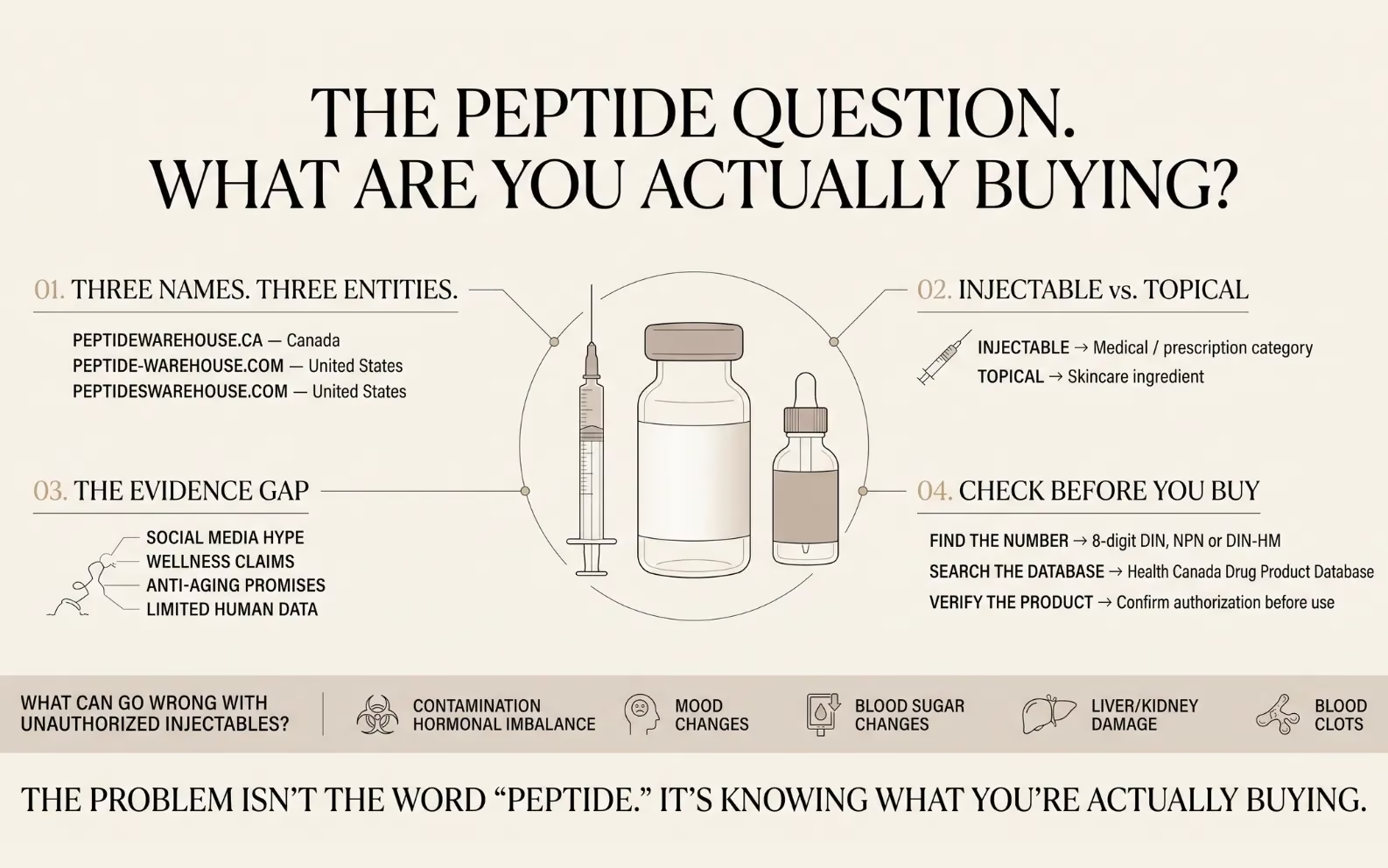
Here is the breakdown of the three entities that share the “Peptide Warehouse” name:
peptidewarehouse.ca is the Canadian operation. Based at 3166 Lenworth Dr, Unit #110, Mississauga, Ontario (L4X 2G1), it claims to be the only Canadian supplier that manufactures and fills vials domestically rather than importing pre-filled products from overseas. The company claims HPLC testing on its products.
peptide-warehouse.com is a US-based operation that explicitly states on its own site that it is “not affiliated with peptideswarehouse.com or any similarly named websites, brands, or entities” and “operates independently.”
peptideswarehouse.com is also US-based. Trustpilot reviewers have gone out of their way to note the distinction: “This company is not affiliated with peptidewarehouse.ca. One company is based in Canada, while the other is based in the USA.”
Practitioners on Reddit’s r/bpc_157 community have posted threads titled “Is Peptide Warehouse Canada Legit?” precisely because they cannot determine which vendor they’re dealing with. One reviewer asked: “Which site represents the real company? Both websites are identical.” The confusion is not a minor inconvenience. When you’re considering injecting something into your body, knowing exactly who made it is not optional.
Peptides: A Quick Science Primer
Peptides are short chains of amino acids, the building blocks of larger proteins. When two or more amino acids link together, they form a peptide. Your body produces peptides naturally. They act as chemical messengers and play key roles in growth, metabolism, healing, and skin repair.
That’s the simple version. The important distinction for anyone researching peptide warehouse Canada vendors is the difference between two very different categories of peptide products.
Topical Peptides (Skincare)
Topical peptides are ingredients in creams, serums, and moisturizers. In skincare, peptides signal the skin to produce collagen, support firmness, and improve texture. Common examples include copper peptides (GHK-Cu), Matrixyl, and Argireline. These are legal, widely available in Canada through retail stores, and supported by cosmetic-grade evidence. If you’re interested in skincare and beauty, topical peptides are a legitimate, regulated category worth exploring.
Injectable Peptides (Research Chemicals)
Injectable peptides sold online, including BPC-157, TB-500, Melanotan, CJC-1295, and dozens of others, are a completely different story. In Canada, these are regulated as prescription drugs. They are the focus of Health Canada enforcement actions, and the risks associated with them are real and documented.
Are Injectable Peptides Legal in Canada?
No. Not when purchased from unauthorized online vendors.
Health Canada’s position is unambiguous: injectable peptides are regulated as prescription drugs in Canada. In an April 2026 public advisory, the agency warned that these drugs are often marketed as helping with weight loss, anti-aging, or bodybuilding, along with general wellness. Health Canada has not authorized any of the seized products, meaning they have not been assessed for safety, efficacy, or quality. Selling unauthorized drugs is illegal in Canada.
The advisory specifically named products that were seized, including BPC-157, CJC-1295, DSIP, Epitalon, GHK-Cu (injectable form), HCG, Ipamorelin, KPV, Melanotan I and II, MOTS-C, NAD+, SS-31, TB-500, and Retatrutide.
The “Research Use Only” Loophole That Isn’t One
Many peptide warehouse Canada vendors, including peptidewarehouse.ca, label their products “for research use only.” The .ca company itself responded to a Trustpilot review by stating: “We make no claims about our products. We inform our customer that there is no research to support any therapeutic effects for peptides. These products have not been approved for human or animal use and they are sold strictly for research purposes.”
Health Canada has directly addressed this tactic. Just because some drugs are marketed as for research use only, the agency says, that does not make them legal or exempt from regulatory requirements. The label is a legal fiction that does not protect the vendor or the buyer.
Enforcement Is Already Happening
Health Canada has seized unauthorized injectable peptide drugs from “Canada Peptide,” with products being sold via the company’s website. The agency also seized unauthorized injectable peptides from Prime Research of Sherbrooke, Quebec; at Health Canada’s request, that company stopped advertising and took down its website.
The Canada Border Services Agency is now working with Health Canada to intercept unauthorized peptide shipments entering the country. This is not theoretical. It is active enforcement.
If you’re navigating questions about hormonal health during perimenopause, the temptation to try peptides marketed for anti-aging or hormone support is understandable. But the regulatory and safety picture should give anyone pause.
Health Risks That Health Canada Has Flagged
Using unauthorized peptide drugs can cause serious health risks including hormonal imbalance, mood swings, blood sugar imbalance, liver or kidney damage, blood clots, and growth of cancerous tumours. That list comes directly from Health Canada’s advisory.
Beyond the peptides themselves, there are contamination risks. Consumers using unauthorized peptide drugs are exposed to products that may contain solvents, heavy metals, particles (fibers, glass, plastic), or microbials including bacteria, fungi, and endotoxins. When products are manufactured without regulatory oversight, there is simply no guarantee of what is in the vial.
Real-World Consequences
In 2025, two women were hospitalized in Las Vegas after receiving peptide injections at an anti-aging conference. Their symptoms included swollen tongues, difficulty breathing, and elevated heart rates. One woman had to be put on a ventilator.
Dr. Knoepfler, a researcher quoted in multiple reports, warned: “There’s no recommended safe dose for these because they aren’t approved as drugs,” citing potential cancer risk with long-term use, along with kidney, liver, or other organ damage.
Why Women Over 40 Face Higher Risks
Many people ages 50-plus have chronic conditions and take multiple medications, increasing the chance of harmful interactions. For women in midlife managing perimenopause symptoms, thyroid conditions, blood pressure medications, or hormone replacement therapy, adding an unregulated injectable peptide to the mix introduces unknown variables into an already complex picture. Given the lack of evidence and unanswered safety questions, many doctors say older adults are better off avoiding them entirely.
Explore more on identity and body image to understand the broader cultural pressures behind anti-aging trends targeting women.
The Evidence Gap Is Staggering
The gap between what peptide sellers promise and what science has actually demonstrated is enormous.
“There isn’t any meaningful data on these peptides,” says Dr. Eric Topol, cardiologist and director of Scripps Research Translational Institute. “People are taking them on blind faith.”
BPC-157 is the most popular injectable peptide. Published human evidence for it remains trivial: a retrospective knee-pain report included 16 patients, an interstitial cystitis pilot trial enrolled 12 women, and a recent IV safety pilot involved just two healthy adults. These studies are far too small and poorly controlled to establish efficacy for anything.
McMaster University’s Professor Stuart Phillips made a pointed observation: if peptides were effective, pharmaceutical companies would patent and sell them. He suspects pharma companies likely examined popular injectable peptides but opted not to pursue them because of weak results or safety concerns. That’s not proof of ineffectiveness, but it’s a telling signal.
The Ozempic Halo Effect
Part of what’s driving the peptide trend is the success of approved peptide-based drugs like Ozempic and Wegovy (GLP-1 receptor agonists). These are legitimate, rigorously tested prescription medications. Their popularity has created a halo of legitimacy around all peptides, making consumers assume that if one peptide drug works, others sold online must also be safe and effective. That assumption is wrong. Approved peptide drugs went through years of clinical trials involving tens of thousands of patients. The peptides sold by peptide warehouse Canada vendors have not.
What About Peptides in Skincare?
Here’s where the picture gets much brighter. Topical peptides in skincare are a genuinely useful, well-studied category that has nothing to do with the regulatory issues surrounding injectable products.
Common skincare peptides include:
GHK-Cu (copper peptides): Support wound healing, collagen synthesis, and skin elasticity.
Matrixyl (palmitoyl pentapeptide-4): Stimulates collagen and fibronectin production, reducing the appearance of wrinkles.
Argireline (acetyl hexapeptide-3): Works by relaxing facial muscles, sometimes called “topical Botox” (though the effect is much milder).
These ingredients are found in serums, moisturizers, and eye creams sold by Canadian retailers. They pair well with hyaluronic acid, vitamin C, and niacinamide. Results typically appear after 4 to 8 weeks of consistent use.
If you’re interested in peptides for anti-aging or skin health, this is the safe and legal path. Browse beauty essentials for more evidence-informed skincare recommendations.
BTC subscribers also get exclusive perks at Ontario wellness and beauty partners, which can include local spas and skincare providers.
How to Verify Whether a Drug Product Is Authorized in Canada
Health Canada says that authorized health products carry an eight-digit Drug Identification Number (DIN), Natural Product Number (NPN), or Homeopathic Drug Number (DIN-HM). If a product doesn’t have one of these numbers, it has not been assessed by Health Canada.
To check a product:
Go to Health Canada’s Drug Product Database (search “Health Canada DIN lookup”).
Enter the product name or DIN number.
If no results appear, the product is not authorized for sale in Canada.
This takes about 30 seconds and can save you from injecting an unknown substance. None of the products listed on peptide warehouse Canada vendor sites carry DIN numbers, because they have not gone through the approval process.
What to Do If You’ve Used an Unauthorized Peptide
If you’ve already purchased or used injectable peptides from an unauthorized source, take these steps:
Contact your healthcare provider. Be honest about what you used, including the product name, dose, frequency, and where you bought it. Doctors cannot help you if they don’t have accurate information.
Stop using the product. Do not assume that because you haven’t had side effects yet, the product is safe. Some adverse effects, particularly hormonal disruption and organ stress, develop over time.
Report adverse reactions to Health Canada through the Canada Vigilance Program.
Dispose of remaining products safely. Do not flush them. Return unused injectables to a pharmacy that accepts medication returns.
User Reviews: A Mixed Bag
Community discussion around peptide warehouse Canada vendors reflects the confusion and inconsistency in this market.
On the positive side, one Trustpilot reviewer reported purchasing from peptidewarehouse.ca “over the last two years” with “nothing but good experiences,” noting the staff is “very knowledgeable and helpful” and highlighting the option of mannitol-free peptides.
On the negative side, an April 2026 review reported ordering GHK and MT2, noting visibly different consistency compared to another brand and stating: “I’m very confident with saying that these peptides are not what they say they are.”
The challenge for consumers is that without independent third-party testing, there is no way to verify these claims in either direction. This is the fundamental problem with unregulated products: you’re trusting the seller completely, with no recourse if they’re wrong or dishonest.
The Canadian Peptide Market Is Growing Fast
According to Grand View Research, the Canadian peptide therapeutics market generated USD 5.1 billion in revenue in 2025 and is projected to nearly double to USD 10.5 billion by 2033, growing at a compound annual rate of 8.4%. Most of that growth comes from approved pharmaceutical applications, but the underground market for unauthorized peptides is riding the same wave.
Social media accelerates the trend. Peptides are being promoted online for everything from weight loss to anti-aging, often by wellness influencers and biohackers on TikTok and Instagram. The popularity of approved peptide-based drugs like Ozempic has helped bring broader attention to the category. A Calgary wellness company founder declined to promote peptides, stating simply: “I’m definitely not qualified to educate or sell something that you inject into your body.”
That candor is refreshing. And it’s the right instinct.
The Bottom Line
Peptides are not inherently dangerous. Some of the most important drugs in modern medicine, including insulin and GLP-1 receptor agonists, are peptides. The problem is not the molecule class. It’s the way unregulated, untested products are being sold online to consumers who have no way to verify what they’re actually getting.
If you’re interested in peptides for wellness, the responsible path is to work with a prescribing physician who can assess your individual health situation and, if appropriate, prescribe an authorized peptide medication.
If you’re interested in peptides for skincare and anti-aging, topical peptide products are widely available through trusted Canadian retailers. They work. They’re safe. They don’t require a needle.
For more evidence-based wellness content, explore our curated collections or listen to conversations about women’s health on the podcast.







Comments
No comments yet
No comments to show yet. Subscribe to join the conversation.
Log in or subscribe to comment on this article.