If you’ve flipped over a serum bottle lately and seen words like “palmitoyl pentapeptide” or “acetyl hexapeptide” buried in the ingredient list, you’re not alone in wondering what any of it means. Peptides have become one of the most talked-about ingredients in skincare, showing up in everything from $12 drugstore moisturizers to $200 clinical serums. The global peptide cosmetics market was valued at USD 2.6 billion in 2025 and is projected to reach USD 8.3 billion by 2035, growing at 12.3% annually.
But popularity doesn’t equal understanding. Most women know peptides are supposed to be “good for your skin” without being able to explain why, or whether the specific peptide in their product actually does anything meaningful. This guide breaks it all down: what peptides are, the four types you’ll encounter on labels, what the clinical research actually proves, and how to use them without wasting money.
What Are Peptides, Exactly?
Peptides are short chains of amino acids. Amino acids are the building blocks of proteins, and when a handful of them bond together (typically between 2 and 50), the result is a peptide. String enough peptides together and you get a protein. The proteins that matter most for skin? Collagen and elastin.
In skincare, peptides function as cellular messengers. When applied topically, certain peptides signal your skin’s fibroblasts (the cells responsible for producing collagen and elastin) to ramp up production. Think of them as little memos delivered to your skin cells, telling them to act younger.
One important clarification: these are not the same peptides making headlines as weight-loss supplements. Both are technically chains of amino acids, but they serve completely different functions. Skincare peptides work on the surface and upper layers of your skin. They won’t affect your metabolism or appetite.
The Four Types of Peptides in Skincare
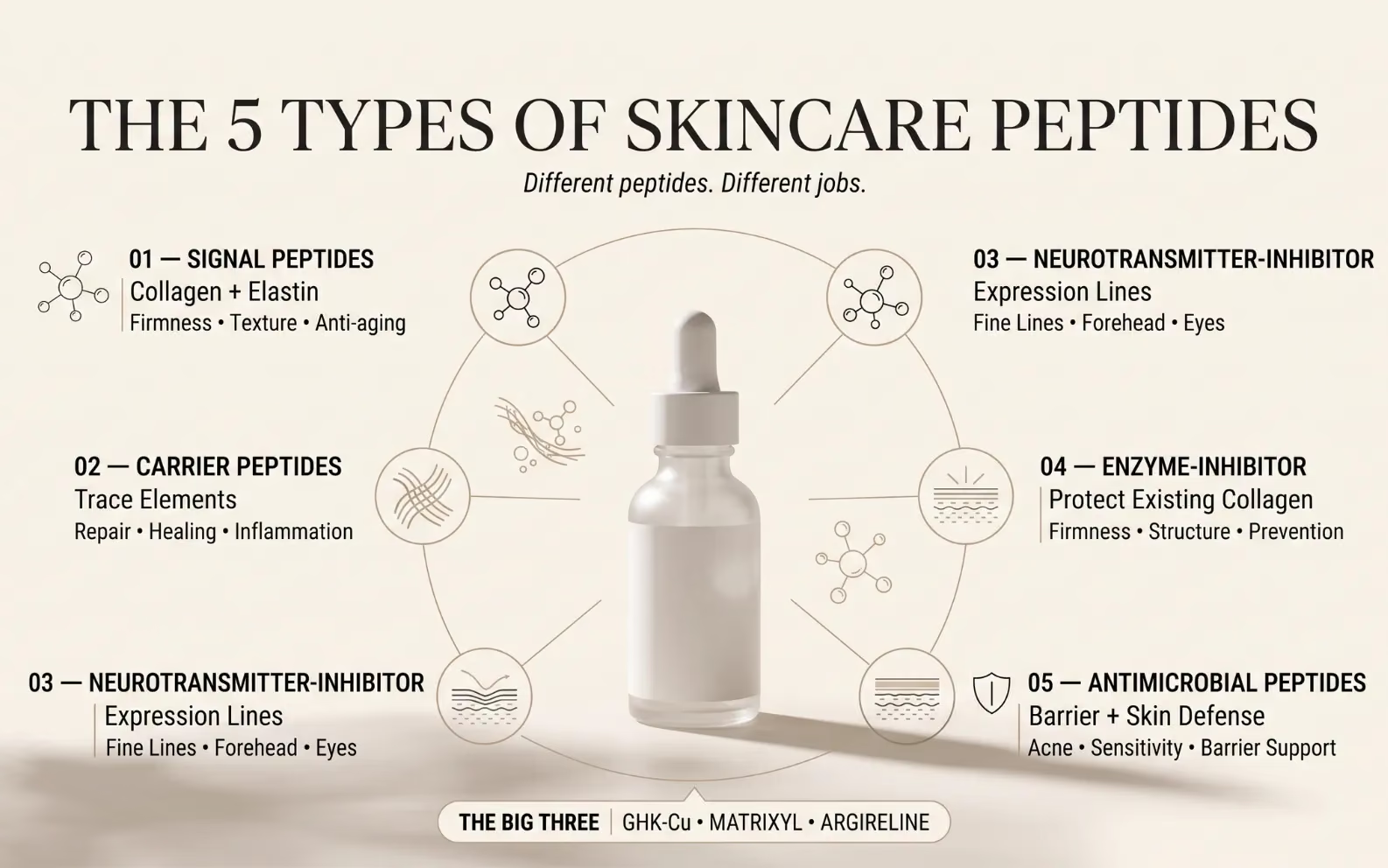
Not all peptides do the same thing. Based on their mechanism of action, researchers classify them into four categories: signal peptides, carrier peptides, neurotransmitter inhibitor peptides, and enzyme inhibitor peptides. Knowing which type is in your product tells you what it’s actually trying to accomplish.
Signal Peptides
These are the workhorses of the peptide world and have the strongest evidence base, according to board-certified dermatologist Dr. Jenny Liu in her YouTube breakdown of peptide research. Signal peptides stimulate fibroblasts to produce more collagen, elastin, and other structural proteins.
What to look for on labels: Matrixyl (Palmitoyl Pentapeptide-4), Matrixyl 3000, Syn-Coll Best for: Fine lines, loss of firmness, overall aging prevention Clinical result: Palmitoyl pentapeptide-4 reduced wrinkle depth by up to 20% within twelve weeks without the irritation associated with topical retinoids.
Carrier Peptides
Carrier peptides act as delivery vehicles. They bind to essential minerals (most commonly copper) and transport them into skin cells to support repair, collagen synthesis, and antioxidant activity.
What to look for on labels: GHK-Cu (Copper Tripeptide-1)
Best for: Wound healing, skin repair, post-procedure recovery, overall skin resilience
Clinical result: In a study of 40 women aged 40 to 65, GHK-Cu produced a 55.8% reduction in wrinkle volume after eight weeks of topical application. In a separate 12-week trial, GHK-Cu improved collagen production in 70% of treated women, compared to 50% with vitamin C cream and 40% with retinoic acid.
Neurotransmitter Inhibitor Peptides
These work on a principle similar to Botox. They block the chemical signals that tell facial muscles to contract, which can soften expression lines around the eyes and forehead.
What to look for on labels: Argireline (Acetyl Hexapeptide-8)
Best for: Expression lines, crow’s feet, forehead wrinkles
Clinical result: Argireline reduced wrinkle depth by up to 30% after four weeks without toxicity, though its potency is considerably lower than injectable botulinum toxin.
Enzyme Inhibitor Peptides
Rather than building new collagen, these peptides slow down the enzymes that break existing collagen apart. They’re the defensive players on the team.
Best for: Preserving existing skin structure, preventing premature collagen degradation
These are less commonly featured as standalone ingredients and are more often part of multi-peptide formulations.
Quick-Reference Table
Peptide Type | What It Does | Common Trade Name | Best For |
Signal | Stimulates collagen production | Matrixyl, Syn-Coll | Fine lines, firmness |
Carrier | Delivers minerals for repair | GHK-Cu (Copper Peptide) | Repair, resilience |
Neurotransmitter Inhibitor | Relaxes facial muscles | Argireline | Expression lines |
Enzyme Inhibitor | Slows collagen breakdown | Various (often in blends) | Preservation |
Why Peptides for Skin Matter More After 40
Here’s where this gets personal for a lot of readers. Collagen production doesn’t just slowly fade with age. It falls off a cliff.
Women can lose up to 30% of their skin collagen in the first five years after menopause. When estrogen levels drop during perimenopause and menopause, fibroblast activity slows dramatically. The result is thinner skin, deeper wrinkles, loss of elasticity, and slower wound healing, all happening faster than most women expect.
If you’re navigating menopause or perimenopause, this biological reality makes peptides worth understanding, not because they’re a magic fix, but because they represent one of the gentler tools available for supporting skin that’s undergoing real hormonal stress.
As dermatologist Dr. Ostad has noted, peptides are “especially helpful for patients who cannot tolerate strong retinoids.” For women dealing with the increased skin sensitivity that often accompanies hormonal changes, that tolerance issue isn’t hypothetical. It’s daily life.
Explore subscriber perks from beauty and wellness partners: Perks & Places
What the Science Actually Says (An Honest Assessment)
The Wins
The clinical evidence for certain peptides is real and specific. Matrixyl has shown 20% wrinkle depth reduction in 12 weeks. Argireline has demonstrated 30% wrinkle depth reduction in just 4 weeks. GHK-Cu outperformed both vitamin C and retinoic acid for collagen production improvement in a head-to-head comparison.
Around 64% of U.S. skincare consumers actively seek products with clinically tested ingredients, according to market research from Mordor Intelligence. That demand is driving formulation innovation, and the diversity of peptides available in products has nearly doubled in recent years.
The Penetration Problem
Here’s what most peptide marketing conveniently ignores: getting peptides through the skin’s outer barrier (the stratum corneum) is genuinely difficult. Despite their promise, peptides face considerable challenges penetrating this barrier, which limits their bioactivity.
A 2026 meta-analysis published in Frontiers in Medicine found that oral polypeptides drove most of the wrinkle-reduction effect in studies, while topical formulations showed more limited impact. That doesn’t mean topical peptides are useless. It means the formulation matters enormously.
Why “Palmitoyl” on the Label Is a Good Sign
This is a practical detail most articles skip. Palmitoylated peptides, those with a fatty acid tail attached, penetrate the stratum corneum measurably better than plain hydrophilic peptides in water-based formulations. When you see “palmitoyl” in front of a peptide name on an ingredient list, that’s a signal the manufacturer has addressed the delivery problem.
Practitioners on Reddit consistently echo this point: the formulation vehicle matters as much as the peptide itself. A well-made serum with palmitoylated peptides at effective concentrations will outperform an expensive cream with trace amounts of unmodified peptides listed near the bottom of the ingredient panel.
The Evidence Gap
There remains a significant shortage of large-scale in vivo clinical trials to confirm the efficacy of many bioactive peptides. Most studies are small, short-term, and sometimes funded by ingredient manufacturers. This doesn’t invalidate the results, but it means healthy skepticism is warranted.
The Dermatologist Consensus
Dermatologist Dr. Rogers puts it well: peptides are “helpful, not heroic.” They can support skin health by promoting collagen, aiding repair, and improving hydration, but they’re not the cornerstone of a skincare routine.
Cleveland Clinic’s Dr. Bergfeld adds a cost-reality check: “If you’re looking for anti-inflammatory products for things like wrinkles and aging skin, things like hyaluronic acid and retinoids are very effective and tend to be less expensive.”
Peptides vs. Retinol: A Quick Comparison
This is the question that comes up constantly, both in dermatology offices and in skincare forums. It’s not really an either/or situation, but the differences matter.
Factor | Peptides | Retinol |
How it works | Signals cells to produce collagen | Increases cell turnover, stimulates collagen at gene level |
Results timeline | 6 to 12 weeks | 4 to 12 weeks (often faster for texture) |
Irritation risk | Very low | Moderate to high (dryness, peeling, redness) |
Safe during pregnancy | Generally considered safe (consult your doctor) | No, retinoids are contraindicated |
Best for | Sensitive skin, prevention, supporting a broader routine | Moderate to significant aging concerns, acne, hyperpigmentation |
Sun sensitivity | Does not increase | Increases photosensitivity |
Many women over 40, especially those whose skin has become more reactive during perimenopause, find that peptides allow them to support collagen without the irritation cycle that retinol can trigger. The most common approach in skincare communities is using both: retinol a few nights a week, peptide serum on the alternating nights.
Peptides work primarily as signaling molecules rather than altering gene transcription directly, which is why they’re non-irritating and rarely provoke redness or flaking. For women exploring gentler options, this distinction matters.
For more on building routines that work with your body’s changes, browse our Health & Wellness section.
How to Actually Use Peptides for Skin
Choose the Right Format
Serums and creams (leave-on products) are the only formats worth considering. Peptides in cleansers get washed down the drain before they can do anything. Your product needs contact time with the skin.
Layering Order
Apply peptide serums after cleansing and toning, on slightly damp skin. They go before heavier creams and oils. If you’re using a dedicated peptide serum plus a peptide-containing moisturizer, the serum goes first.
What to Pair With
Peptides for skin play well with several other ingredients:
Hyaluronic acid for hydration (they complement each other without interference)
Niacinamide for barrier support and brightening
Sunscreen (always, every morning, non-negotiable)
What to Avoid Using at the Same Time
Strong AHAs and BHAs (glycolic acid, salicylic acid) can shift your skin’s pH enough to reduce peptide effectiveness. If you use both, apply them at different times of day or on alternating days.
Read the Label
Two practical tips that save money:
Look for the palmitoyl prefix. It indicates the peptide has been modified for better skin penetration.
Check where the peptide falls in the ingredient list. Ingredients are listed in descending order of concentration. If the peptide is dead last, after fragrance and preservatives, you’re paying for marketing, not results.
Most products don’t disclose exact peptide concentrations, which makes position on the ingredient list one of the few clues you have.
Set Realistic Expectations
Most peptide benefits appear gradually. Visible improvement in texture or fine lines typically takes 6 to 12 weeks of consistent, daily use. This is not an overnight ingredient. The most common complaint on Reddit skincare forums is “I can’t tell if it’s doing anything,” and the answer is almost always: give it more time, or check whether the product actually contains a meaningful concentration.
Community consensus on Reddit is clear: peptides work best as supporting actors in a skincare routine, not the lead. Pair them with sunscreen, a good moisturizer, and (if tolerated) a retinoid for the strongest overall results.
Common Peptide Myths, Debunked
“Peptides replace Botox.”
No. Argireline operates on a similar principle (inhibiting muscle contraction signals), but its potency is far lower than injectable botulinum toxin, and topical delivery limits how much reaches the muscle. It can soften expression lines. It will not freeze them.
“All peptide products are equal.”
Not even close. The specific peptide, its concentration, the formulation vehicle, and whether it’s been modified for penetration (palmitoylation) all vary enormously between products. A $15 serum with palmitoylated pentapeptide in the first third of its ingredient list can outperform a $150 cream with unmodified peptides at trace levels.
“Peptides work overnight.”
They don’t. The biological processes they trigger (collagen synthesis, repair signaling) take weeks to produce visible changes. Expect a minimum of six weeks before judging.
“Peptides are only for mature skin.”
Preventive use in your 20s and 30s is perfectly valid. Signal peptides in particular can support collagen maintenance before significant loss begins. That said, women over 40 stand to notice the most difference because their collagen production has declined more significantly.
“Expensive always means better.”
The skeptics in skincare communities have a point here. Price often reflects branding and packaging more than peptide quality or concentration. Focus on the ingredient list, not the price tag.
Key Peptide Terms at a Glance
Amino Acid: The molecular building blocks of peptides and proteins. Twenty different amino acids combine in various sequences to create every peptide.
Argireline (Acetyl Hexapeptide-8): A neurotransmitter inhibitor peptide that reduces muscle contraction signals, softening expression lines. Sometimes called “topical Botox,” though that overstates its potency.
Collagen: The most abundant protein in skin, responsible for structure and firmness. Production declines with age, especially after menopause.
Copper Peptide (GHK-Cu): A carrier peptide that binds copper ions and delivers them into skin to support repair, collagen production, and antioxidant defense. Among the most-studied peptides in skincare.
Elastin: A protein that gives skin its ability to snap back after stretching. Works alongside collagen to maintain youthful texture.
Enzyme Inhibitor Peptide: A category of peptides that slow the enzymes responsible for breaking down collagen.
Fibroblast: The skin cell type responsible for producing collagen, elastin, and other structural components. Signal peptides target fibroblasts specifically.
Matrixyl (Palmitoyl Pentapeptide-4): A signal peptide that stimulates collagen and elastin production. One of the most well-studied and widely used peptides in commercial skincare.
Neurotransmitter Inhibitor Peptide: A peptide that blocks signals between nerves and facial muscles, reducing the appearance of expression-related wrinkles.
Palmitoylation: The attachment of a palmitic acid (fatty acid) tail to a peptide, improving its ability to penetrate the skin’s outer barrier. A palmitoyl prefix on an ingredient name is a positive sign.
Signal Peptide: A peptide that communicates with fibroblasts, telling them to increase production of collagen and other proteins.
Stratum Corneum: The outermost layer of skin, made of dead cells and lipids. It acts as a barrier that most topical peptides struggle to penetrate without modification.
Understanding these concepts changes how you read product labels. It shifts the power from marketing departments back to you. For more on topics like identity and confidence during life’s transitions, our editorial team covers those conversations with the same honesty.
Discover curated content across wellness, beauty, and lifestyle in our Collections.









Comments
No comments yet
No comments to show yet. Subscribe to join the conversation.
Log in or subscribe to comment on this article.