Here's the thing, your skin doesn't do the same job during the day that it does at night. Nobody tells you that part. You just get handed a dozen products and a vague sense that you're "supposed" to use them in some order, at some point, and hope for the best.
Truth is, your morning and night skincare routine should look different, because your skin is literally doing two different jobs depending on the time of day. In the morning, it's playing defence. At night, it's running repairs. Mix up the two, and you're not causing a disaster, but you're leaving results on the table (and possibly making a mistake or two along the way, like I did for years).
Let's break this down.
Why Your Morning and Night Skincare Routines Should Be Different
Ever wonder why your morning routine feels lighter than your nighttime one? It's not just a habit. It's biology.
During the day, your skin's main job is protection, shielding you from UV rays, pollution, wind, and that brutal Canadian dry-indoor-heat combo we all pretend not to notice until our cheeks start flaking in January. So your morning skincare routine should be built around antioxidants, hydration, and (non-negotiable) sunscreen.
At night, your skin shifts into repair mode. Cell turnover speeds up, blood flow to the skin increases, and this is when your products can actually do the heavy lifting, think retinol, exfoliating acids, peptides. It's also when trans-epidermal water loss increases, which is why your skin often feels tighter or drier by morning if your nighttime routine skipped a step.
So, in short: morning is about protecting what you've got. Night is about rebuilding it.
What to Use in a Morning Skincare Routine
Your morning skincare routine doesn't need to be complicated. It needs to be consistent.
Cleanser A gentle, non-stripping cleanse to remove overnight sweat and product residue, without disrupting your skin barrier before you head into the day.
Toner (optional) Helps balance skin and prep it for the next steps. Not mandatory, but nice if your skin likes it.
Serum This is where your antioxidants come in (more on that below).
Moisturizer Locks in hydration and reinforces your skin barrier before sunscreen goes on.
Sunscreen The single most important step in your entire routine. Full stop.
(Yes, sunscreen is non-negotiable even in January.) I know, I know, it's cloudy, it's -15°C, the sun feels like a rumour. But UV rays punch straight through cloud cover, and Canadian winters are notorious for lulling people into skipping SPF. A friend of mine skipped sunscreen on cloudy days for years, until she noticed uneven patches showing up on her cheeks that just wouldn't budge. Guilty of this one? You're definitely not alone.
If you're still figuring out which products actually suit your skin, identify your skin type first, it changes what a "gentle cleanser" or "lightweight moisturizer" even means for you.
What to Use in a Night Skincare Routine
Your nighttime routine is where the real transformation work happens. Here's what belongs in it:
Makeup removal Non-negotiable step one. Sleeping in makeup clogs pores and undoes anything good you're about to do.
Double cleansing An oil-based cleanser followed by a water-based one, especially if you wore sunscreen or makeup that day.
Treatment serums Retinol, exfoliating acids, peptides, the ingredients that need overnight, undisturbed time to work.
Eye cream (optional) If you use one, nighttime is when it's most useful.
Night moisturizer Typically richer than your day moisturizer, since you're not layering sunscreen on top.
Now, here's where it gets interesting: if you're anything like me, you've probably wondered if you really need a separate day and night cream. Short answer — yes, and it comes down to weight and purpose. Night creams are designed to be richer and more occlusive, because they're supporting repair while you sleep, not fending off environmental stressors.
For product order specifics, How to Layer Skincare Products walks through the exact sequencing, this article is about timing, not layering.
Morning vs Night: Which Ingredients Work Best When
Morning Ingredients
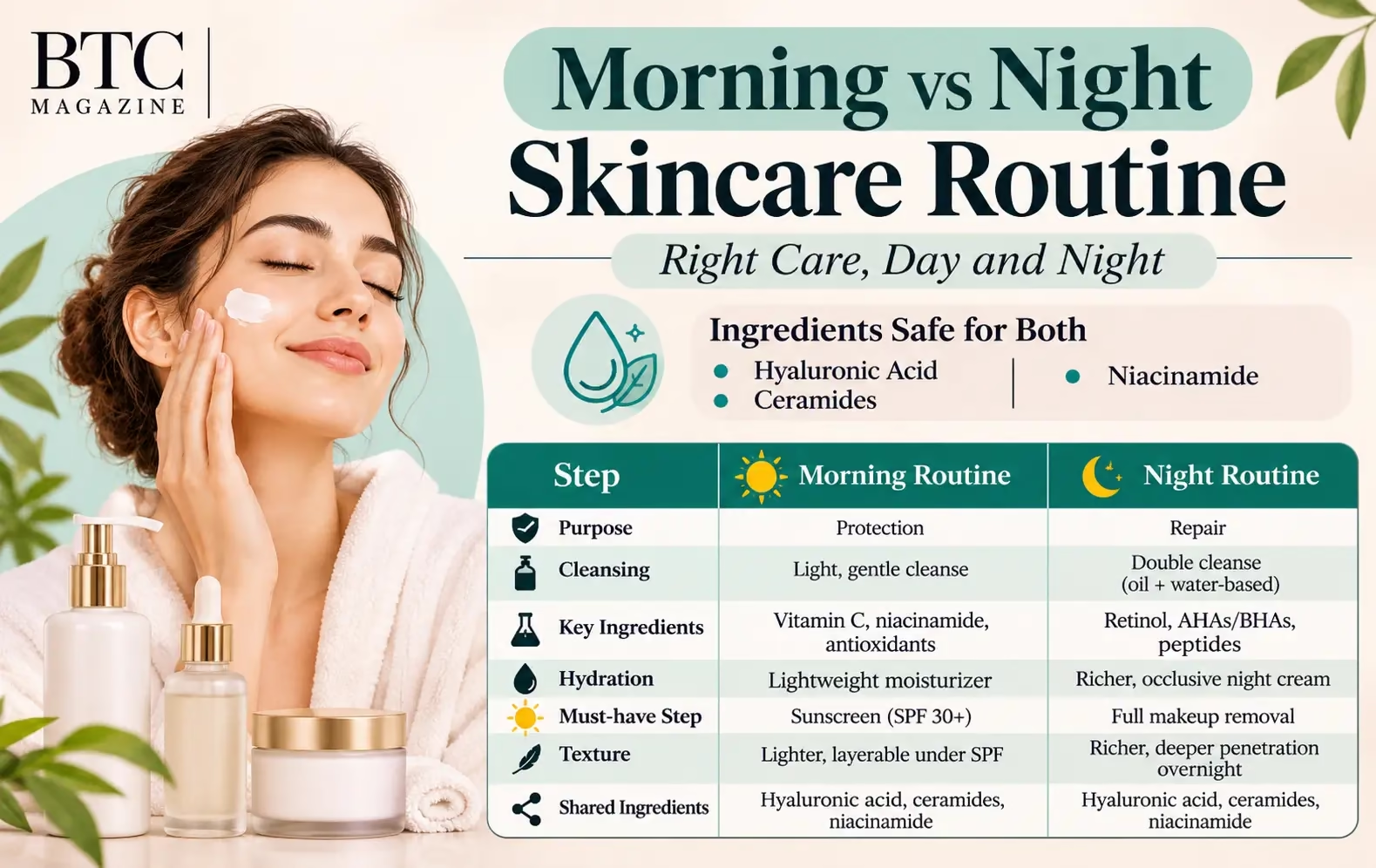
Vitamin C, niacinamide, hyaluronic acid, ceramides, and antioxidants all thrive in a morning skincare routine. Vitamin C in particular is a great morning pick for melanin-rich skin, since it helps brighten and even out tone while offering some antioxidant protection against the free-radical damage that contributes to hyperpigmentation.
Night Ingredients
Retinol, retinal, AHAs, BHAs, peptides, and barrier creams belong at night. These are the ingredients that increase sun sensitivity or exfoliate actively, using them in daylight is asking for irritation or worse. (I learned this the hard way, applying retinol in the morning for months before realizing my skin was constantly irritated because of it. Not great. Lesson learned.)
If you're incorporating acids or retinol for the first time, patch test a new skincare product before adding it to your full routine, and check how often you should exfoliate so you're not overdoing it.
Ingredients Safe for Both
Hyaluronic acid, ceramides, and niacinamide are the flexible players, gentle enough for morning, hydrating enough to support repair at night. These are your safe, any-time staples.
Morning vs Night Skincare Routine Comparison Table
Step | Morning Routine | Night Routine |
Purpose | Protection | Repair |
Cleansing | Light, gentle cleanse | Double cleanse (oil + water-based) |
Key ingredients | Vitamin C, niacinamide, antioxidants | Retinol, AHAs/BHAs, peptides |
Hydration | Lightweight moisturizer | Richer, occlusive night cream |
Must-have step | Sunscreen (SPF 30+) | Full makeup removal |
Texture | Lighter, layerable under SPF | Richer, deeper penetration overnight |
Shared ingredients | Hyaluronic acid, ceramides, niacinamide | Hyaluronic acid, ceramides, niacinamide |
Common Mistakes to Avoid
Let's be real, most of us have made at least one of these:
Using retinol in the morning. It increases sun sensitivity, so save it for night.
Skipping sunscreen. Even in a Canadian winter. Especially in a Canadian winter, since skin already stressed by dry indoor heat needs more protection, not less.
Using exfoliating acids twice a day. Your skin barrier will not thank you.
Sleeping with makeup on. It clogs pores and undoes your night routine before it starts.
Using too many active ingredients at once. Retinol plus three different acids in one night isn't "maximizing results", it's asking for a reaction.
If you're over 40, your nighttime routine may need to lean even more into hydration and barrier support, since skin's natural repair and moisture retention slows with age. That doesn't mean overhauling everything, just being a little more generous with richer creams and barrier-supporting ingredients at night.
How to Build a Routine That Fits Your Skin
Timing is only half the equation, the other half is choosing products that actually fit your skin type and concerns. If you haven't already, take a look at How to Build a Skincare Routine for Your Skin Type for the full step-by-step, and How to Choose a Moisturizer for Dry, Oily or Sensitive Skin if hydration is still a question mark for you.
Not sure which products belong in your morning or night routine? Take the Papa & Filles Beauty Quiz to discover products matched to your skin type and concerns, or browse the Papa & Filles skincare collection for clean, simple products that fit a daytime routine, and treatment-focused skincare designed for overnight repair.









Comments
No comments yet
No comments to show yet. Subscribe to join the conversation.
Log in or subscribe to comment on this article.