Why Do I Look Good in the Mirror and Terrible in Every Photo?
"Why do I look good in the mirror and terrible in every photo?" I get some version of this DM more than any other. It usually arrives around 11 p.m., attached to a selfie taken from about eight inches away. So let's settle it. You know the mirror I mean. The one you walk past and think, damn, I look pretty good today. A small surge of confidence. For a minute you feel unstoppable. Then you open your phone camera and you're exhausted, asymmetrical and a decade older. Which one is telling the truth?
Neither Is Lying
Neither is lying. They're answering different questions under different conditions, and the phone's conditions are worse. A mirror gives you a reversed, three-dimensional version of yourself, in a place you chose, in light you know. Your brain has been looking at that reflection your entire life. It normalized it a long time ago, flipped and all. Think about how many hours you've spent recognizing yourself in that space.
What the Phone Camera Does to Your Face
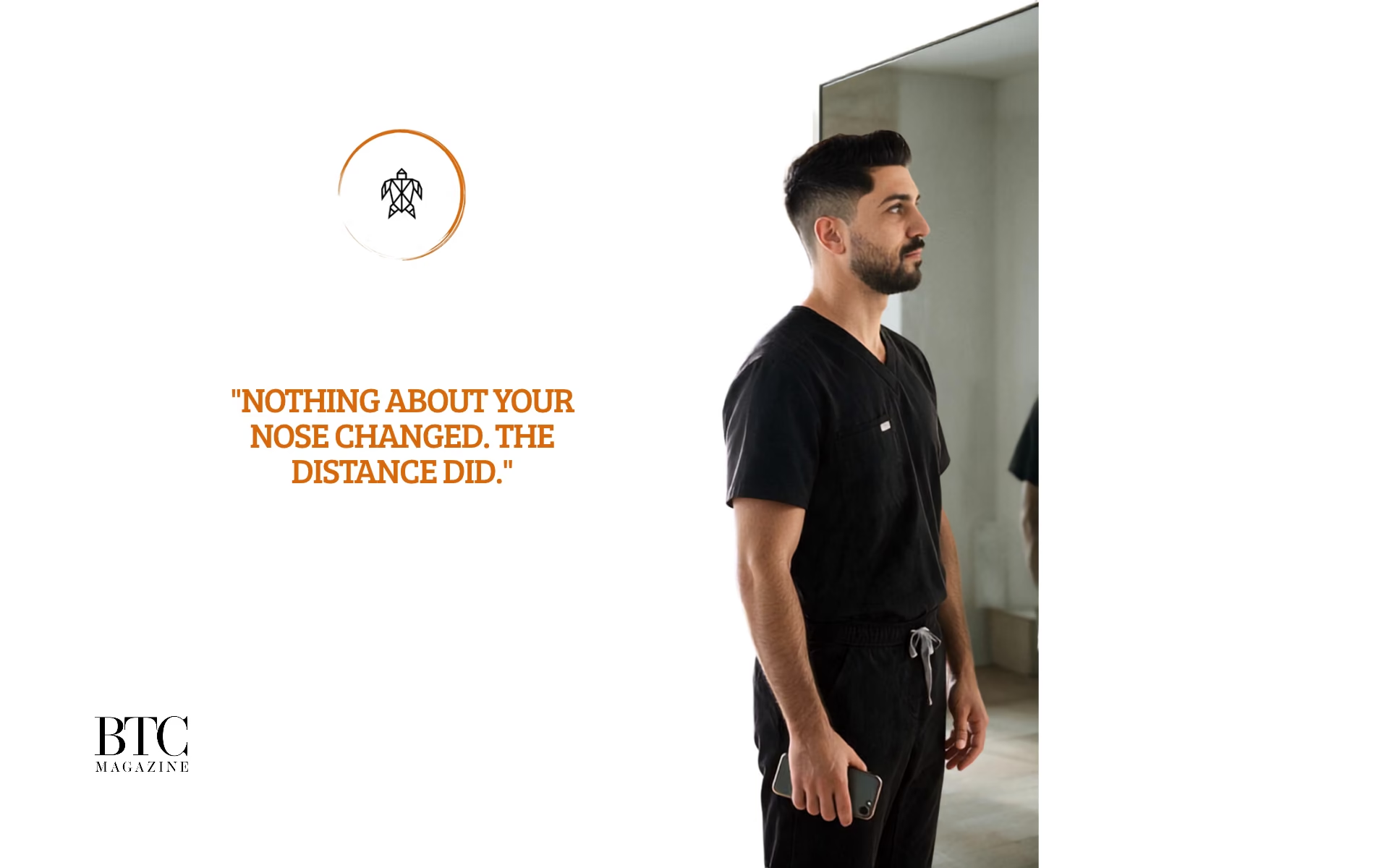
A phone camera gives you a flat image that depends on the lens, the distance, the angle, the shadows, the lighting and, now, the software. A 2018 study out of Rutgers put a number on it: a selfie taken at 12 inches makes your nose look about 30 percent wider than a photo of the same face taken from five feet. Nothing about your nose changed. The distance did. So when you look at that photo and think, why is my nose enormous, why are my cheeks so flat, why is my face so round: those are questions about camera position, not anatomy. Your face didn't change somewhere between the bathroom and the parking lot. Your perception of it did.
The Photo Isn't the Patient
Here's where this stops being a fun fact and becomes my job. A version of this happens in my clinic most weeks. Someone sits down, pulls out their phone and shows me a photo. Sometimes it's a photo of themselves with a filter. Sometimes it's a photo of someone else, with a filter, and a different bone structure, and a ring light, and a retouching app that quietly narrowed the jaw and lifted the eyes. And they say: this. I want this. What I actually do is put the phone down and look at the face in front of me. Not to be dismissive. It's just that the photo isn't the patient. I can't inject a face into a lens angle. What I can do is talk about what's really there, what's changed with age, what's just Tuesday-morning lighting, and whether anything needs doing at all. Some of those consults end with a plan. A lot of them end with, honestly, go home, you're fine, buy a better lamp.
Natural Facial Asymmetry: Why Your Face Isn't Crooked
Which brings me to asymmetry, because that's the other thing the phone loves to point out. Asymmetry is about as natural as it gets. One eyebrow is longer and thinner, the other sits higher. One eye is rounder. One side of the jaw is sharp and defined and the other side is softer. Your face is not crooked. It's a face. A perfectly mirrored face, one side copied onto the other, looks wrong to almost everyone who sees it. Symmetry is not the goal. Balance is.
Mirror vs. Camera: Which One Is Telling the Truth?
So which one is telling the truth? Don't believe either of them blindly. Follow the patterns. If something bothers you in one specific mirror, at one time of day, when the light hits it a certain way, it probably doesn't exist. If it bothers you in every mirror and every photo and it's bothered you for a year, that's worth a conversation.
Your Face Is More Than a Single Moment
A mirror catches a reflection. A camera captures a fraction of a second. Your face is full of micro-expressions, constantly moving, uniquely yours. Sometimes the answer is skincare or sleep. Sometimes it's a better camera or different lighting. Sometimes it's nothing at all.
Your Phone and Mirror Don't Define Your Appearance
Your phone isn't the enemy. The mirror isn't truth serum. Neither one should get a vote on how you feel about your face, and neither one captures the whole person. The character. The personality. The way you look when you're actually laughing instead of holding still for the front camera.
Understanding Your Face Before Fixing It
Sometimes the most important treatment isn't getting something injected into your face. It's learning to understand what you're actually seeing before deciding something needs to be fixed.
— Sasha (@the.injector.genie)







Comments
No comments yet
No comments to show yet. Subscribe to join the conversation.
Log in or subscribe to comment on this article.