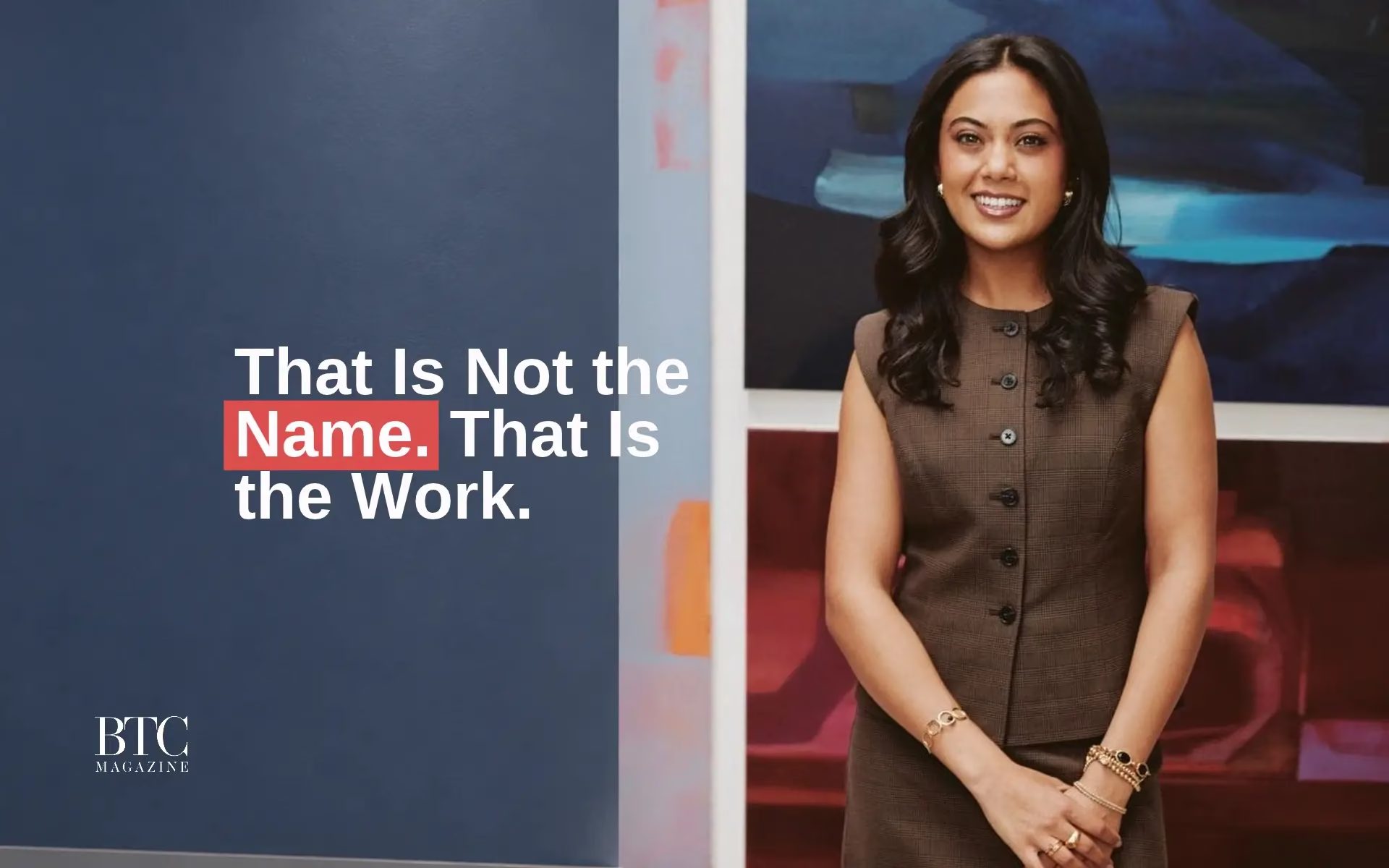
The other women in this issue are done with things that were done to them. Jaiya Varshney is twenty-six. She's done with the terms.
Jaiya Varshney — Co-founder and COO, Tydra Laboratories, Vancouver, BC
The Room in Dallas
There was a conference in Dallas. Maybe fifteen percent of the room was women, and of that fifteen percent, Jaiya Varshney says, almost none were young and almost none were women of colour.
“People did not take me seriously. Almost everyone who talked to me made it clear they were there for something other than the business.”
What the Name Gives Her
She'd never had that in Vancouver. It took leaving to see the difference.
“I didn't realise the privilege I had with my last name until I started going to networking events outside of Vancouver. My family is well known here, so I've never really faced that same level of second intention. It's given me some sort of barrier. Protection. What the name gives me is a chance at a door being opened. It is not enough to get me through it. Everything past the door is my own merit and execution.”
What It Costs Her
Then she names what it costs.
“People don't give credit. People assume that my family has funded my project, or the company. They don't give as much credit for the work I've put in. There's a lot of assumptions that because I have a strong family background, that's the reality of it.”
She pauses.
“People don't actually believe that what I've done is the result of my hard work. That's the cost.”
Fungi, Chitin and a Hundred Percent the Work
Her company grows fungi on food waste to make chitin, a biopolymer that replaces synthetic materials in cosmetics. They've raised $1.85 million, across grants and investment. A large share of it came from grants.
“It is a very rigorous application process. Month-long. They bring in panels of technical experts.” Then, flatly: “That is not the name. That is a hundred percent the work.”
Seven to One
Her first pitch competition, she walked into a room of five other entrepreneurs and two coaches.
“I was the only person under forty. The only woman. The only person of colour. Seven to one. I remember thinking, I wish someone could take a photo of this. And when I spoke, everybody listened. People expected so little. I was remembered.”
What She Says in Pitches
Ask her what she says in pitches that she doesn't believe, and the co-founder of a sustainable materials company doesn't blink.
“People don't care about sustainability. I pitch a lot on sustainability and I think it's important — I really do. But it's not a reason people invest. It's not a reason a business succeeds. It has to solve a real problem, and the economics have to make sense.”
The Unglamorous Part
There's one thing she keeps off her profile. She sends it later, in writing.
“How much of it is unglamorous. How many no's we got. The profile makes it look like momentum. Most of it was applications that went nowhere and started again the next month.”
That's the pattern. The part that counts is the part that doesn't show.
Done With the Dopamine Economy
Ask her what she's done with and she doesn't reach for the business answer.
“I refuse to do it the normal way. Literally anything and everything. When you really start thinking about why we do things, you realise there are so many incentive systems.”
“I'm so over the dopamine economy and how it has us addicted to so many different things. I feel like we've become almost enslaved by these systems, and we don't even know that we are.”










Comments
No comments yet
No comments to show yet. Subscribe to join the conversation.
Log in or subscribe to comment on this article.