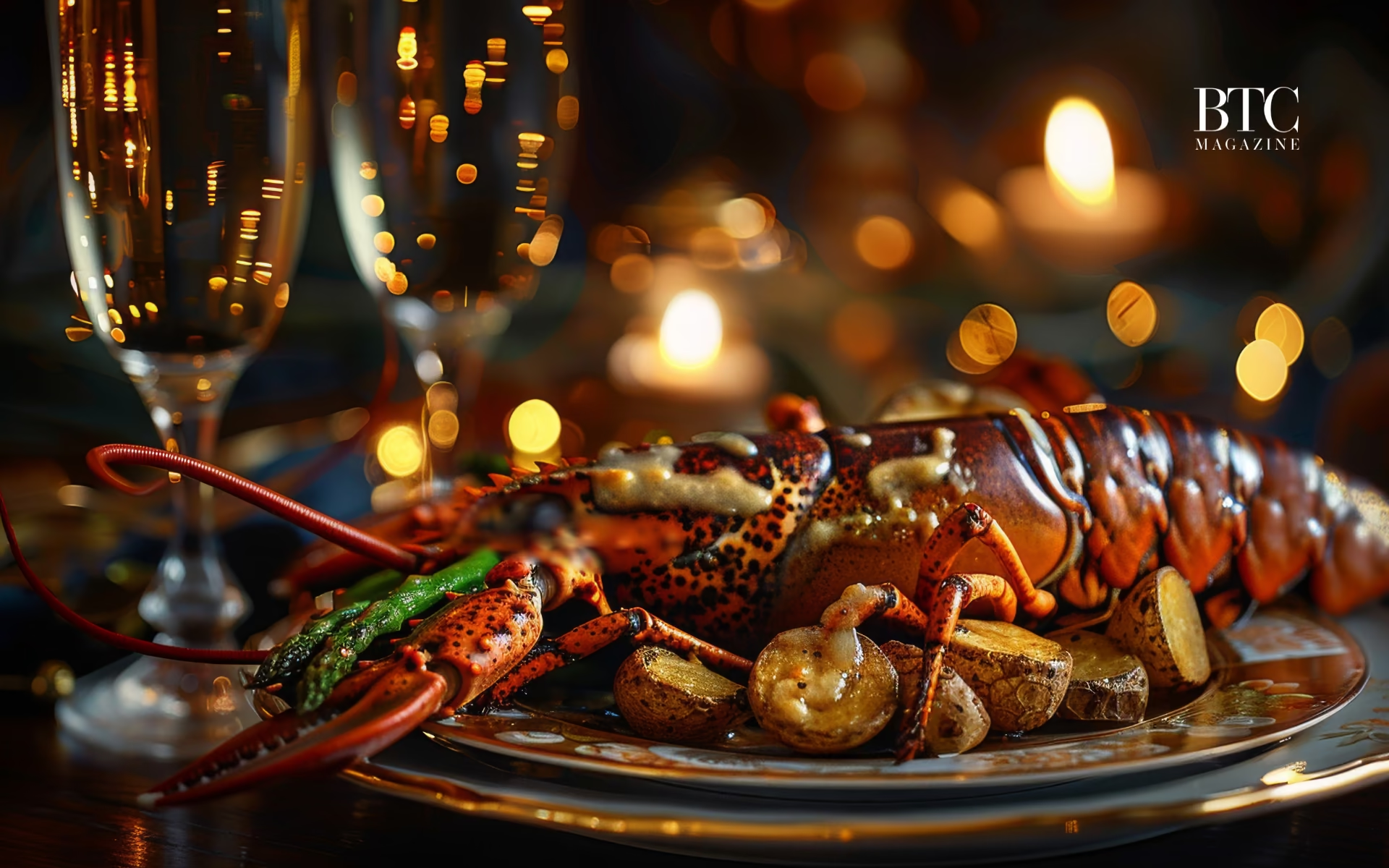
Canada's most celebrated seafood has always lived on the coasts. The lobster of PEI, the salmon of BC, the oysters of Nova Scotia — the coast is where the conversation starts and usually ends. Montreal has no coastline, no ocean at its door. And yet, somehow, it has become one of the most remarkable seafood cities in the country.
Because Montreal is a city where the world showed up.
Portuguese kitchens, Greek dining rooms, Lebanese fish counters, Japanese precision — every culture that came to this city built on a river, carried its relationship with the sea and planted it here. The result is a seafood scene that doesn't belong to any one coast.
It belongs to all of them.
Ferreira Café
Ferreira Café has been doing this since 1996 — and 1446 Rue Peel has never stopped showing up for it. In a city where restaurants come and go, nearly thirty years in the same room is its own kind of credential.
The fish at Ferreira comes from Portugal. Not inspired by Portugal, not Portuguese-style — sourced directly from the Algarve and carried across the ocean to Chef Natalia Machado's kitchen. Under her direction, Ferreira handles that fish with the precision and care that justifies every mile it traveled to get here.
The wine list tells you everything else you need to know — 400 distinct labels. This is a restaurant that has thought carefully about every part of the experience, from the first glass to the last plate.
Listed as a MICHELIN Plate in 2025, Ferreira has earned its place in Montreal's seafood conversation the slow way — one year at a time, for nearly three decades. In a city full of restaurants with something to prove, Ferreira finished proving it a long time ago.
Instagram: @ferreirarestaurant
Website: ferreiracafe.com
Estiatorio Milos
Before Estiatorio Milos existed in Athens, New York, Miami, or London, it existed at 5357 Avenue du Parc, in Montreal's Mile End neighbourhood. Costas Spiliadis opened it in 1979, and it has been there ever since — the original, the one that started everything.
The menu at Milos operates on two tracks. Guests can order from a traditional printed menu — a raw bar of oysters, ceviche, and tuna and salmon tartares, a selection of fish filets, and a meat section for anyone not in the mood for seafood. Or they can do it the other way.
The other way begins with the walk. A server guides guests from their table to the market counter, where whole fish rest on a bed of ice — some of it flown in from Greece the same day it's served. The guest points at the fish they want. The kitchen takes it from there, weighing it to determine the price, then preparing it to order — commonly charcoal-grilled whole with olive oil and lemon, baked in a thick sea salt crust.
Milos has been earning their ritual for nearly fifty years. The world eventually followed it everywhere. It started here.
Instagram: @estiatoriomilos
Website:estiatoriomilos.com
La Sirène de la Mer
At 114 Av. Dresden, La Sirène de la Mer has been feeding Montreal since 1994. Joe Cheaib arrived in Montreal from Lebanon at ten years old, one of nine children, and what he built here is a testament to exactly that journey — a Lebanese fish restaurant and market in the heart of the Town of Mount-Royal, that has outlasted trends, loss, and time.
La Sirène was one of the first Montreal restaurants to build a fish market directly into the dining experience. Where Milos presents its fish with Greek restraint — whole, charcoal-grilled, olive oil and lemon — La Sirène brings the Mediterranean through a Lebanese lens. Guests still choose their fish from the in-house market, still point at what they want and watch it go to the kitchen. But what surrounds that fish is entirely different.
The menu moves between worlds, and does both well. The mezze alone is worth the visit — fattoush, hummus, muhammara, kibbeh croquettes, grilled halloumi — the kind of spread that turns a dinner into anevening. From there, the table opens to the sea. Whole fish, grilled or baked, chosen fresh from the market and prepared to order.
Unfortunately, Joe passed away in 2020. Today, his wife Terry and their children Emilia and Peter carry the restaurant forward, the way families carry forward the things worth keeping — not because they have to, but because he built something worth continuing.
Instagram: @restolasirene
Website: sirenedelamer.com
Jun I
Arriving in Quebec from Japan in 1989, chef Junichi Ikematsu didn't open a restaurant for sixteen years. That patience — the kind that belongs to someone building toward one very specific idea — stands out in a lineup of institutions, empires, and family markets. Jun I, at 156 Av. Laurier O, is what sixteen years of conviction looks like.
The measure of any sushi restaurant comes down to two things: the freshness of the fish and the quality of the rice. Very few hit both; Jun I bullseyes them. The menu is rooted in Japanese tradition, shaped by French culinary training, and entirely uncompromising — no concessions to trend, nothing that doesn't need to be there.
Next door, Ikematsu also runs Ôkini — a Japanese grocery with an occasional eight-seat omakase. This is a chef who is so committed to the integrity of the ingredients, that he built a store to control them.
MICHELIN recommended, and quietly one of the most serious Japanese restaurants in the country, Jun I is the room you find when you stop looking for something loud.
Instagram: @restaurant_juni
Website:juni.ca
Le Filet
Tucked under a greystone triplex at 219 Avenue du Mont-Royal Ouest, Le Filet does not announce itself — you have to know it's there. Inside, the room earns the secrecy. Designed to recall the sea, metallic surfaces catch the light like shimmering water, dark green wood tones pull the walls inward, and a long black slate bar runs the length of an open kitchen — the kind of room that makes dinner feel like an occasion before the food arrives.
Le Filet comes from the team behind Le Club Chasse et Pêche — one of Montreal's most respected restaurant groups — and the kitchen reflects that pedigree. Chef Yasuhisa Okazaki marries Japanese precision with European bistro techniques, and the result is a menu that belongs entirely to him. Miso gratin oysters, tuna tartare, gemelli pasta, grilled octopus with crispy quinoa, seafood linguini, wagyu beef tataki — dishes that are precise without being cold, creative without being restless. The menu shifts with the catch and the season, so what arrives at the table is always whatever deserves to be there most.
MICHELIN recommended in 2025, Le Filet has earned every seat on the ocean floor.
Montreal has no saltwater at its shores. But below a greystone triplex on Mont-Royal, it has something just as good.
One City, Every Shore
Montreal may not be able to offer the lobsters of Prince Edward Island or the salmon of British Columbia. It may not be home to the seafood Canada is known for. But Montreal is home to the world — and the world brought its oceans with it.

.webp)

Comments
No comments yet
No comments to show yet. Subscribe to join the conversation.
Log in or subscribe to comment on this article.