If your closet is full but nothing feels right, you are in good company. Something shifted. Maybe it happened gradually, maybe it hit all at once, but the clothes that used to work stopped working. The jeans gap at the waist. The blazer feels like a costume. The fabrics that never bothered you before now itch, cling, or overheat.
This is not a personal failing. It is a collision of real changes happening at the same time. Perimenopause commonly begins between ages 40 and 50 and can last up to ten years. Body composition shifts, with fat redistribution moving from lower body to more abdominal patterns. Careers change. Relationships change. Your tolerance for uncomfortable shoes evaporates overnight.
Practitioners on Reddit describe the frustration clearly. One 47-year-old poster said she found only two options when shopping: clothing that felt ultra young, short, and tight, or oversized, printed, and frumpy. Another woman said she did not need clothes that hid her body, did not look good in boxy shirts, and absolutely did not want a blazer for everyday life. These are not picky preferences. They are the central tension of fashion for women over 40: how to look current and feel like yourself without performing youth or accepting invisibility.
This glossary exists because women searching for style help after 40 keep running into terms like “capsule wardrobe,” “elevated basics,” “quiet luxury,” and “smart casual” without clear explanations of what those phrases actually mean in practice. Each term below includes a plain definition, why it matters for your body and life now, and a concrete example.
Explore subscriber perks for savings on local fashion, beauty, and wellness services that support the wardrobe you are building.
What “Fashion for Women Over 40” Actually Means
Fashion for women over 40 is style that considers your current body, lifestyle, comfort needs, and self-expression without assuming you need to hide, shrink, or follow outdated rules. It is not a consolation category. It is not a niche.
Canada had roughly 10.07 million women age 40 and older in 2021, representing about 53.6% of all women in the country. Globally, people aged 50 and older are expected to drive 48% of incremental growth in fashion spending, and those 55 and older hold 72% of U.S. wealth. Women over 40 are not a marginal audience. They are the audience.
Yet 64% of Gen X women and 74% of Boomer women feel older adults are underrepresented in product advertising. The fashion industry is starting to catch up (2026 runways featured more models in their 40s, 50s, and 60s than recent seasons), but plus-size representation on those same runways stayed below one percent. Age diversity is improving. Body diversity is still far behind.
The position this glossary takes: “age-appropriate” is an outdated framework if it means restriction. A better filter is life-appropriate. Does the outfit work for your actual schedule, climate, body, mood, and goals today?
The 5-Part Style Filter
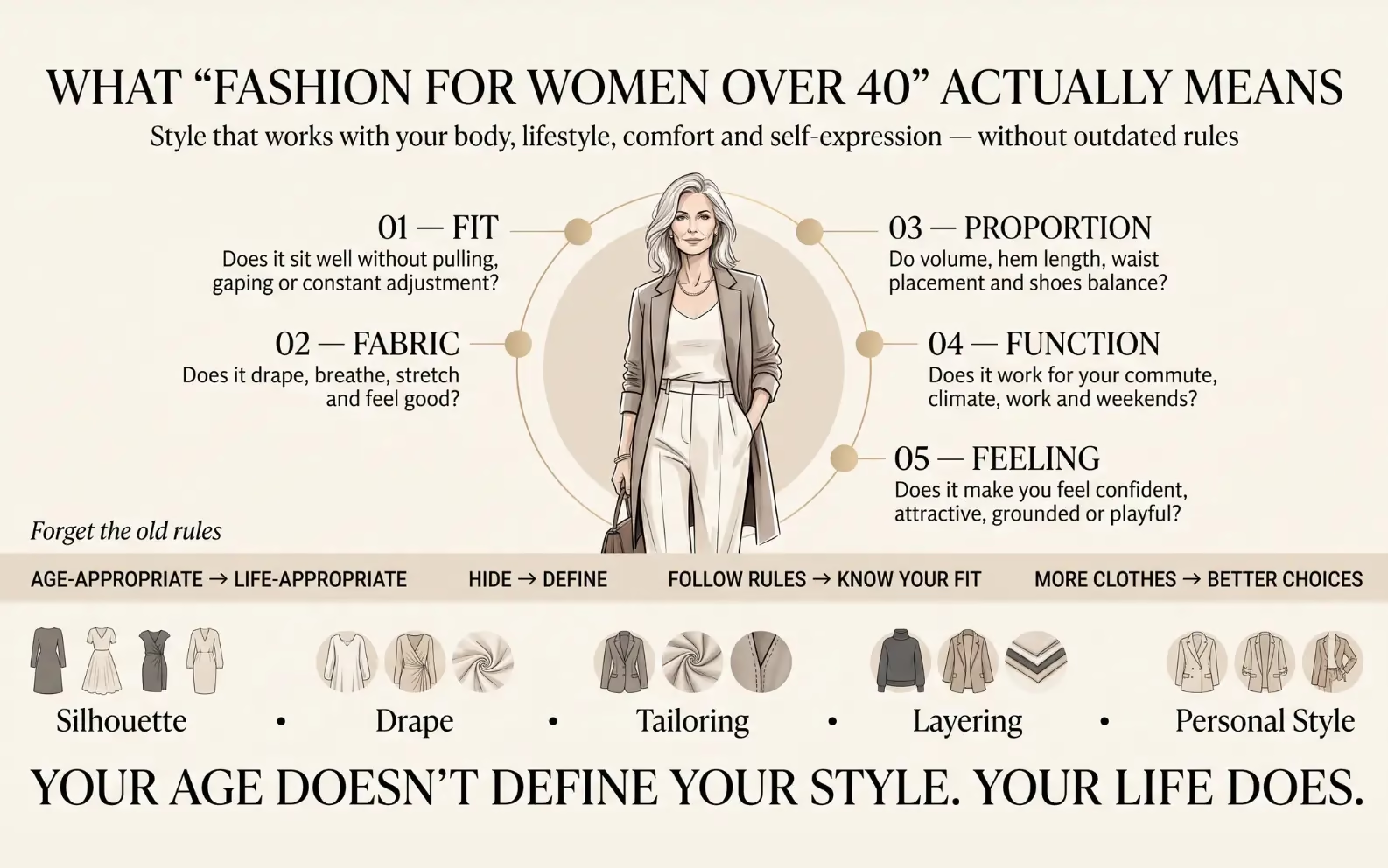
Before getting into individual terms, here is the framework that ties everything together. Every glossary entry below connects back to one or more of these five questions.
Fit. Does the garment sit well on your body without pulling, gaping, sagging, or requiring constant adjustment?
Fabric. Does the material drape, breathe, stretch, hold shape, and feel good against your skin?
Proportion. Does the outfit have balance between volume, waist placement, hem length, and shoe weight?
Function. Does it work for your real life, including your commute, your climate, your Zoom calls, your Saturday plans?
Feeling. Does it make you feel visible, grounded, attractive, powerful, playful, or relaxed?
One practitioner on LinkedIn put it simply: most women do not need more clothes. They need clarity about which clothes actually serve them. Another stylist described fit as psychologically powerful, noting that when a garment sits wrong, confidence disappears, but when it drapes correctly, posture and energy shift entirely.
If you are navigating body changes alongside wardrobe confusion, the health and wellness section covers the broader physical and emotional transitions women face in midlife.
Fit and Silhouette Terms
Silhouette
The overall outline or shape an outfit creates before anyone notices the details. A silhouette is the first thing the eye reads, which is why two outfits made of similar colors and fabrics can feel completely different.
Why it matters after 40: If an outfit feels “off” but you cannot pinpoint why, the silhouette is often the problem. Too much volume everywhere, the wrong hem length, a rise that hits at the widest part of the midsection. Fixing the silhouette usually fixes the feeling.
Example: A wide-leg trouser creates a different silhouette than a skinny jean, even if both fit properly. Neither is wrong. But one may work better with your proportions and your preferred shoes.
Drape
How fabric hangs, folds, and falls on the body. Drape is the reason two black tops at the same price can look completely different on the same person.
Why it matters after 40: Good drape lets fabric skim your body without grabbing every line. Stiff fabrics hold rigid shapes. Soft, fluid fabrics follow curves gently. For women dealing with bloating, heat, or shifting weight, a drapey fabric can feel like relief.
Example: A viscose blouse often drapes more softly than a cotton poplin shirt. If you want flow, check the drape before you check the color.
Body-Skimming
Close enough to show shape, loose enough not to cling. This is the sweet spot between tight and shapeless.
Why it matters after 40: Body-skimming fit answers the “too young or too frumpy” problem directly. It shows your silhouette without compression.
Example: A body-skimming tee in heavier cotton looks more polished than either a clingy stretch top or a boxy oversized one.
Tailoring
Adjusting a garment to fit your specific body: hems, waist, sleeves, darts, straps. Tailoring is not fussy or old-fashioned. It is practical.
Why it matters after 40: Personal stylist Dana Lynch calls fit one of the most overlooked wardrobe power moves, noting that expensive clothes can still look off if they do not fit, and that fit issues like tugging, smoothing, and pulling undermine confidence in professional settings. A $60 trouser hemmed properly can look better than a designer trouser that pools at the ankle.
Example: Hem wide-leg pants to the shoes you actually wear. Have blazer sleeves shortened if they cover your knuckles. Add darts to a shirt that gaps at the chest.
Rise
The distance from the crotch seam to the waistband on pants or jeans. Low rise sits below the navel. Mid rise hits around it. High rise goes above.
Why it matters after 40: Rise affects comfort, waist definition, and how pants sit on a midsection that may have changed shape. A mid-rise jean might feel better than ultra-high rise if you sit at a desk all day. Experiment rather than defaulting to whatever rise you wore ten years ago.
Ease
The extra room between your body and the garment. Positive ease means looser. Negative ease means the fabric stretches tight against you.
Why it matters after 40: Ease explains why a size can be technically correct but still feel wrong. You may want more ease in a linen shirt (room to breathe) and less ease in a ponte pant (smooth line without sagging).
Proportion and Volume Balance
Proportion is the relationship between top length, bottom width, hem placement, and shoe weight. Volume balance means pairing something with volume against something with shape so the outfit looks intentional.
Why it matters after 40: When women say they look “frumpy,” the real issue is often proportion, not the clothes themselves. Everything oversized at once reads as shapeless. Everything fitted at once can feel too tight.
Example: Wide-leg trousers pair well with a shorter or tucked top. An oversized shirt works better with a straighter jean. If the bottom is voluminous, give the top some structure, or vice versa.
Petite, Midsize, and Inclusive Sizing
Petite is a clothing category designed for women around 5’4" and under, with adjusted proportions throughout the garment, not just shorter hems. Midsize is an informal term for bodies between straight-size and plus-size ranges. Inclusive sizing means brands design across a broader size range instead of treating larger sizes as an afterthought.
Why it matters after 40: Many women over 40 search for midsize and plus-size examples because standard fashion imagery ignores them entirely. A peer-reviewed study found the average adult American woman wears between a Misses size 16 and 18. Yet most style advice is photographed on a size 2. Inclusive sizing is not just adding bigger sizes to a rack. It is designing fit, proportions, and fabric for those sizes from the start.
Fabric and Quality Terms
Natural Fibers
Fibers from plants or animals: cotton, linen, wool, silk, cashmere. Often breathable and comfortable, though not automatically superior for every situation.
Why it matters after 40: If you have developed new sensitivities to heat, texture, or synthetic smells, natural fibers can feel like a revelation. But quality matters more than fiber type alone.
Linen
A fabric made from flax. Breathable, cool, textured, and yes, it wrinkles. For many women, the relaxed texture is part of the appeal.
Why it matters after 40: Linen trousers can replace shorts when you want coverage without heat. A linen shirt in July, layered over a tank, works for everything from a patio dinner to a weekend market.
For a real take on managing hot flashes and menopause, breathable fabric choices matter more than most style guides acknowledge.
Viscose, Rayon, and Lyocell
Viscose and rayon are man-made cellulosic fibers that often drape beautifully. Lyocell (Tencel is a branded version) tends to be soft, smooth, and comfortable against the skin.
Why it matters after 40: These fabrics work well for elevated basics and sensory comfort. A lyocell shirt can feel softer and less stiff than crisp cotton. One note: if a label says “bamboo,” check the fine print. FTC guidance warns that bamboo-derived textiles should be labeled as rayon or viscose made from bamboo, not simply marketed as bamboo.
Ponte
A stable double-knit fabric, usually with stretch. It holds structure while feeling soft.
Why it matters after 40: Ponte pants can feel like leggings but look more polished. They work for Zoom, errands, travel, and casual offices. If you have sworn off hard-waistband pants, ponte is worth trying.
Fabric Weight and Cling
Fabric weight refers to how heavy or substantial a material is. Cling is when fabric sticks to the body instead of skimming over it.
Why it matters after 40: Thin fabrics tend to cling. Heavier fabrics tend to skim and hold shape. If white tees always feel unforgiving, try a heavier cotton. If a dress clings at the stomach, look for a heavier knit or a lined construction. Cling is a fabric problem, not a body problem.
Pilling
Small balls of fiber that form on fabric from friction and wear.
Why it matters after 40: Pilling can make even expensive clothes look tired. Check high-friction areas: underarms, hips, seat, and wherever a bag strap sits. Cashmere is not automatically investment-worthy if the knit is thin and pills after three wears.
Care Labels
The tag showing fiber content and care instructions. In Canada, textile labels must include generic fiber names and content information in both French and English. Reading labels before buying helps you avoid fabrics that shrink, itch, overheat, or require care you will never do.
Example: A beautiful blouse is not a bargain if it is dry-clean-only and you have not been to a dry cleaner in two years.
Wardrobe-Building Terms
Capsule Wardrobe
A smaller set of versatile pieces that mix and match across multiple outfits and situations.
Why it matters after 40: A capsule helps when you have a full closet but nothing works together. It is not mandatory beige minimalism. Your capsule can include color, print, and personality. The point is intentionality, not restriction.
One stylist on LinkedIn noted that women often have a wardrobe full of clothes but nothing to wear because pieces no longer suit their life, body, or current style. She recommends keeping only what fits, feels good, suits the current lifestyle, and gets worn on repeat.
Style Uniform
A repeatable outfit formula that feels like you. Not the same outfit every day, but the same structure.
Why it matters after 40: Reduces decision fatigue. Especially useful for busy professionals, caregivers, women rebuilding their style after a life change, or anyone tired of staring at a closet every morning.
Example: Your uniform might be wide-leg jeans, a fitted knit, statement earrings, and a soft jacket. Different colors, same bones.
Elevated Basics
Simple pieces with better fabric, fit, detail, or construction than their cheap counterparts.
Why it matters after 40: Practitioners on Reddit describe wanting fewer, better things. One commenter said she never wanted to own an acrylic sweater again. A white tee becomes elevated when the neckline flatters, the fabric has weight, and the sleeve length looks intentional.
Cost Per Wear
The price of an item divided by how many times you wear it.
Why it matters after 40: Women choosing fewer, better pieces often use cost per wear as a reality check. A $250 boot worn 100 times costs $2.50 per wear. A $40 trendy top worn once costs $40 per wear. The more expensive item was the better deal.
Closet Audit
Reviewing what fits, feels good, suits your life, and actually gets worn. Essential after weight change, job change, perimenopause, divorce, retirement, or a long stretch of remote work.
Starter question: Pull out anything that belongs to a version of your life you no longer live. The corporate suits from a job you left. The party dresses from a social life that has shifted. The jeans from a body that no longer exists. You are not throwing away memories. You are making room.
Third Piece
A finishing layer beyond top and bottom. A jacket, cardigan, vest, scarf, belt, or overshirt.
Why it matters after 40: The third piece is what makes simple outfits look styled without needing discomfort. Jeans plus a tee becomes an outfit with a trench, a belt, or a bold necklace. Reddit users who rejected the “just add a blazer” advice still benefited from the third-piece concept, they just wanted different options: a denim overshirt, a leather jacket, a long cardigan, a structured knit.
High-Low Dressing
Mixing casual and polished pieces in the same outfit.
Why it matters after 40: Real life rarely fits one dress code. High-low dressing is how most women over 40 actually get dressed. Silk blouse with jeans. Sneakers with a midi skirt. Cashmere with cargo pants.
Quiet Luxury
Understated, logo-light dressing focused on cut, fabric, and polish rather than visible branding.
Why it matters after 40: It can be useful as one aesthetic option, but it should not erase color, body, or personality. Quiet luxury is not a moral achievement. It is a look. If you love color, print, or statement jewelry, that is equally valid.
Outfit Formula Terms
Casual Chic
Comfortable casual pieces styled with enough polish to feel intentional. This is what most women searching for fashion over 40 actually want, even if they do not use the term.
Example: Straight-leg jeans, silk tee, leather belt, loafers.
Smart Casual
More polished than weekend casual, less formal than business wear. Useful for restaurants, work events, school meetings, casual offices, and travel.
Example: Wide-leg trousers, knit top, soft jacket, pointed flats.
Executive Presence Dressing
Clothing that supports authority and credibility in professional settings. Not a stiff suit. More like polish plus intention plus movement.
Why it matters after 40: One Reddit commenter pushed back on “wear whatever you want,” noting that many women need to dress a certain way at work to be taken seriously, especially given age discrimination. Stylists on LinkedIn connect fit, polish, and personal brand directly to women’s leadership visibility.
Example: Monochrome base, tailored coat, strong shoe, structured bag.
Elevated Loungewear
Soft clothes designed to look intentional outside the house. Remote work normalized comfort, but many women want to avoid looking like they gave up.
Example: Matching knit set, trench coat, clean sneakers.
Canadian Layering
Dressing in adaptable layers for temperature swings, transit, weather, and seasons. If you live in Toronto or anywhere in Ontario, you know that October mornings, afternoon sun, and evening chill can require three different outfits in one day.
Example: Thin base layer, merino or cotton knit, trench or wool coat, weatherproof boot. Remove layers as the day warms. Add them back on the evening commute.
To see how current trends connect with self-expression and style, the principle remains the same: adapt what works and ignore the rest.
Column of Color
Wearing one color vertically as your base layer to create a long, clean line. Then adding a contrasting outer layer.
Example: Black tank plus black trousers plus camel coat. The eye reads a continuous line, which elongates and simplifies.
Tonal Dressing
Wearing related shades of the same color family head to toe. Softer than strict monochrome and very forgiving.
Example: Cream, oatmeal, camel, and chocolate together.
Style Identity Terms
Age-Appropriate
Traditionally, this meant dressing according to age expectations: cover more, mute the color, lower the heel, stop having fun. The modern interpretation is better: dressing for context, comfort, body, and self-respect, with no upper age limit on style, sensuality, or visibility.
Why it matters after 40: This is the most loaded term in the entire topic. “Age-appropriate” should mean appropriate to your life, not invisible. One Reddit user described the phrase as harmful because it pressures women to preemptively shrink themselves. Stylist Renée Lindo frames over-40 style differently: as alignment between who you have become and what you wear.
A stronger alternative: energy-appropriate dressing. This phrase, which appeared in a Reddit discussion, asks a simpler question. Does this outfit match the energy I want today? That question respects mood, context, identity, and body without defaulting to age.
For more on identity and self-expression, the connection between who you are and how you present yourself runs deeper than clothing.
Frumpy
A subjective label usually applied when clothes look shapeless, dated, poorly fitted, heavy, or disconnected from the wearer.
Why it matters after 40: Women use this word constantly, but it usually points to fixable problems: wrong fabric weight, off proportion, tired shoes, or a missing finishing detail. If an outfit feels frumpy, check the silhouette before blaming your body.
Trying Too Hard
The fear that an outfit looks forced, too trendy, or disconnected from the setting. Reddit posts show this anxiety peaks around 40.
The fix: Do not avoid trends entirely. Use one trend at a time. A barrel-leg jean with a simple knit and classic shoe is current without shouting. A full head-to-toe trend outfit on anyone, regardless of age, risks looking like a costume.
Personal Style
The recurring choices that make clothes feel like you. Colors you reach for. Silhouettes that feel right. The difference between clothes you own and clothes you wear.
Why it matters after 40: Style may shift after body changes, role changes, and midlife transitions, and that is normal. One Reddit poster described loving an elaborate vintage bohemian wardrobe for twenty years, then suddenly feeling comfortable only in leggings and baggy jumpers, even though her self-esteem was fine. Style evolution is not failure. It is information.
Sensory-Friendly Style
Clothes chosen for how they feel on skin and body: soft seams, breathable fabric, non-restrictive waistbands, no scratchy tags, no overheating.
Why it matters after 40: Important for perimenopause symptoms, neurodivergence, long workdays, bloating, heat sensitivity, and anyone who has reached the stage of life where physical discomfort is no longer worth tolerating for appearance.
When Every Outfit Feels Off, Check This First

Before buying anything new, run through this diagnostic.
Is the fabric too thin, clingy, stiff, or hot? Swap for a different weight or fiber.
Is the rise wrong? Try a different rise before abandoning pants altogether.
Is the hem fighting your shoes? Hem trousers to the shoes you wear most.
Is there too much volume everywhere? Add one fitted element for balance.
Is the outfit missing a third piece? Try a jacket, scarf, belt, or earrings.
Are you dressing for an old job, old body, old relationship, or old version of yourself? Edit honestly.
Does the outfit need one current detail? An updated shoe shape, a modern earring, a cleaner bag.
Industry veteran Julia Reynolds argues that mature women often face styles designed for 20-somethings, poor quality, unpleasant fabrics, or shapeless “age-appropriate” options, and end up blaming their bodies rather than the clothes. Sometimes the problem is not you. It is the garment.
Easy Outfit Formulas for Women Over 40
These are starting points, not prescriptions. Adjust for your body, climate, and personal style.
Social dinner: Dark straight-leg jeans, drapey blouse, heeled ankle boot, statement earrings.
Work without a blazer: Wide-leg trousers, fitted knit, trench or soft knit jacket, loafer.
Weekend: Barrel or straight jeans, substantial tee, overshirt or chore jacket, clean sneaker.
Date night: Wrap top, dark denim, low block heel, bold earring or red lip.
Remote work upgrade: Ponte pant, refined knit, interesting earrings, comfortable flat.
Canadian spring: Cotton knit, trench coat, cropped trouser, weatherproof loafer.
Summer heat: Linen trouser, tank or sleeveless blouse, flat sandal, light scarf for air-conditioned restaurants.
Travel: Lyocell shirt, wide-leg pull-on trouser, sneaker, packable jacket. Everything should wrinkle-release and mix with everything else.
Executive casual: Monochrome column, tailored coat, structured bag.
Going out after 40 (not a club, not a couch): Dark denim, silk camisole, leather jacket, pointed flat or low heel. Sensual without costume.
Browse fashion and lifestyle coverage for more outfit ideas, seasonal guides, and real-life style stories.








Comments
No comments yet
No comments to show yet. Subscribe to join the conversation.
Log in or subscribe to comment on this article.