Picture a pair of hands pulling wool through a wooden loom on Vancouver's North Shore. Those hands belong to Indigenous women artists in Canada, and they're doing far more than making beautiful things. They're keeping whole worlds alive. Here's the thing. Traditional Indigenous arts aren't relics behind museum glass. They're living practices, carried by women who refuse to let them fade. You'll find them beading, weaving, carving, drawing, and teaching as they go. Maybe you've admired Indigenous beadwork without knowing its story. Spend a few minutes with the five women below. You'll see knowledge moving, grandmother to granddaughter, one generation to the next.
More Than Art: What Traditional Practices Carry
You're looking at First Nations, Inuit, and Métis peoples, hundreds of distinct nations, each with its own art forms. There's no single "Indigenous style," and that's the point. So what does a piece of beadwork carry? More than you'd think. Look at a Métis floral pattern and you're seeing knowledge about medicinal plants. Pick up a Coast Salish spindle whorl and you're holding wool, weaving, and ceremony. Hold a Mi'kmaq ash basket and you hold generations of skill. These practices carry language, too. The words for stitches, dyes, and tools live inside the making. Lose the practice, and you lose the vocabulary with it. Here's what matters most. These art forms carry relationships. Grandmothers teach grandkids. The artwork is almost a bonus. What you inherit is the time, care, and teaching wrapped into every stitch.
The Indigenous Women Artists Carrying Traditions Forward
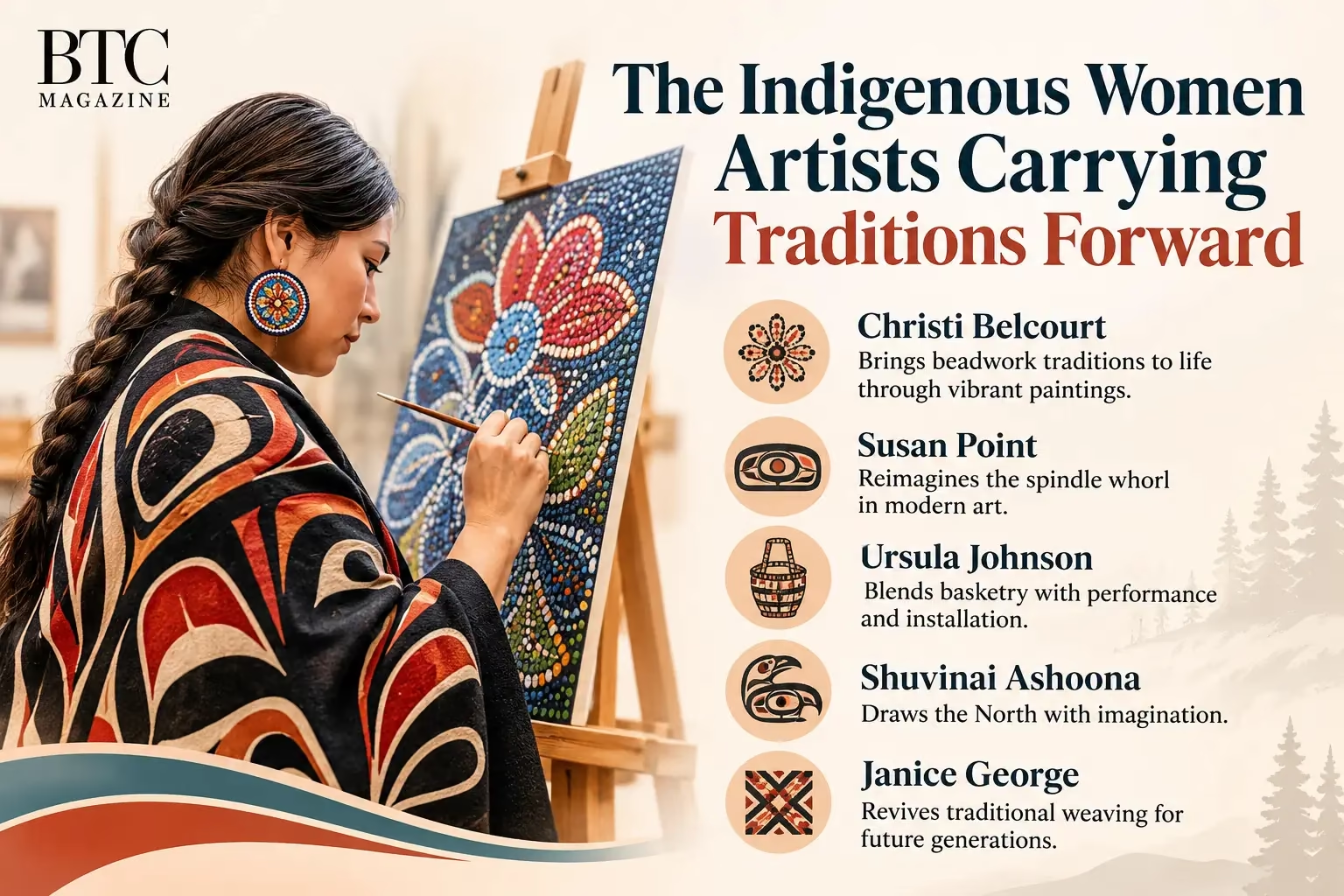
Christi Belcourt: Painting Like Beadwork
If you've seen Christi Belcourt's paintings, you probably remember the dots. Thousands of them. Some large works hold more than 250,000 hand-painted dots, echoing Métis floral beadwork. Belcourt is a Métis visual artist from Ontario. She's said her paintings grow directly out of the beadwork tradition her ancestors left behind. You can feel that lineage in every canvas. But she doesn't stop at the studio. In 2012 she started Walking With Our Sisters, a touring memorial of 1,700-plus beaded moccasin vamps. The vamps honoured missing and murdered Indigenous women and girls. It visited 19 communities before closing in Batoche, Saskatchewan, in 2019. Her design Giniigaaniimenaning (Looking Forward) hangs where you'd least expect it: stained glass in Parliament's Centre Block.
Susan Point: The Spindle Whorl, Reclaimed
Susan Point's story starts at a kitchen table. Back in the early 1980s, the Musqueam artist was a legal secretary pulling silkscreen prints at home. Then a jewellery course changed everything. She discovered Coast Salish art had its own visual language. Point made the spindle whorl her signature. It's a small wooden disk Coast Salish women used to spin wool for ceremonial blankets. She turned it into prints, carvings, and towering sculptures in glass, steel, and cedar. You can spot her work across Vancouver, from the airport to UBC's Museum of Anthropology. When Point began, few women carved. She did it anyway, and helped spark a Coast Salish art revival. She became an Officer of the Order of Canada in 2006. The legacy continues at home. "All of my children are artists," she's said, "and my grandchildren are too."
Ursula Johnson: Baskets That Refuse to Sit Still
Ursula Johnson learned to weave baskets at her great-grandmother's side. That great-grandmother was Caroline Gould, a renowned Mi'kmaq basket maker from Eskasoni Mi'kmaw Nation in Cape Breton. You can't ask for a better teacher. Born in Sydney, Nova Scotia, she took those lessons somewhere unexpected. She weaves, yes. But she also builds performances and installations around basketry. If you picture baskets sitting quietly in museum cases, she'd ask you to look again. In 2017, she won the Sobey Art Award, the first Atlantic Canadian ever to do so. The jury praised how she "redefines traditional materials and re-imagines colonized histories." She began her acceptance speech in Mi'kmaq. (Her mother was the only one who understood every word.) Notice what matters here: her insistence that Mi'kmaq knowledge belongs in contemporary galleries.
Shuvinai Ashoona: Drawing the North, Imagining More
Some artists inherit a tradition. Shuvinai Ashoona inherited a whole family of them. Her grandmother was Pitseolak Ashoona, one of Kinngait's most celebrated graphic artists. Her cousin was Annie Pootoogook. Ashoona was born in 1961 in Kinngait (Cape Dorset), Nunavut. She began drawing in the 1990s at Kinngait Studios, the West Baffin Eskimo Co-operative. She learned by watching elders work. Her drawings start in daily Arctic life: seal cleaning, tents, tundra. Then they drift somewhere stranger. Women birth worlds. Tentacled creatures wander through. Look long enough and you'll swear the creatures are watching you back. Her work showed at the 2022 Venice Biennale. You'll find her drawings in the National Gallery of Canada, too.
Janice George: Weaving a Nation Back Into Its Robes
Imagine growing up with photos of your chiefs in magnificent woven robes. Now imagine nobody in your nation could still make them. That was Janice George's reality. "Nobody was doing it," she recalls. George, Chepximiya Siyam', a hereditary chief of the Squamish Nation, changed that. In 2003, she and her husband, Willard "Buddy" Joseph, travelled to Washington State. Master weavers Susan Pavel and Bruce Miller taught them Coast Salish wool weaving. Then they brought it home. The couple co-founded L'hen Awtxw Weaving House in North Vancouver. They've spent twenty-plus years teaching across Salish territory. By the 2010 Vancouver Olympics, Squamish weavers were dressing their people in robes again. "Their breath is carried on in the teachings I pass on," she says of her mentors. You're not just watching a craft revive. You're watching a nation wrap itself in its own inheritance.
Tradition Isn't Frozen in Time
Notice something about these five women? None of them treats tradition like a museum piece. Back in 2015, Italian fashion house Valentino built a collection around Belcourt's paintings. Point carves in glass, steel, and concrete, materials her ancestors never touched. Ashoona folds horror-film creatures into drawings of Arctic life. Johnson turns basketry into gallery-filling performance art. That's not a betrayal of tradition. That's how tradition survives.
Every generation of Indigenous women has adapted: new tools, new materials, new audiences. Glass beads were once the new thing. Now it's fashion houses and the Venice Biennale. The forms change. The teachings hold. So when you hear "traditional art," don't picture something frozen. Picture something passed hand to hand, changing a little with each pair of hands. That's what Indigenous women artists in Canada are showing you right now.
What the Next Generation Receives
So what travels from one generation to the next? Not just technique. It's knowledge: which plants heal, which stories matter, which words name the stitches. It's identity, the confidence to say this is who we are. It's memory — grandmothers like Caroline Gould and Pitseolak Ashoona, whose hands taught the next pair of hands.
And here's the hopeful part. This transfer isn't finished. It's happening right now, in weaving houses, co-op studios, and kitchens across Canada. Indigenous women artists are carrying traditional arts forward, and they're making sure someone is there to receive them. Next time you see a beaded vamp or a woven robe, look closer. You're not looking at the past. You're looking at a promise.







Comments
No comments yet
No comments to show yet. Subscribe to join the conversation.
Log in or subscribe to comment on this article.