
This Is Bigger Than Me
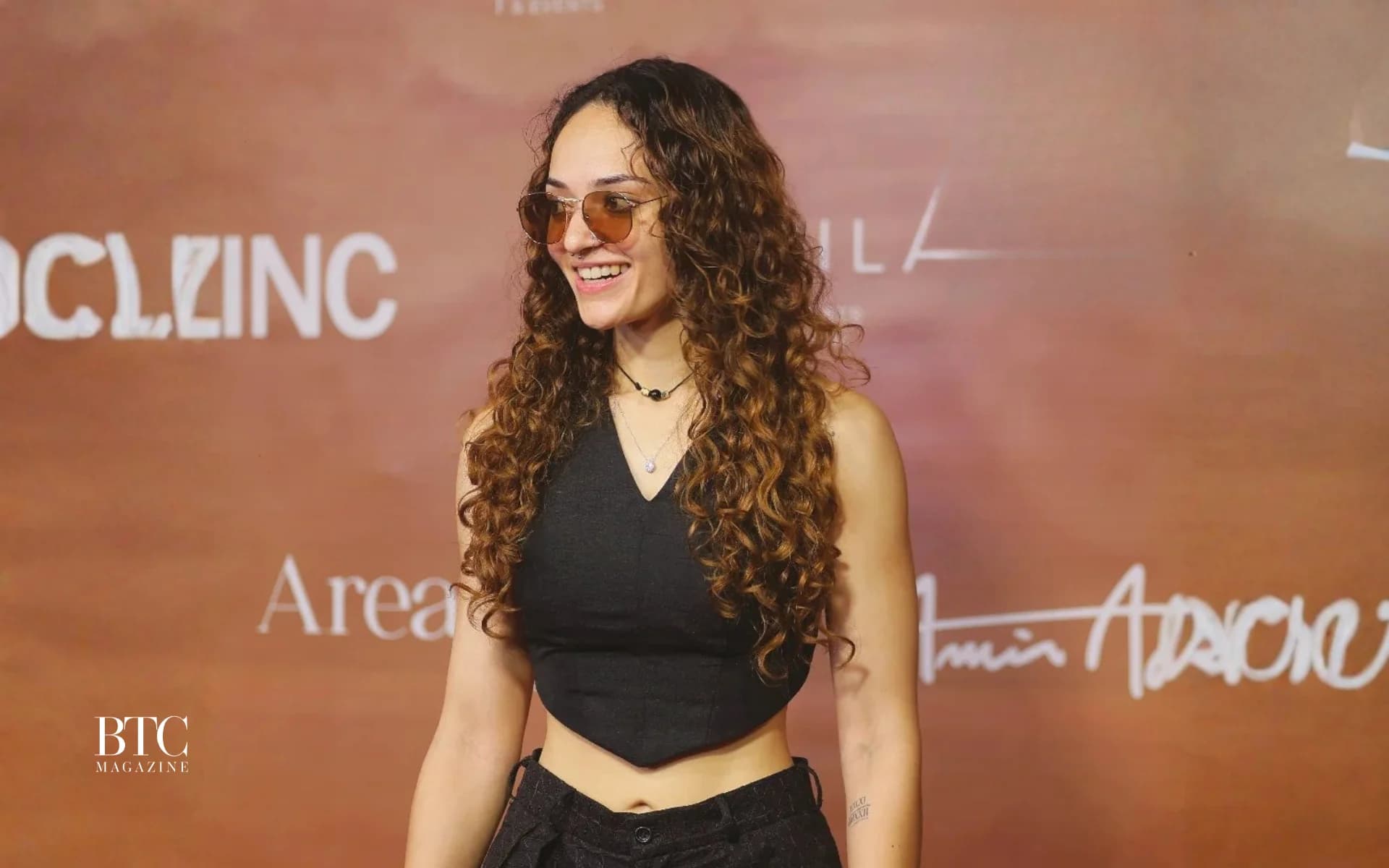
Parishae Adnan inherited an empire, buried her ego, and put her father’s sherwanis on women’s bodies. Now she’s trying to remember who she was before she became who she had to be.
The senior partner’s name was Seth. He had given twenty years to the firm. He had the title, the office, the trajectory everyone around him understood to be success.
Parishae Adnan was sitting across from him in a routine check-in—a senior consultant at a London supply-chain practice, doing the kind of work that looks correct on a CV and feels like suffocation in the body. She was supposed to be talking about her performance. Instead, she asked him a question.
“Are you happy?”
He laughed. She asked again. He deflected. She pushed. Finally, Seth said something that would end her career in consulting and begin everything that came after: he said he’d wanted to start a restaurant.
Twenty years. A corner office. And the thing he actually wanted was a kitchen.
“I looked at him,” Parishae says, “and I was like, I don’t want to be you.”
She pauses. “If I stay in this position, if I keep doing what I’m doing, if I don’t change everything that I know to be my reality right now, I am going to be Seth. And then when somebody who’s twenty or thirty years younger than me asks me if I’m happy, and I can’t answer—I will not be able to live with myself.”
She quit. She didn’t have a plan. Her colleagues asked what she was going to do. She didn’t know. She just knew she couldn’t stay.
That was the version of the story that looks like courage.
Pakistan does not do fashion dynasties. There are no generational handoffs, no second-act designers inheriting the house and remaking it in their image. When the founder retires, the brand typically fades or corporatizes. Parishae Adnan is the first woman in the country’s fashion history to take the creative and operational helm of a major house from the generation that built it.
And she is doing it not by continuing her father’s vision but by arguing with it, inside the garments themselves. She is thirty, she is female, she is leading an industry that was not built to be led by someone who looks like her—and the way she is doing it, burying her own label, surrendering her ego, deconstructing the literal fabric of her father’s legacy and reshaping it for women’s bodies, is less an act of inheritance than a new template for what power might look like when the inheritor refuses to simply repeat what came before.
Her father is Amir Adnan. If you’re of a certain generation in Pakistan, the name is shorthand for the modern sherwani—the garment that dressed prime ministers and grooms and turned menswear into something that carried cultural weight. He launched the label in 1990 and spent thirty-five years building an empire that includes multiple brands, a creative partnership with his wife Huma Adnan—who founded FnkAsia and Craft Stories—and a reputation that, in Pakistani fashion, is as close to a dynasty as the industry has produced.
Parishae is the eldest of three. Her brother is in Toronto finishing an MBA. Her sister—“an actual genius,” Parishae says, without a trace of competition—is starting a PhD in astrophysics at NYU. Neither of them went into fashion. Parishae did, eventually, after trying not to.
She is the CEO of Shapar Private Limited, the company that holds the House of Amir Adnan. She is also a nepo baby. She knows it. She says it before you can.
“That’s the biggest thing,” she says, when asked what people get wrong about her. “The connotation that comes with the word.”
She doesn’t fight the label. She metabolizes it.
“I was born to this immense amount of privilege, and I don’t deny that at all. The rags-to-riches story was not mine. It was my father’s. I was pretty much handed everything.” A beat. “But what did you do with it?”
What happened, she explains, is that social media leveled a playing field her father’s generation never had to contend with. Amir Adnan built his name through print press, television interviews, paper clippings—media that reached a specific demographic. That generation will always see Parishae as his daughter. But the generation that came up through Instagram—the one she belongs to—discovered her first and him second.
“There’s an entire generation of people who know me, who know my brand, but they have no idea what my father did,” she says. “Or what the legacy even is.”
In five months, she went from thirty thousand followers to four hundred and fifty-seven thousand. Not through controversy. Through visibility—the particular kind that happens when a young woman in Pakistan stops performing palatability and starts performing herself.
Around the age of nineteen, Parishae started wearing a black shalwar kameez. Not the soft, draped version—a tailored one. Collar, cuffs, buttons, tapered to her body. Deep pockets, no purse required.
“It was like, she’s dressing like a man,” she says. “She’s dressing like a man.”
She kept wearing it. Over time, it became her identity—her eastern power suit. And embedded in that choice is something nobody tells you about leadership in Pakistan: it is coded masculine.
She describes walking into a production unit to negotiate with the men who own the manufacturing supply chain: a room of men in their fifties and sixties, her entire team of men behind her, and Parishae at the head of the table in her black suit. The room registers her age, her face, her gender—in that order. Then she starts talking numbers, and the dynamic shifts, but it shifts from a deficit. Every meeting begins with a silent negotiation that has nothing to do with the agenda.
“If I became sensitive over something—which is so human—that’s a negative sign,” she says. “If I dress too colourful, I’m not taken seriously. It’s never ‘you’re a leader.’ It’s always a woman first and then anything else.”
The suit does its work. But here is the cost, and she names it precisely: “When I came home, for the longest time, it was like mask off. I am a woman. I keep reminding myself of the divine femininity.”
“This is not something they teach you—to be able to balance internally your femininity with that masculinity when you’re in that leadership position. I wish somebody had coached me on that earlier.”
There is a version of Parishae that her family loved that isn’t useful to the CEO.
“The rebellious version,” she says. She doesn’t hesitate.
“If you had seen me in California, that is the version of me that I feel is the most authentic to my being. I’ve got my tattoos and I’ve got my piercings.” She laughs. “I remember the first time I came into the position and my CFO was like, ‘Can you take this off?’ And I was like, ‘No, man, it’s permanent.’ And he’s like, ‘It’s permanent?’”
When asked when she first realized that being “good” and being herself might not be the same thing, she doesn’t reach for an abstraction. She reaches for a specific wound.
“When I got my first tattoo. My mother tried to disown me.”
She says it matter-of-factly. Her mother’s position was clear: this is not good. Parishae’s was equally clear: this is who I am, and I am not harming anyone. The distance between those two statements—between a mother’s definition of good and a daughter’s definition of self—is the distance this entire issue is trying to map.
But the story has a second act. As Parishae’s public persona grew, her mother’s friends started noticing the tattoos. And suddenly, the same woman who had threatened disownment was telling her daughter to show them off.
“Is this the same lady?” Parishae says, still incredulous. “You tried to kick me out of the house. And now I’m the cool daughter.”
The self didn’t change. The audience did. And that reversal—from transgression to brand asset, from moral failure to social currency—tells you everything about who holds the power to define “good” in a culture where the definition keeps shifting under your feet.
There is a harder question underneath all of this, one Parishae has been turning over with her sister—the astrophysicist, the other daughter who inherited the same upbringing, the same schooling, the same family name. They have noticed something. Both of them share a relentless, almost compulsive need to prove themselves. Their brother does not. All three were raised identically. Same parents, same nurture, same structure.
“Sometimes he calls us out on it,” Parishae says. “He’s like, ‘Why are you pushing so hard?’ And we don’t have an answer.”
She suspects it is gendered—that something in the soil of growing up female in Pakistan, even in a progressive household, even with a father who never once told her to take over the business, installs a drive that looks like ambition but feels like debt. Her brother takes things for granted that she never would. She goes above and beyond to prove herself in spaces where he would simply show up. And neither of them chose this. It was already there before they could name it.
This is the part of Parishae’s story that unsettles the neat narrative of empowerment. She is not just a woman who chose to lead. She is a woman who may never fully know whether her drive is hers or whether it was installed by a system that demands women earn what men inherit by breathing. The question sits inside her, unresolved, and she is honest enough to leave it there.
In 2022, Parishae came back to Pakistan and launched House of Parishae with a debut collection called Un-Gaze. She took her father’s actual sherwanis—garments designed fifteen to twenty years earlier—and deconstructed them. A sherwani became a kurta. A turban became a sari. Every piece was a one-off. The women who walked the show were not models but regular women of different body types, and Parishae spent two weeks with each of them beforehand, learning who they were, what they believed, what looked right on their bodies.
The press read it as legacy. An homage. Parishae reads it differently.
“The point of that collection was, for all intents and purposes, a big fuck you to the industry.”
She had returned from London with a clear-eyed view of what fast fashion was doing globally and a bewilderment at what the wedding industry was doing in Pakistan. Her answer was Un-Gaze: proof that upcycled, sustainable couture could be beautiful, could sell, could command the same respect as new fabric. That giving something old new life didn’t require it to look like rebellion. It could just look like a stunning garment.
When asked whether deconstructing her father’s clothes was permission or transgression, she rejects both frames. “It was just a statement. Here’s this thing that’s very old. You give it no meaning. If I present it to you as this, would that change the way you see it?”
Her father was not in the audience seeing it for the first time. He was in the room during the edit. Parishae describes the process like surgery: she and her team build the collection, then step back. Then Amir Adnan walks in with his notebook and pen.
“We are not allowed to say anything. Because at that point we’ve done everything in our power. We’re so close to it that we’re unable to do anything with it. And that’s when the edit begins.” She mimes the impact. “Nope, I hate this colour. This sucks. Get rid of this. Shorten the length. Bang bang bang bang. Brutal.”
It is the same for every collection—including Darbar, the Spring/Summer 2026 show she staged at Khaliqdina Hall, one of Karachi’s oldest landmarks, where she unveiled a runway-to-retail model that put pieces in stores the day after they hit the runway. A rapper opened that show, interrogating fashion hierarchies before the first look appeared. It was not a fashion show. It was a thesis defence for a new way of running the business.
But whether it’s Un-Gaze or Darbar, the dynamic is the same. Parishae builds. Amir edits. The daughter creates from the father’s material. The father’s rigour shapes the daughter’s vision. It is collaboration, and it is also a kind of beautiful, productive violence—two generations arguing inside the same garment about what it should become.
There is a moment on the House of Parishae Instagram page where the posting stops. She has thought about shutting it down. The silence on that page tells a story she now narrates openly.
When she came back to Pakistan, the plan was to do her own thing. House of Parishae was hers—her name, her label, her ego. She uses the word deliberately. In Urdu, she says, it’s called anna—a personal ego, distinct from the social performance of the superego. She was living for herself. It felt right.
Then she looked at the landscape. She saw one other Pakistani designer who had tried to break from a family legacy and build independently. She studied what happened. And she arrived at a conclusion that cost her something real.
“The minute it hit me that it was a mistake to let go of a legacy—to put weight as a sole person on my ego—I would not only be killing myself in the process, because I would be starting from scratch, but I would also be letting go of everything they had built up for the last thirty years.”
She pauses.
“And the minute I had that realization, I was like: oh, fuck. Alright. This is bigger than me.”
“This is bigger than me.”
Five words. The ego burial. The moment a young designer with a name, a brand, and a point of view decided that the most powerful thing she could do was fold herself into the thing she’d spent years trying to stand apart from. It is, in the language of this issue, the self she buried to become who she is today.
But sit with it a moment longer and the story gets less comfortable. What Parishae did—what she calls the right decision, what she describes as her pivotal realization—was give up her own name to carry a man’s. She dissolved her independent identity into her father’s empire. She traded authorship for stewardship. In a piece about the selves women bury to become “good,” that fact deserves more than a passing glance. The sacrifice was real. The calculation was sound. And the cost—of a woman’s name disappearing into a man’s legacy, even lovingly, even strategically—is a cost this country has been asking women to pay for a very long time.
When asked to complete the sentence—The self I buried to become who I am today was—she answers immediately: her ego. “Severely,” she adds.
But there is something else. Something she alludes to twice during the conversation without naming. “There’s one other thing which I can’t speak about,” she says. She says it plainly, without drama, and moves on. The fact that she names the silence—that she tells you there is a door she cannot open—is its own kind of statement in a country where certain silences are survival.
The deepest wound in Parishae Adnan’s story is not the men in the manufacturing room or the CFO who asked her to remove a piercing. It is the women.
Her mother tried to disown her over a tattoo, then claimed it as social currency when the audience shifted. The young women on her Instagram who love her most fiercely exist alongside the ones who would police her if they knew everything. And in Pakistan’s broader cultural landscape, the same dynamic plays out every March.
The Aurat March—Pakistan’s annual women’s march—has become a lightning rod for everything the country cannot agree on about gender, faith, and public space. When asked about the young women who oppose it, who call the slogans inappropriate and frame the march as a Western agenda, Parishae is precise.
“There’s a saying in this country,” she says, translating from Urdu: “A woman is her own worst enemy.”
She connects it to a pattern that predates Pakistan by a century. During the suffragette movement, it was white women who gave other women the hardest time. The dynamics are not new. They are just arriving later.
“These women haven’t actually gone in and seen the demands of the march,” she says. “They’re going off of claims they’re overhearing in rumours. But that’s not what the march is about. The march is about standing up for all these women that—because she didn’t warm the food on time—the poor thing is dead now.”
It is the oldest wound in the story of women’s progress—not the men who hold the gate, but the women who help them hold it, out of fear, out of habit, out of a definition of “good” they inherited and never examined. Parishae has lived on both sides of it. She has been the daughter judged by her own mother and the CEO whose most cutting critics are other women.
But she refuses to end there. “There’s a lot of women out there that are actually circling away from that patriarchy,” she says. “There’s a lot of hope.”
The thing Parishae Adnan is trying to recover is not a brand or a market position. It is a self.
She calls her “baby Prish.” The child who made a poster at seven saying she wanted to be a fashion designer. The one who didn’t care what anyone thought. The one for whom it was always playtime.
“What happens is, as you grow older and the world comes at you, you are told to bury things,” she says. “But then when you try to break free, you have to go back to everything you unlearned. You have to think about how you behaved as a child. You have to see everything with this childlike wonder that they tell you to get rid of. You have to be wide-eyed.”
She has been practising this. People have noticed. They tell her she’s bubbly, chirpy, passionate. She smiles when she reports this, but the smile has weight behind it.
“It’s a practice,” she says. “It’s a freaking practice.”
Because the alternative is Seth. Twenty years in a corner office, dreaming about a restaurant. Answering someone else’s question about happiness with a laugh that means please stop asking.
Parishae Adnan is not going to be Seth. She decided that in a conference room in London, and she has been deciding it every day since—in the black suit she puts on each morning, in the ego she surrendered to carry a name larger than her own, in the sherwanis she cut apart and remade for bodies they were never designed to hold.
There are parts of herself she cannot show. Not yet. Not in this country, not in this life. Some doors stay closed because opening them would cost more than silence.
If someone sat across from her in twenty years and asked if she was happy, she would not laugh. She would not deflect. She would tell them about a poster a seven-year-old made, and a black suit with deep pockets, and a turban that became a sari, and an ego she buried in the foundation of something bigger than herself. And then she would say: yes.
“The self I buried to become who I am today was my ego.”
“Severely.”
— Parishae Adnan
Parishae Adnan is the CEO of Shapar Private Limited, which operates the House of Amir Adnan, FnkAsia, and Craft Stories. Her personal label, House of Parishae, launched in 2022 with the Un-Gaze collection. Her most recent show, Darbar (Spring/Summer 2026), introduced a runway-to-retail model at Khaliqdina Hall in Karachi. She holds a master’s degree from the London School of Economics.
Frequently asked questions
Parishae Adnan is the CEO of Shapar Private Limited, which operates the House of Amir Adnan, FnkAsia, and Craft Stories. She is the first woman in Pakistan to lead a major fashion house handed down from its founding generation.
The House of Amir Adnan is a major Pakistani fashion house founded by designer Amir Adnan. Parishae Adnan now leads it, reinterpreting its menswear heritage, including putting her father's sherwanis on women's bodies.
House of Parishae is Parishae Adnan's personal label, launched in 2022 with the Un-Gaze collection. Her recent show, Darbar for Spring/Summer 2026, introduced a runway-to-retail model in Karachi.
She describes surrendering her own label and personal ambition to carry a name larger than herself. The self she buried to become who she is today, she says, was her ego.
Related Articles
.webp)

.webp)