Be honest. You've probably looked at your degree and wondered if you chose wrong.
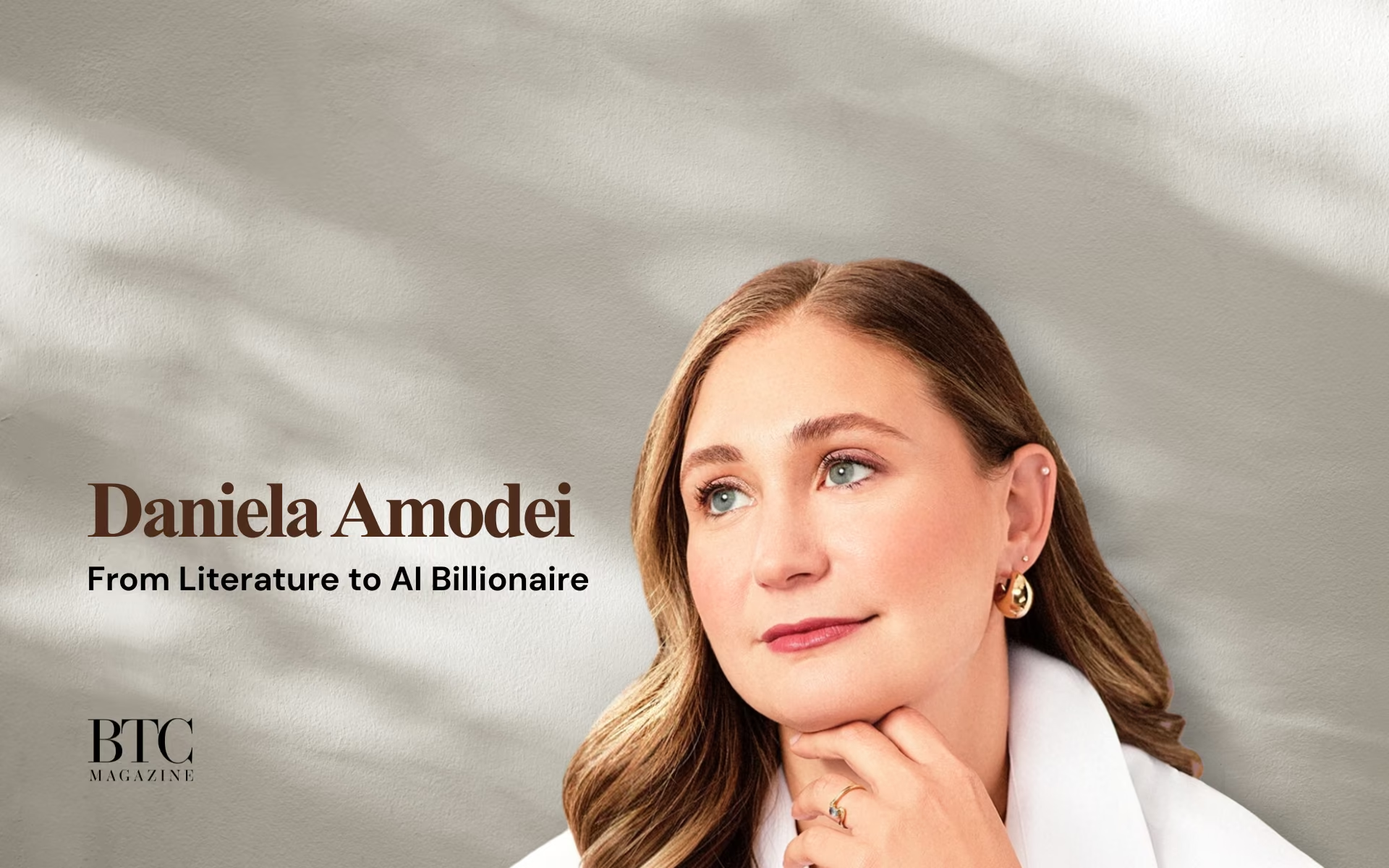
Daniela Amodei didn't have a computer science degree. She didn't study engineering. She graduated from UC Santa Cruz in 2009 with English Literature. She was a classical flutist on scholarship. She was far from Silicon Valley.
Today, she's worth roughly $7 billion. She co-founded Anthropic, valued at $965 billion. She's on Time's 100 Most Influential People list for 2026.
Here's what her journey teaches us. Your background doesn't lock you in. Your first job doesn't define your last. And women in the news aren't just breaking glass ceilings. They're building new buildings entirely.
In our Editorial & Voices corner, we celebrate female changemakers who refuse to stay in their lanes. Daniela's story is one of the most inspiring women in the news today. Let's unpack how she got here.
No tech background required. Just an open mind and a little hope.
Who Is Daniela Amodei?
An Unconventional Path to Tech
Daniela didn't grow up coding. She grew up playing flute. She graduated summa cum laude from UC Santa Cruz. She won the Concerto competition. She took her humanities degree and stepped into politics.
She worked on a congressional campaign. She managed communications for a representative. She learned how to organise. She learned how to build trust.
These skills became her superpower. (Trust me on this one.)
The English Literature Degree That Changed Everything
You've probably heard that STEM is the only path to tech success. Daniela proves that's nonsense.
In a February interview, she said something powerful. "I believe in a world where AI is very smart. The things that make us human will become more important."
She went on. "These models are good at STEM. But understanding ourselves, understanding history, understanding what makes us tick — that will always matter."
Your English degree isn't a limitation. It's a lens. And Daniela is living proof.
Before AI — A Career Rooted in Service
Global Health and Public Policy
After graduating, Daniela chased purpose, not prestige. She worked in global health and policy. She spent time at the IRIS Center at the University of Maryland. She learned how systems work.
These weren't wasted years. They were foundation years. She learned how the world operates outside tech bubbles. She learned how to listen. How to advocate.
Every skill would serve her later. She just didn't know it yet.
How Non-Tech Experience Shaped Her Leadership
Here's the thing nobody tells you. Tech companies need more than engineers. They need people who understand people. They need people who can communicate complex ideas. They need people who can build teams and navigate policy.
Daniela's early career gave her all of that. Her humanities background taught her critical thinking. Her policy work taught her systems thinking. Her communications roles taught her how to translate between worlds.
These are the exact skills that make her invaluable at Anthropic today.
The Stripe Years — Building Teams, Not Code
Joining Stripe as One of the First Recruiters
In 2013, Daniela joined Stripe. The company had about 45 employees. She wasn't an engineer. She was a recruiter. One of the first.
Early recruiting at a startup shapes the entire culture. Every hire changes the trajectory. Daniela understood this. She didn't just fill seats. She built the foundation.
Growing the Team from 45 to 300
Stripe grew fast. Daniela grew with it. She helped scale the team from 45 to roughly 300. She learned how to spot talent. She learned how to sell a vision. She learned how to create processes that didn't suffocate the company.
This was her MBA. It was her crash course in scaling. It taught her that culture isn't accidental. It's built one hire at a time.
The Pivot to Risk Management
In 2015, she shifted to Risk Programme Management. By 2016, she was a Risk Manager. She added user policy and underwriting to her plate.
This pivot matters. Risk management in fintech isn't glamorous. But it's where you learn to protect users. Where you learn that speed without guardrails is dangerous.
That lesson became central to her philosophy at Anthropic.
The Birth of Anthropic
Leaving OpenAI — A New Beginning
In 2018, Daniela joined OpenAI. She managed the team that built GPT-2. She rose to Vice President of Safety and Policy. She was inside the machine.
But by late 2020, she and her brother Dario saw something worrying. They believed AI safety needed to be the mission. Not a side project. The mission.
Leaving wasn't easy. At Stanford, she later called it "kind of a crazy thing to do." She walked away from stability. From reputation. From a company already changing the world.
A mentor told her something that changed everything. "You already know what the right answer is."
She trusted her gut. She left.
Co-Founding with Her Brother Dario Amodei
In 2021, Daniela and Dario co-founded Anthropic. They brought five other former OpenAI colleagues. Jack Clark. Jared Kaplan. Chris Olah. Ben Mann. Sam McCandlish. Tom Brown.
It was a family affair. But it wasn't nepotism. Dario became CEO. He focused on research. Daniela became president. She focused on business operations. Policy. Security. Enterprise sales. Hiring. The safety organisation.
She built the machine that powered the research. He steered the science. Together, they created something remarkable.
A Focus on AI Safety and Responsible Research
Anthropic's mission is simple and radical. Build AI systems that are safe and honest. Make sure they align with human values. Don't just build fast. Build right.
This isn't marketing. It's the core of everything they do. Daniela's background in policy and risk made her uniquely suited to lead this charge.
She understood that technology without guardrails isn't progress. It's danger dressed as innovation.
The Mission That Sets Anthropic Apart
While other AI companies raced to release products, Anthropic focused on safety. They developed Claude, their AI assistant. They built Constitutional AI for training models to follow principles.
They refused to cut corners. They refused to move fast and break things when the things being broken were human trust.
That stance cost them early headlines. But it earned them something more valuable. Credibility.
The Numbers — Five Years Later
Anthropic's $965 Billion Valuation
In May 2026, Anthropic closed a $65 billion Series H round. The valuation hit $965 billion. Nearly a trillion dollars. Five years after founding.
The company partners with Amazon and Google. It has over 2,500 employees. It has 300,000+ business customers. Eight of the Fortune 10 use Claude.
This isn't a startup anymore. It's a force.
Daniela's $7 Billion Net Worth
Forbes estimated Daniela's net worth at roughly $7 billion in February 2026. Other estimates range from $1.2 billion to $3.6 billion. The exact number matters less than the trajectory.
She's one of the wealthiest self-made women in tech. She's one of the most powerful women in the news today. And she got here without ever writing code.
What This Means for Women in Tech
Daniela's success rewrites the playbook. You don't need to be an engineer to lead a tech company. You don't need to fit the Silicon Valley mould to change the world.
You need vision. You need courage. You need the humility to build around your gaps. And you need the stubbornness to keep going when everyone says your background is wrong.
Why Her Story Matters for Women Today
Redefining What a Career in Tech Looks Like
You've probably been told that tech is for coders. That founders should be technical. That humanities degrees are useless.
Daniela is the counterargument. She's president of a nearly trillion-dollar AI company. Her degree is in English Literature. Her early career was in politics and global health.
Women in the news are often portrayed as exceptions. But Daniela isn't an exception. She's evidence. Evidence that many paths lead to the top. Evidence that the narrow gate we've been shown isn't the only entrance.
The Power of Transferable Skills
Communication is a transferable skill. Critical thinking is a transferable skill. Building teams is a transferable skill. Navigating policy is a transferable skill.
Daniela didn't waste her early career. She invested it. Every role taught her something she uses today. The humanities taught her to question. Politics taught her to persuade. Recruiting taught her to spot talent. Risk management taught her to protect.
Your past isn't a detour. It's preparation.
Lessons for Women Over 40
Daniela is 38. She didn't found Anthropic straight out of college. She spent over a decade building experience before taking the leap.
If you're 40, 45, 50 — this matters. It's not too late. Your best work might still be ahead. Your biggest impact might be your next chapter.
Age isn't a liability. It's an asset. You know more. You've seen more. You've survived more. That wisdom is exactly what bold ventures need.
BIPOC Women and Career Reinvention
Daniela's story isn't just about gender. It's about belonging. It's about walking into rooms where you don't see yourself reflected. It's about proving that different backgrounds bring different strengths.
BIPOC women face extra skepticism in tech. Their expertise gets questioned. Their presence gets scrutinised. Their leadership gets coded as "aggressive" instead of "assertive."
Daniela's success carves out space. It says, "We belong here. We've always belonged here."
What We Can Learn from Daniela Amodei's Journey
Success Isn't Linear
Daniela's path zigzags. Literature to politics to recruiting to risk management to AI safety. No straight line. No five-year plan.
That's how most real careers work. They twist. They turn. They surprise you. The key is staying curious. The key is saying yes to things that stretch you.
Your Background Doesn't Define Your Future
Your degree doesn't own you. Your first job doesn't own you. The expectations people placed on you at 22 don't own you.
Daniela could have stayed in politics. She could have stayed in recruiting. She could have decided that AI was her brother's world, not hers.
Instead, she expanded her definition of possible. You can too.
Sometimes Building the Team Is More Important Than Building the Product
Daniela doesn't write the models. She builds the company that writes them. She hires the people. She sets the policies. She protects the mission.
That's not secondary work. It's essential work. The best technology fails without the right people around it. The right culture. The right guardrails.
If you're the person who builds teams, who creates systems, who keeps people safe — you're not supporting the mission. You're driving it.


.webp)
.webp)
Comments
No comments yet
No comments to show yet. Subscribe to join the conversation.
Log in or subscribe to comment on this article.