
What Was Taken, What Was Kept
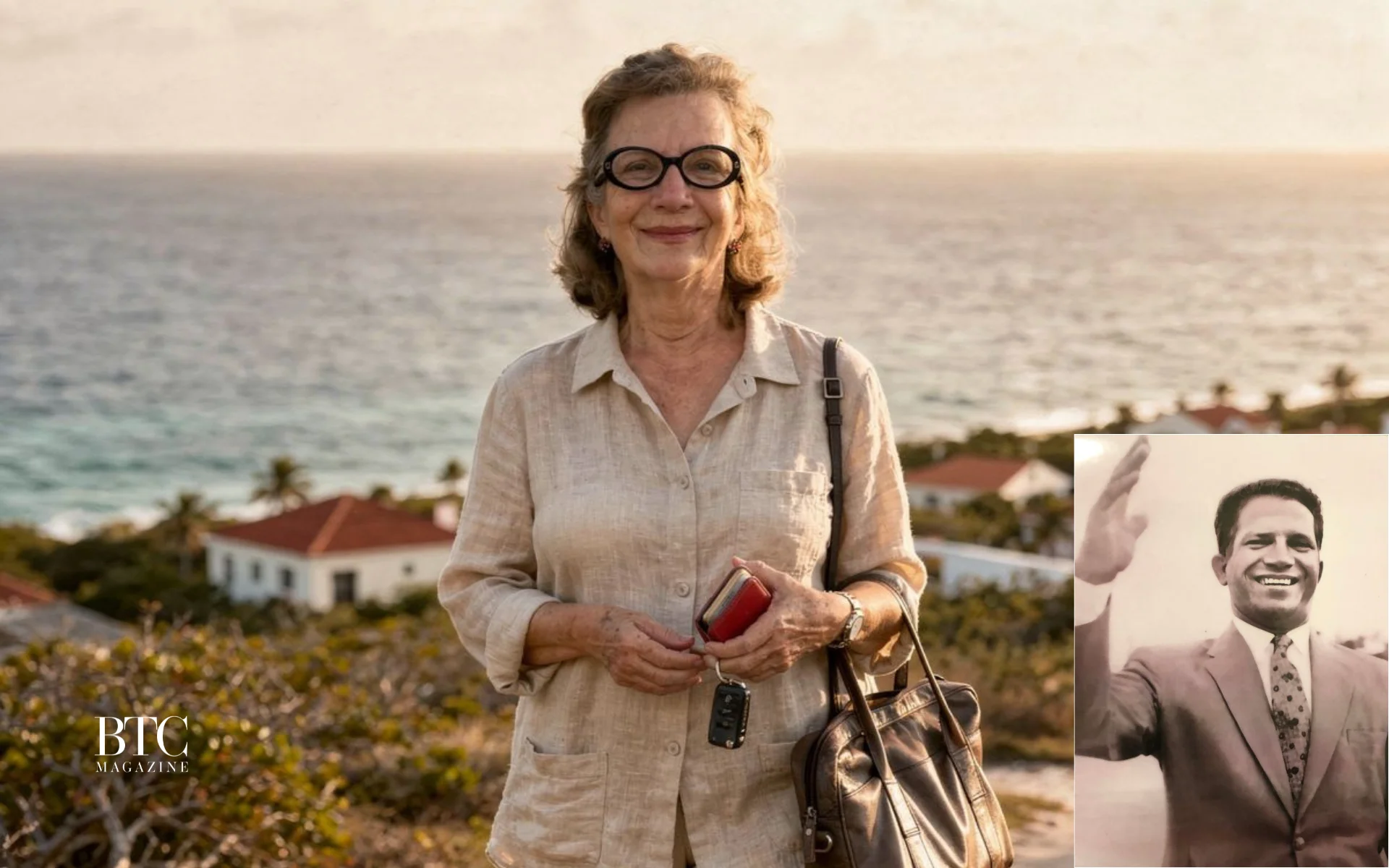
Yadira Bakhuis didn’t inherit a legacy. She fought one back.
The day her father bought Koraal Tabak, he put all his children in the Cadillac El Dorado — the big one, the convertible, the kind of car that announces itself before it arrives — and drove them to the edge of the land without telling them why.
She was seven, maybe eight. Maybe nine. She doesn’t remember the exact number.
She remembers everything else.
He stepped out. He stood at the border where the guard house now sits. And he said, simply: This is all your land.
Yadira Bakhuis has spent the better part of her life making sure it stayed that way.
She’s 75 now, and she moves through a conversation the way she seems to move through everything else — with an unhurried precision that keeps catching you off guard. She laughs easily. She corrects herself carefully. She doesn’t perform wisdom; she just has it, layered in her the way sediment layers in old stone — Dutch sailors and African ancestors and a Costa Rican mother and a Curaçaoan father who built half an island and died before anyone could stop him.
“In Curaçao,” she says, “nothing is secret. Everyone knows everything. Even secrets are not secrets.”
She means it as permission — to talk about all of it.
Her father was not a simple man, and she doesn’t ask you to see him as one.
He was born in Curaçao to a lineage already tangled by history — Dutch sailors, enslaved women, generations of children whose fathers’ names went unrecorded because the record-keepers didn’t think their names mattered. His grandfather made Panama hats. Straw, dried in the sun, exported wherever the trade winds took them. Her father grew up watching industry and decided he wanted to build it.
He became a mechanic. Then he started a bus line — six, seven secondhand buses, chauffeurs who treated each one like it was personally theirs, routes that ran on time when nothing else on the island did. People still stop Yadira today to tell her: I went to school on your father’s bus. It was always on time.
The government decided public transportation should be in government hands. They nationalized the routes. The buses that followed were never quite the same.
He pivoted. He always pivoted. Concrete blocks. Land acquisitions. He’d buy a plot, divide it, lay the streets himself, install the lights, sell the lots. He was not accumulating wealth so much as constructing a world — the way some men do when they understand, bone-deep, that nothing comes unless you build it first.
And then there was Campo Alegre.
This is the part of the story that requires context, and Yadira provides it without flinching.
Post-World War II, Curaçao was flooded with sailors and workers and men far from home. The government, in concert with the Catholic Church — an alliance she describes with the measured tone of someone who has made peace with irony — decided the answer to disease and disorder was a regulated, medically supervised brothel. They needed a businessman willing to run it.
Her father raised his hand.
I’ve interviewed enough people to know when someone is bracing for your reaction. Yadira doesn’t brace. She just tells you. And something about that — the absence of apology, the absence of performance — makes you sit up straighter and listen harder.
“He was not the devil,” she says, and you believe her — not because she’s defensive, but because she isn’t. “When drugs came, he said: not in Campo. He dropped it.”
The women who worked there were tested weekly. There was a nurse on site. Some, she says quietly, eventually married local men and built lives. Nobody talked about it — not from shame, but from the particular mercy of small-island people who understood poverty from the inside and saw no point in adding cruelty to it.
Her father died with a funeral like a head of state. Police escort in front, police escort behind. People lined the sides of the road. Crying. Blessing. Sending him off the way you send off someone who made life more possible.
“So,” Yadira says. “You think he is a pimp, but people loved him.”
A pause. Then:
“He was a real businessman. He liked to develop things.”
“Ownership is the biggest asset in capitalism. And we are living in capitalism. So tell me — how is it possible that someone takes something without paying?”
He died too early. That sentence sits underneath everything that comes next.
Yadira had been in Holland studying, working, building a life — where she married, and where her son was born. She raised him there through more than twenty years, all while carrying the promise of a director’s position waiting for her back home. After her divorce, she returned to Curaçao with her son — and landed to find the position already had a director. A fact no one had thought to mention.
She canceled the furniture she’d planned to ship. Found a small consulting contract. Delivered a plan to reform the island’s social services subsidy system in two weeks — a timeline so far outside expectation that her clients initially refused to believe it was finished.
“They said: What? How is this possible? Two weeks?”
She told them to read it. If it wasn’t right, she’d fix it.
It was right.
That is how Curaçao began to understand what it had in Yadira Bakhuis. Not by announcement. By work.
Decades of government service followed. Youth policy. Education reform. The kind of institutional work that doesn’t generate headlines but quietly determines what opportunities exist for children who never know whose decisions made them possible. Work came to her. She didn’t chase it.
And then her mother called.
Koraal Tabak — the land from the day in the El Dorado, the land her father had driven to almost every day once it was his — was gone. A business partner her mother had trusted had maneuvered more than twenty square acres through a notary and into his own name.
The family lawyer agreed to take the case on one condition: put Yadira in charge.
She went home and read Marx — the actual text, not the summary — trying to build an argument from first principles, because that was the only tool she had.
“If I’m not mistaken,” she told the lawyer, “ownership is the biggest asset in capitalism. And we are living in capitalism. So tell me — how is it possible that someone takes something without paying?”
He looked at her. Then he said: Call your mother.
What followed was ten years. Ten years of hearings and filings and continuances, of watching the other side introduce complications designed to outlast her will. There were documents she’d read so many times the language stopped making sense. There were mornings when she couldn’t think past the fight to what came after it, because imagining an after felt like something she couldn’t afford.
She kept going.
The judge ruled clearly, at the end. This was a man who had exploited a mother. The transfer was reversed. The land came home.
“When I got it back,” she says. “I got everything back.”
I’m a son of immigrants. I know something about what land means to people who were never supposed to have any. When Yadira says everything, she isn’t talking about square meters.
Stand at Koraal Tabak on a still morning and something happens to you.
The trade wind comes in off the water before you’re ready for it — not a breeze, something fuller, something that moves through your chest and keeps going. The salt is there, but cut with something drier, something that smells like caliche and wild sage and the particular warmth of stone that has been holding sun since before you arrived. The sea is visible on two sides. On one, Sint Joris Bay. On the other, open water pushing toward the horizon. Between them, a silence that isn’t really silence — it’s the sound of land that has been here longer than anyone’s claim on it.
Yadira has watched it work on strangers. People who visited once as schoolchildren come back decades later to tell her they never forgot the day they stood there. That they’d wanted to stay. That something in the air did something to them they couldn’t name then and still can’t.
“When you leave Koraal Tabak,” she says, “you feel like you can do anything you want.”
She sees what comes next: wide paths where people walk without urgency, freshwater lakes catching the afternoon light, red rooftops and green ones visible from the water, children on bicycles, sailboats crossing the frame of the horizon. Her father’s plan — sports facilities, open land, a place people arrive at on purpose — finished, finally, by the one person who understood what it cost to keep.
“The air,” she says. “I keep the air like it is. The air is the most beautiful thing.”
Stand still for ten minutes. Don’t perform being there. Just stand.
Then you’ll feel it.
There is a question worth sitting with, about a woman who spent decades in service, raised a son alone, fought a ten-year legal battle for land that was always hers, and is now building a community on the northeastern coast of the island where she was born:
Why didn’t she see sooner what she had?
A friend once gave her the answer she still carries.
“What you think is natural — other people don’t think is natural. That’s why you don’t know the difference between yourself and someone else.”
She considers that. Then:
“Maybe I don’t need to know. I live a joyous life.”
It is not resolution. It is a woman who built something, lost it, fought ten years to get it back — who still can’t entirely explain why she was the one who could, and has decided that question matters less than the doing.
If she could reach back to the little girl in the El Dorado, she’d say one thing:
Come home sooner.
Not because Holland was wrong. But because some land doesn’t just wait for you.
It holds your name in the ground until you return to claim it.
Koraal Tabak Estates is a residential development on the northeastern coast of Curaçao.
Frequently asked questions
Koraal Tabak is an estate on the northeastern coast of Curacao, now a residential development called Koraal Tabak Estates. It was bought by Yadira Bakhuis's father and later reclaimed by her after a ten-year legal battle.
Yadira Bakhuis is a 75-year-old Curacaoan woman who spent decades protecting her family's land. After a ten-year legal fight she reclaimed Koraal Tabak and is building a community on the island where she was born.
The profile paints Curacao as a place of deep history and natural beauty, layered with Dutch, African, and Caribbean heritage. Bakhuis says the air itself is the most beautiful thing, best felt by standing still for ten minutes.
Koraal Tabak Estates is a residential development on the northeastern coast of Curacao, built on land Yadira Bakhuis fought to reclaim. It represents both a family legacy and a future community on the island.
Related Articles
.webp)
.webp)
.webp)