Dr. Zargar Eye Care
10% off for treatment and $500 credit for sunglasses/glasses with RF .

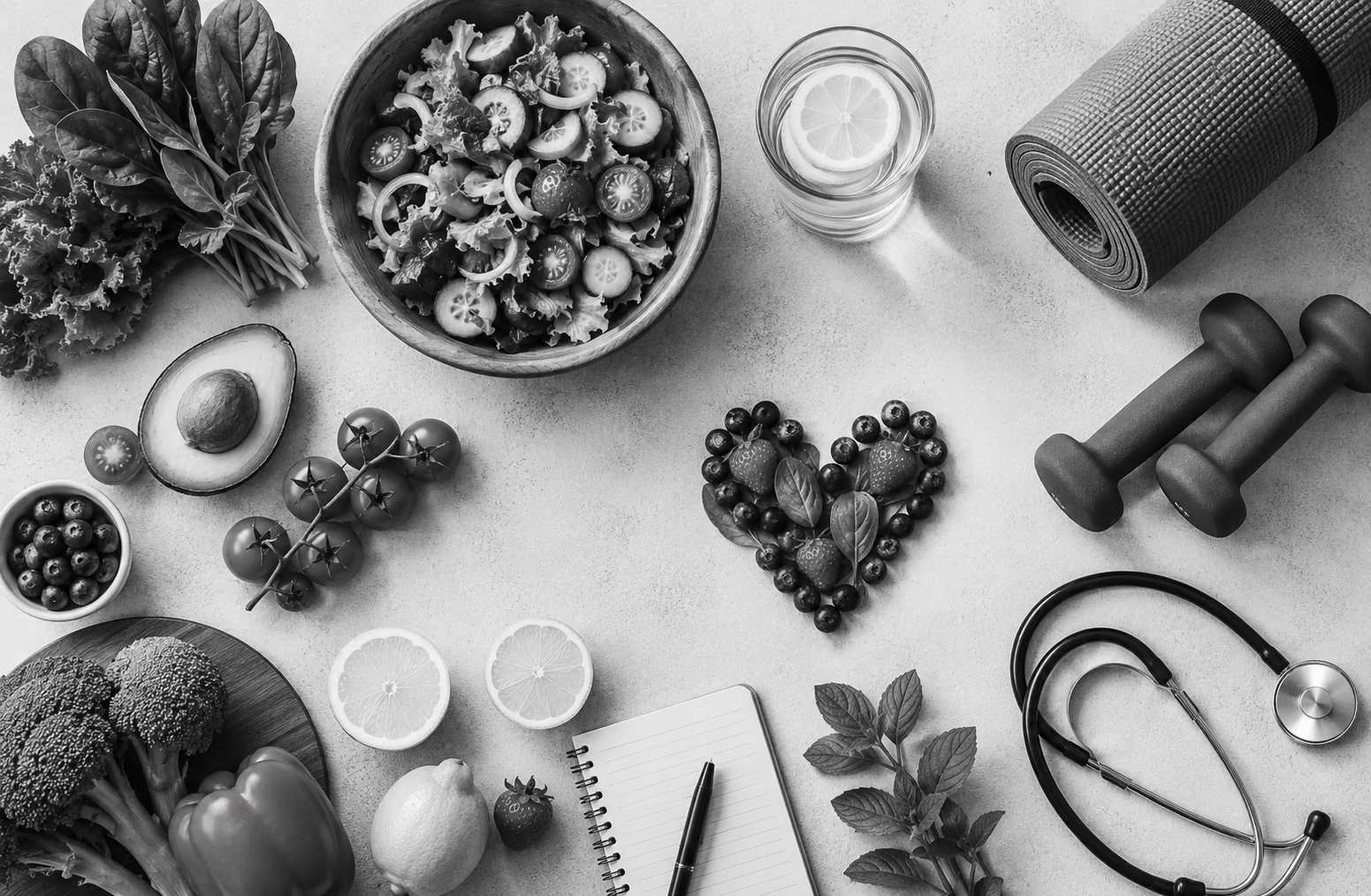
Health & Wellness – Building Balance in Modern Life Health and wellness are more than just buzzwords—they represent a way of living that prioritizes physical, emotional, and mental well-being. In today’s fast-paced world, where stress and responsibilities often pull us in multiple directions, embracing a holistic approach to wellness is essential. A healthy lifestyle isn’t about perfection; it’s about creating sustainable habits that support balance, resilience, and happiness for both individuals and families. The Importance of Holistic Wellness True wellness goes beyond exercise and diet. It encompasses the mind, body, and spirit, recognizing that each aspect of health influences the others. For example, a nutritious diet fuels not just physical energy but also mental clarity. Similarly, mindfulness practices like meditation reduce stress while improving emotional resilience. By taking a holistic approach, we address overall well-being rather than focusing on isolated goals. Holistic wellness also emphasizes prevention over cure. Instead of waiting for health issues to arise, prioritizing daily habits such as proper sleep, hydration, and stress management can reduce long-term risks and improve quality of life. Building Healthy Habits Healthy habits form the foundation of a balanced lifestyle. Some of the most effective habits for everyday wellness include: Balanced nutrition: Eating whole foods, lean proteins, fruits, and vegetables while limiting processed options. Regular movement: Incorporating exercise into daily routines—whether it’s a structured workout, a walk after dinner, or yoga in the morning. Consistent sleep: Prioritizing rest by maintaining a regular bedtime routine that allows the body to recover and recharge. Hydration: Drinking enough water throughout the day to support energy and focus. Mindful breaks: Pausing during busy schedules to breathe deeply, stretch, or reset the mind. These small, consistent practices add up to lasting results and create a healthier lifestyle that feels manageable, not overwhelming. Self-Care for Mental and Emotional Health In a world filled with constant demands, self-care has become a vital component of wellness. Taking time to recharge emotionally is not selfish—it’s necessary. Self-care can be as simple as journaling, taking a warm bath, practicing meditation, or enjoying a favorite hobby. Equally important is mental wellness. Seeking professional support when needed, setting boundaries in relationships, and practicing gratitude all contribute to a stronger, more balanced mindset. Prioritizing mental health not only improves individual well-being but also strengthens relationships and family dynamics. Family Wellness and Parental Support Health and wellness extend beyond the individual—they are central to creating a balanced modern family life. Parents play a critical role in modeling healthy habits for their children. When families cook nutritious meals together, stay active, and practice open communication, children learn the value of wellness from an early age. Parental support also involves creating an environment where kids feel emotionally secure. Simple practices such as listening without judgment, spending quality time together, and encouraging independence help build resilience in children. For parents, self-care and support networks are equally important. Parenting is rewarding but demanding, and seeking guidance or sharing experiences with other parents can make the journey easier. Embracing Wellness in Everyday Life Wellness doesn’t have to mean major lifestyle overhauls. It’s about small, intentional choices that improve daily living. Preparing a healthy lunch instead of fast food, taking a walk instead of scrolling through a phone, or setting aside time for a family game night are all meaningful steps toward balance. Incorporating wellness practices into daily life fosters stronger families, healthier communities, and greater fulfillment. Each choice brings us closer to a lifestyle that prioritizes both personal well-being and collective family happiness. Final Thoughts Embracing health and wellness is about creating harmony in every aspect of life—body, mind, and relationships. By focusing on healthy habits, practicing self-care, and nurturing family connections, you can build a foundation of strength and balance that supports long-term well-being. Remember, wellness is a journey, not a destination. It’s about progress, not perfection. Each step—no matter how small—brings you closer to a healthier, happier, and more fulfilled life. Start today, and embrace the possibilities of holistic health and wellness.
Dive deeper into specific topics within Health And Wellness
Health Habits – Building a Better Lifestyle Introduction Developing strong health habits is one of the best ways to improve your overall lifestyle. From eating nourishing meals to getting enough rest and movement, small daily choices can create lasting benefits. By focusing on consistent routines, you can build a healthier foundation that supports energy, focus, and long-term wellness. Why Health Habits Matter Habits shape the way we live more than we realize. A single choice may seem small, but repeated daily, it becomes powerful. Positive routines improve mood, strengthen the body, and even shape relationships. Unlike short-term fixes, habits work quietly in the background, building resilience and protecting against illness. When you invest in better routines, you’re essentially investing in your future self. Core Health Habits to Practice Nutritious Eating What we eat directly impacts how we feel. A balanced diet filled with whole foods—fruits, vegetables, proteins, and grains—keeps the body fueled. Mindful eating is also important: slowing down, savoring meals, and paying attention to portions can reduce overeating and support digestion. Staying hydrated by drinking enough water each day is another simple but powerful habit that keeps the body functioning well. Regular Movement Movement doesn’t have to be complicated. Walking, stretching, cycling, or dancing are all ways to keep the body active. The goal is consistency, not perfection. Even short daily sessions can increase strength, improve posture, and lift mood. Over time, regular activity becomes less about discipline and more about enjoyment. Restful Sleep Sleep is one of the most underrated pillars of health. Getting 7 to 9 hours each night gives the body time to repair, process, and recharge. Poor sleep can affect mood, memory, and immunity. Creating a bedtime routine—like dimming lights, avoiding screens, and setting a regular sleep schedule—helps signal the body that it’s time to rest. Managing Stress Modern life can be stressful, but how we handle pressure makes all the difference. Relaxation practices such as deep breathing, meditation, or journaling help calm the mind. Spending time outdoors, listening to music, or simply enjoying a quiet moment with loved ones can also restore balance. Stress management doesn’t mean eliminating challenges, but building the capacity to respond calmly. Consistency Above All The real power of habits lies in repetition. A single workout or one healthy meal won’t change much, but done daily, they create momentum. Small steps—like taking the stairs, cooking at home more often, or adding a few minutes of stretching—become part of a rhythm that’s easy to maintain. How to Build Lasting Habits Begin small: Choose one new practice and focus on it until it feels natural. Create reminders: A note on the fridge, an alarm, or an app can keep you on track. Stay accountable: Share your goals with a friend or partner to stay motivated. Celebrate progress: Recognize even small wins to encourage consistency. Conclusion Health habits are not about perfection but about steady improvement. By choosing nourishing foods, moving your body, prioritizing sleep, and handling stress with care, you create a lifestyle that supports both body and mind. Over time, these choices shape not just your health, but your confidence, energy, and outlook on life. Start with one step today, and let it grow into a habit that strengthens your future.
Lifestyle & Wellness – Creating Balance in Everyday Life Introduction Wellness is more than just avoiding illness—it’s about creating balance in every part of life. A fulfilling lifestyle means caring for the body, mind, and spirit together. Small, intentional choices, when practiced daily, can create harmony and help us feel more present, joyful, and connected. Lifestyle and wellness are not short-term goals but lifelong journeys of growth, reflection, and mindful living. What Lifestyle & Wellness Really Mean Lifestyle refers to the patterns of choices we make each day—how we spend time, what we eat, how we move, and even the company we keep. Wellness is the state of feeling good, both physically and emotionally. When these two are aligned, life feels easier and more meaningful. A balanced lifestyle isn’t about being perfect but about finding a rhythm that suits personal values and needs. Key Elements of a Balanced Lifestyle Nourishing the Body Food and movement are at the heart of well-being. Eating fresh, whole foods provides energy and vitality. Staying active through enjoyable activities such as yoga, walking, or swimming strengthens the body and lifts mood. When we treat the body with care, it becomes a reliable partner in everything else we do. Caring for the Mind Mental wellness is equally important. A busy world often overwhelms us, making it crucial to slow down. Practices like meditation, journaling, or mindful breathing can ease stress and sharpen focus. Creating space for hobbies, reading, or creative outlets also nurtures mental health and builds resilience against life’s pressures. Building Positive Relationships Human connections deeply affect lifestyle and wellness. Supportive, kind, and respectful relationships provide comfort and motivation. Spending time with loved ones, listening deeply, and showing gratitude create stronger bonds. On the other hand, learning to set boundaries protects emotional energy and encourages self-respect. Finding Purpose and Joy Wellness goes beyond physical and emotional health—it also includes a sense of purpose. Whether through work, volunteering, creative projects, or simply pursuing passions, having meaning in life adds fulfillment. Joy can be found in simple things: watching a sunset, cooking a favorite meal, or spending time in nature. Everyday Practices for Wellness Morning routines: Starting the day with reflection, movement, or a healthy breakfast sets the tone. Mindful breaks: Short pauses during work help restore focus and prevent burnout. Gratitude practice: Noting a few things to be thankful for daily boosts mood and perspective. Digital balance: Limiting screen time and social media allows more presence in real-life moments. Self-care rituals: Activities like skincare, reading, or enjoying a warm bath remind us to slow down. Overcoming Common Challenges Creating balance isn’t always easy. Busy schedules, stress, and external demands can throw us off track. The key is flexibility. Wellness doesn’t require grand changes—it thrives on small, sustainable actions. Instead of aiming for perfection, focus on progress. Missing a workout or having a stressful day doesn’t undo the bigger picture of consistent effort. Conclusion Lifestyle and wellness are deeply personal journeys. They aren’t defined by trends or strict rules but by what brings peace, energy, and happiness to your life. By nourishing the body, caring for the mind, nurturing relationships, and pursuing meaningful activities, you can create a lifestyle that feels both balanced and rewarding. Start with small steps and allow them to grow into habits that guide you toward a healthier, more joyful future.
Recently, in a moment of pure desperation (and possibly hormone-fueled panic), I inquired about a new weight loss program I saw on TV. The struggle is real. Somehow, I’ve gained five whole pounds since the summer and I swear, it wasn’t from consuming too many croissants in Paris or Sangrias in Spain (I think). What in the name of estrogen-imbalance is going on?I sat at my kitchen table frustrated, determined, confident and made a declaration: the time has come! I refuse to ‘roll’ into my 50s feeling like a perimenopausal statistic, constantly being told by mom, “These are normal life changes hokis (Armenian for sweetheart) … just accept it!” Blah. Blah. Blah.I decided to take matters into my own hands. I made myself the ultimate “healthy woman” breakfast this morning - Greek yogurt, blueberries and a spoonful of flax seeds (which, according to the internet, help with irritability, though my husband is ready to file a formal complaint on that claim). Then I filled out the online form, ready to reclaim my balance, my energy and my jeans (that still fit) but no longer deserve the title ‘fat jeans’.I hit submit. I waited. I felt hopeful. And then…“Our weight loss program isn’t a good match for you at the moment. Your current BMI is not well suited for treatment.”Excuse me… WHAT?! ‘At the moment? This IS the moment. What moment are we waiting for? What happened to being proactive!?Apparently, I’m too healthy to qualify, too small to lose weight and too average for assistance. So now we’re segregating the skinny-chubby-ish folks? Let me tell you, when you’re only five feet tall, gaining 5lbs pounds is basically like packing on 10lbs for the average person.I wasn’t asking for a miracle. I didn’t want a shot (maybe just a little), a pill (I mean…), or a motivational text from a bot named “Scale Slayer Sandy.” I just wanted a roadmap back to my pre-hormonal self, and some accountability to kick my butt back into shape. Instead, my BMI decided to gaslight me in the cruelest way possible. WTF.Evidently, perimenopause is the ultimate game player. Your body starts playing by new rules and doesn’t even care to send a ‘Hey Queen, heads up!’ memo. One day, you’re crushing hot yoga and Pilates, the next, your jeans are cutting off circulation and you’re googling “Can stress cause back fat?”So no, I don’t want to “accept it.” I want answers. I want balance, and maybe for some understanding that five pounds, whether you’re a small-framed person like me, or not, in perimenopausal math is basically thirty in emotional weight.Turning half a century old hasn’t exactly been a walk in the park or a simple hot flash in yoga pants (note: still waiting on the “hot flashes” to occur) but being surrounded by a tribe of fabulous women who’ve already crossed this milestone, I’ve learned a lot.While recently out for dinner with friends, I dramatically sighed over the dreaded question, “Soooooo, what are your plans for your 50th?” one of the ladies chimed in, as she sipped her Pinot:“Girl, 50 is incredible. It’s the age where you finally stop giving a F$%# about anything!”I almost dropped my slice of prosciutto pizza onto my fried calamari. Wait what? You mean, at this new stage, people’s opinions, guilt trips, and unsolicited advice just don’t matter anymore? Sign. Me. Up!!For someone like me who’s spent most of her life making sure everyone else is happy, empathizing, apologizing, harmonizing (and overanalyzing) that statement hit me like an estrogen-filled truth bomb.My #1 mantra has always been to spread kindness in life. I will still live by that rule, but let’s be real, “Killing them with kindness” may sound nice on Pinterest, but in real life, it’s often code for swallowing your feelings and smiling through clenched teeth & stress induced cold sores. Nope. Not anymore. Fifty means pulling up our big-girl Alo leggings, speaking our minds, and letting our “kindness” take a well-deserved nap (still there, just resting a bit).It means finally saying no without guilt (I will work on this relentlessly), yes to dessert (chocolate-filled-Cannoli & sticky toffee pudding, bring it on) and ‘maybe later’ to anyone who drains my energy because of their own lack of kindness or unresolved issues. It’s the magical age where self-respect becomes your new skincare routine and honestly, it’s more effective than beef tallow (ok maybe not, but let’s pretend).So, here’s to all my the hot-flashing, jalapeno-chip-eating, flax-seed-sprinkling, tequila-sipping lady warriors who are rewriting what 50 looks like. It’s time to stop apologizing for our brain fog, our emotional rollercoasters, or our love of chocolate chip cookies! Let’s eat the Cannoli, sip the tequilas, and sprinkle flax seeds with pleasure. Fifty isn’t ‘the end’ it’s the upgrade series. It’s our hard-earned VIP pass to say what we want, do what we love, and finally give a F$%# (or not) to what matters most! We’re not “over the hill” we OWN the mountain ladies, and if you’re lucky, we might even let you hike it with us - in Iceland, St Lucia, or wherever we decide to go - 5lbs & one jalapeño chip at a time!!
I Frayed“I didn’t shatter in one dramatic scene. I frayed.”A little every morning after too little sleep, a little every night picking up the slack no one noticed. Perfectionism dressed as competence. Duty dressed as goodness. The myth of the self-sacrificing mother carved into my nervous system—holy, untouchable, and slowly suffocating.It wasn’t one betrayal; it was a thousand paper cuts: the partner who “forgot,” the toddler battles, the ache of my own childhood. We watched the women ahead of us pay for it—thinning hair, soft bellies from cortisol, circles under tired eyes—bodies that carried everyone’s weight but their own.The wisdom of the feminine—rest, receiving, being held—was replaced with performance. There’s nowhere to lay your head if you’re the pillow for everyone else. When the Body Forgets How to Rest What we call burnout is simply the body’s survival system stuck in overdrive.The hypothalamic-pituitary-adrenal (HPA) axis keeps firing until it forgets how to shut off. Cortisol stays high, the vagus nerve’s calming rhythm weakens, and the “repair” state disappears. Sleep stops working. Meditation feels impossible. You wake already tired. Scientists call it allostatic load—the wear and tear of chronic adaptation. I call it forgetting how to be alive in your own skin.The System We’re Living In Women are cyclical by design, yet we live in a world built on masculine linearity—constant output, reward for speed, no allowance for ebb and flow. Each phase of our cycle asks for a different pace, a different kind of nourishment, but culture celebrates consistency, not grace.So we push when the body asks for pause, proving our worth through exhaustion.We call it being strong; it’s survival in disguise. Eventually our hormones misfire, our nervous systems burn out, and our bodies protest with fatigue, anxiety, insomnia, or pain.We don’t break because we’re weak—we break because we’ve been living against our rhythm for too long.The Unraveling“Sometimes the only way forward is through the unraveling.”Vitamins didn’t touch it. Yoga became another checkbox. One morning I looked in the mirror and saw her—the drained woman I swore I’d never become—and felt a lightning strike of refusal. I’m not doing the saint’s slow death. For the first time, I felt compassion for the woman in the mirror.No pep talk, no optimization—just compassion.There was no pill or quick fix, only small, stubborn choices that worked: the real kind of self-care, not the pandemic slogan slapped on a bubble bath. When the world shut down, women finally saw it—the impossible load we’d been carrying all along. What we needed wasn’t candles; it was rest, support, and permission to stop pretending we were fine.The ReturnEvery healing story begins with one small yes—a single act of softness that tells the body it is safe.You can’t think your way back to yourself; you must feel your way home.Touch, warmth, breath, scent, rhythm—these are the languages of safety.Each long exhale steadies the heart. Each warm hand over the chest releases oxytocin.Each inhalation of rose or neroli whispers, I’m safe now. Sensory rituals aren’t indulgence; they’re neurobiological repair. When you caress your skin with botanical oils or soak in a rose or lavender bath, you’re not masking fatigue—you’re re-educating your cells in the language of calm.The skin and nervous system were born from the same embryonic tissue; they remember each other’s dialect.Homecoming Every woman loses herself a little along the way. It’s okay. What matters is knowing how to find your way back. The way back begins with awareness—seeing exhaustion as wisdom, not weakness.Then compassion—meeting yourself as gently as you meet your child. Then self-forgiveness—because most of us didn’t choose depletion; we inherited it.And finally, the return to joy—not earned, not justified, but joy for its own sake, risingnaturally when the body feels safe again. These layers of care stop feeling like burdens when we realize they’re not luxury—they’reremembrance.No one is coming to save us—and that’s not tragedy, it’s liberation. Because once you understand your own body’s language, you’ll always know the way back. Every breath, every touch, every act of softness becomes a breadcrumb home. Back to your rhythm. Back to your joy. Back to yourself.About the AuthorHenrieta Haniskova is a nurse and clinical aromatherapist exploring the intersection ofpsychodermatology, women’s health, and sensory ritual.Through her practice, she helps women restore nervous-system balance and emotionalvitality using nature’s most intelligent language: touch, scent, and presence.Sidebar | 7-Day Nervous-System Reset1 – Unhook Delete one obligation. Breathe 4-6 for two minutes, five times. Ten minutes ofsunset light.2 – Warm the Core Ten-minute hot-water-bottle warmth after dinner. Cup of broth. Phonesleeps elsewhere.3 – Anoint & Exhale Evening cleanse → indulge in a few minute facial massage with Royal HeirBalancing Rose Serum. Three audible sighs.4 – Reclaim Morning Earlier bedtime offers earlier waking. Enjoy the solitude and silencebefore the house wakes up with a cup of tea and sunrise light on your face. Breathe deeply.5 – Move Like Honey Ten minutes of slow swaying to one song. No metrics—just melt.6 – The Bath Salt/milk bath or an evening with candles, cup of tea and Royal Heir RelaxingRose Botanical Soak for the best sleep of your life.7 – Re-Entry Write three lines: What I’m releasing. What I’m ready to receive. How my bodysays yes.
I need you to understand something: I was living my life at 60% capacity and didn't even realize it.Every morning started the same way—eyes crusted shut, lids feeling like they'd been marinating in chalk dust overnight, and that delightful sensation that someone had replaced my tear ducts with a dehumidifier. By 10 a.m., after exactly 30 minutes of screen time (which, as a writer and parent to twin girls, is basically my entire existence), my eyes would start their daily protest: burning, blurring, that gritty feeling like I'd been sandblasted by a very tiny, very aggressive beach.I'd blink aggressively. Rub them. Squint at my laptop like I was decoding ancient hieroglyphics. Buy every drugstore eye drop promising "relief" (spoiler: they did fuck-all). And then I'd just... continue. Because what else do you do? You're a functioning adult with children who need snacks and deadlines that don't care about your ocular discomfort.But here's the thing about living in constant low-grade misery: you start to think it's normal. You adapt. You power through. Until one day, you catch yourself literally unable to read an Exit sign without squinting, and you think, "Okay, this is actually insane."That's when I walked into Dr. Rana Zargar's office in Richmond Hill, fully prepared to hear that I just needed better eye drops and maybe to stop doom-scrolling at 2 a.m.Instead, she looked at my eyes with what I can only describe as compassionate concern and said: "Your tear film is compromised. Your meibomian glands are blocked. And we're going to fix this."Reader, I almost cried. (If my dysfunctional tear ducts had allowed it.)The Spa Day I Didn't Know I Needed (But My Eyes Definitely Did)Dr. Zargar's approach to dry eye isn't the "here are some drops, good luck" method I'd experienced elsewhere. It's forensic. She calls it a dry eye assessment, but honestly, it felt more like someone finally taking my discomfort seriously enough to investigate.They have a whole dedicated room for this—not some corner of an exam space, but an actual dry eye diagnostic suite that feels weirdly spa-like for a medical setting. And the testing? Comprehensive doesn't even cover it.They measured the salt concentration in my tears (osmolarity testing), checked for inflammation on my eye surface (MMP-9 test), timed how long my tear film stayed stable between blinks (spoiler: not long), and did high-resolution imaging of my eyelids to see what my meibomian glands were actually doing (answer: staging a full mutiny).But here's what really got me: the Neurolens assessment. They had me do this interactive test with a QR code and a comfortable headgear device that measured how my eye muscles were working together. Turns out, my eyes were slightly misaligned, which meant my brain was working overtime to correct the images I was seeing. No wonder I felt exhausted after staring at a screen. My brain was basically doing calisthenics all day just so I could see straight.Dr. Zargar walked me through every result with the kind of patience usually reserved for explaining things to toddlers (which, as a parent of twins, I appreciated). And then she laid out the battle plan."We're not just treating symptoms," she said. "We're going to address the root cause—your meibomian glands, your tear film quality, your eye alignment. And yes, there's going to be some bonus skin tightening around your eyes."I'm sorry, did she just say my treatment would also give me tighter eye skin? Sold. Where do I sign?The Treatments That Changed Everything (Yes, Really)Radiofrequency Therapy: The One Where My Eyes Got a Reset and My Skin Got a LiftThe RF treatment sounds more intense than it is. Controlled heat is applied around your eyelids to unclog those stubborn meibomian glands (the little oil-producing buddies that keep your tear film from evaporating like a puddle in the Sahara). The warmth liquefies the blocked lipids, stimulates collagen production, and basically tells your glands to get their shit together.It's noninvasive, there's no downtime, and it takes about as long as a solid scroll through Instagram. Dr. Zargar typically recommends four sessions, and I'm not going to lie—by the second one, I could already feel a difference. My eyes didn't feel like they were gasping for moisture every five minutes. The crusty morning wake-ups became a distant memory. And yes, the skin around my eyes felt firmer.As someone who's spent years looking perpetually exhausted (thanks, twins), the aesthetic bonus was not unwelcome. But the real win? Being able to work at my computer for more than an hour without feeling like my eyeballs were staging a revolt.Neurolens: Custom Lenses That Fixed a Problem I Didn't Know I HadRemember that eye misalignment I mentioned? Yeah, that was causing a cascade of issues—headaches, neck tension, worsened dry eye symptoms, and digital eye strain that made me want to hurl my laptop into the sun.Neurolens uses contoured prism technology in the lenses to naturally correct that misalignment. It's not just about vision correction—it's about reducing the strain on your eye muscles and giving your brain a break from constantly adjusting images.I wear them when I'm working, and the difference is wild. No more throbbing temples by mid-afternoon. No more rubbing my eyes like I'm trying to manually reboot them. Just... comfortable vision. What a concept.ümay.rest: The At-Home Eye Spa I Didn't Know I NeededDr. Zargar also set me up with an ümay.rest device—a thermal meditation eye mask that you use at home. It's part warming compress, part massage, part "just close your eyes and breathe for ten minutes, you exhausted disaster."It targets your natural blinking rhythm, supports healthy tear production, and honestly? It's become my favorite part of my evening routine. After the twins are finally asleep and I've collapsed on the couch, I put it on and just... decompress. My eyes feel nourished, my brain gets a break, and I come out of it feeling like a semi-functional human again.The After: Living Life with Eyes That Actually WorkHere's what's different now:I don't wake up with my eyelids sealed shut. I can work on my laptop for hours without feeling like I'm staring into the sun. My eyes don't sting, burn, or blur every time I try to read something. I don't have to squint at basic signage like I'm trying to read fine print on a shampoo bottle. And—this is the one that really gets me—I can actually look people in the eye during conversations without feeling like I need to blink seventeen times just to keep my vision clear.The skin around my eyes looks tighter, sure. But the real transformation? I feel like I got my life back. Or at least the 40% of my life I didn't realize I'd been missing.If You're Living in the Land of Gritty, Burning, Exhausted Eyes: Here's What You Need to KnowDrops are not the whole answer. If you've been relying on artificial tears and still feel like garbage, it's probably because the issue is with your oil layer (meibomian glands), not just tear production.Get assessed properly. Dr. Zargar's diagnostic process is thorough for a reason—different causes need different treatments. Don't guess. Don't suffer. Get tested.Ask about your meibomian glands. Seriously. If your eye doctor isn't talking about them, you're missing half the picture.RF therapy typically requires four sessions. It's a process, not a one-and-done. But it's worth it.This might not be covered by insurance. Be real with yourself about the cost. For me, it was worth every penny, but I also know not everyone can swing it. Talk to the clinic about options.The skin-tightening thing is real. I wasn't expecting it, but I'm not mad about it.The Bottom LineI spent years thinking dry eyes were just part of life—an annoying inconvenience I had to deal with, like traffic or my kids refusing to eat vegetables. But it turns out, I didn't have to live like that. And neither do you.Dr. Zargar and her team at Dr. Zargar Eyecare in Richmond Hill didn't just treat my symptoms—they gave me back a level of comfort and function I'd forgotten was possible. My eyes feel open, alive, and like they're finally on my side instead of actively sabotaging me.So if you've been living in the land of scratchy, burning, perpetually exhausted eyeballs—book the damn appointment. Your eyes (and your sanity) will thank you.Dr. Zargar Eyecare 86 Major Mackenzie Drive WestRichmond Hill, ON L4C 3S2 drzargareyecare.comBook your dry eye assessment and stop living life at half-capacity. You deserve to see clearly—and comfortably.
“There’s no bald gene.”That’s the line that stopped me mid-sip of my cappuccino.Lisa Grant said it like it was no big deal — like she hadn’t just upended everything I thought I knew about hair loss.We’re sitting in her studio, surrounded by microscopes, scalp cameras, and enough scientific equipment to make a dermatologist blush. She’s been doing this for 43 years. Worked with NYU, Tulane, and Emory — real research, not “I read this on Reddit” kind of research.And she’s telling me your hair isn’t gone. It’s trapped.WHEN YOUR FOLLICLES THROW TANTRUMSTurns out, a hair follicle is actually an organ — a tiny, hormonal, overly dramatic organ that can regenerate or shut down at will.“They don’t die,” Lisa says. “They just clog.”That clog — she calls it congestion — happens when your system can’t flush out hormones and toxins properly. It’s not hereditary baldness; it’s hereditary traffic jam. Your mom didn’t give you a bald gene. She gave you bad plumbing.Picture it like this: your body’s tossing leftover hormones and environmental junk into your scalp’s endocrine system, the same way you shove laundry into a closet before company comes over. Eventually, the door won’t shut, and your follicles start suffocating.Lisa showed me a magnified image of an actual follicle — it looked like a jellyfish having a nervous breakdown. The hair was there, buried under a hardened film of hormonal buildup, like it was trying to escape.“Your hair isn’t dead. It’s trapped under the body’s clutter.”MY HAIR HISTORY (OR: THE GROOMING OF DESPAIR)Let’s get one thing straight — I’ve tried everything.Transplants. PRP. Lasers. Serums that cost more than rent.I’ve rubbed oils that smelled like regret and plugged my head into LED helmets that made me look like I was auditioning for Tron 3.Some helped for a while. Most didn’t.And I’m not the kind of guy who needs to look twenty again — I just want to feel like my reflection hasn’t given up on me.So when someone told me about plant-based exosomes that “reawaken dormant follicles,” I laughed. Because of course I did. Then I met Lisa.ENTER SCALP SCIENCE PROFESSIONALHere’s the thing: this isn’t another “hope in a bottle.”It’s more like a rehab program for your scalp.The line is designed to clean out the buildup, restore circulation, and reset communication between your stem cells and growth cells — the parts of the follicle that talk to each other and say, “Hey, it’s time to grow.”Lisa explains it like she’s rewiring a power grid.“Most products drill,” she says. “We wire.”That hit me. We’ve spent decades bulldozing our scalps — over-scrubbing, over-treating, trying to force growth — instead of reconnecting the system that already knows how.The system’s simple:Two shampoos — Bodify for lift, Fortify for fragile hair.A conditioner that hydrates without suffocating.A serum that actually reaches the follicle instead of sitting on top like a bad decision.They’ve also developed Scalp XL, a professional-only treatment launching this winter — basically microdermabrasion for your head. Sounds aggressive? It is. That’s why it works.“Most products drill. We wire.” — Lisa GrantONE MONTH LATERNo, I didn’t wake up with a shampoo-commercial mane.But my scalp? Different. Calmer. Healthier.The constant shedding slowed down, the texture changed, and those fine baby hairs started showing up like unexpected party guests.The moment of truth came in my stylist’s chair — the same stylist who’s seen me through peroxide phases and midlife crises. She stopped mid-blow-dry and said, “What have you been doing? Your hair feels thicker.”She said it with suspicion. That’s when I knew.THIS ISN’T AN AD (AND I DON’T BELIEVE IN MIRACLES)I don’t write product pieces. I write about people.Lisa’s one of those rare ones who’s quietly been doing the work while everyone else was chasing hashtags.She doesn’t sell hope — she studies it. And she’s right: we’ve been looking at hair loss as cosmetic when it’s actually biological. Emotional. Even existential.For women, for men, for anyone watching their identity slip strand by strand — this isn’t about vanity. It’s about belonging to yourself again.“When you take away someone’s hair, you take away who they believe they’re allowed to be in the world.” — Lisa GrantWHERE IT’S GOINGScalp Science Professional started in Canada, but it’s already reaching salons in Marbella, Dubai, and beyond. The brand’s goal isn’t to be another shelf product — it’s to build a certified global network of professionals who actually understand scalp health.You can order directly through scalpsciencepro.com or through one of their certified clinics. (And yes — they ship worldwide. Your follicles don’t need a passport.)THE BOTTOM LINEHair doesn’t make the person — but losing it can make you forget who you are.After years of “accepting it,” I’m calling that what it is: nonsense.One month in, I’m seeing life come back to my scalp, and maybe — just maybe — to the guy looking back at me in the mirror.No false promises, no filters, no gimmicks. Just progress.And for me, that’s the real comeback.
I Thought I Was Just Getting Old—Turns Out I Was Running on EmptyI’m a 45-year-old guy, but a few months ago I felt more like 85. And not a healthy 85—I’m talking brain fog so thick I left my keys in the fridge, bloating that made me unbutton my pants by noon, wild mood swings (I nearly cried at a dog food commercial), and a libido that flatlined. My regular doctor looked at my bloodwork, patted me on the back, and said, “You’re fine for your age.” Fine for my age? Hell no. I felt awful for any age. Something was clearly off, even if standard tests insisted I was A-OK.So I did something a little radical for a dude: I sought out a hormone specialist. Enter Dr. Alisha Smith (DNP, NP, MN, BScN, BHSc), the Clinical Director and owner of Jova Medical in London, Ontario. Dr. Smith isn’t your typical white-coat who rushes you out the door with a generic “midlife crisis” diagnosis. She’s a Nurse Practitioner with a Doctorate in Nursing Practice and nearly two decades of experience helping patients look and feel their best. More importantly, she listened—really listened—to my litany of symptoms without once telling me it was “just stress” or “part of getting older.”The Diagnosis: “Normal” Isn’t the Same as OptimalDr. Smith had me do customized bloodwork that went way beyond the cursory panels I’d had before. We checked everything: testosterone, thyroid, cortisol, vitamin levels—you name it. Lo and behold, my hormones were a hot mess. My testosterone, while technically “in range,” was scraping the bottom of the barrel for a man my age. In plain terms, I had the hormonal profile of an over-the-hill couch potato, even though I tried to eat right and exercise. It was validating, to be honest: there was a real reason I felt like a zombie stuck in mud.Here’s the thing I learned: “Normal for your age” doesn’t equal optimal. A lot of doctors see a 45-year-old guy with low-edge testosterone or thyroid hormones and shrug—it’s normal, you’re just getting older. But Dr. Smith doesn’t play that game. Her whole approach is about optimal health, not settling for the bare minimum. In her words, it’s about restoring vitality, balance, and your love of life again. I practically cried when I heard that (again, mood swings… fun!). Finally, someone acknowledged that feeling crappy wasn’t something I had to just accept.Bioidentical Hormones: My Midlife MiracleMy treatment plan was as personalized as it gets. Dr. Smith explained that I was experiencing something akin to “male menopause” (yes, fellas, that’s a thing). It’s technically called andropause—the gradual decline of testosterone and other hormones in men. We usually don’t talk about it, because guys like me often chalk up the fatigue and grumpiness to work stress or that extra 20 pounds of “dad bod.” But it can be hormonal, just like women’s menopause.To tackle it, Dr. Smith started me on Bioidentical Hormone Replacement Therapy (BHRT). These are hormones that are biologically identical to the ones our bodies naturally produce, which means your system recognizes them as familiar. The goal wasn’t to juice me up like some bodybuilder—it was to gently nudge my levels back to where they’d been when I felt my best. “We’re optimizing, not overshooting,” she reminded me. BHRT isn’t a one-size-fits-all deal; it’s a holistic and customized approach that zeroes in on what your body needs. In my case, that meant testosterone therapy (to clear that brain fog and bring back my energy), plus thyroid support and supplements to address deficiencies.Oh yeah, supplements became part of my routine too—think quality fish oils, vitamin D drops, magnesium at night, and a couple of those fancy adaptogenic herbs I can’t pronounce. I was skeptical swallowing a fistful of pills each day, but Dr. Smith explained that hormones don’t work in isolation. They’re divas that require the right nutrients and lifestyle to really shine. Low vitamin D, for example, can tank your energy and immune system, and mess with hormone balance. Who knew? (Dr. Smith knew, obviously.) And it wasn’t just “take these hormones and call me in the morning” either. She had me tweak my lifestyle. I started cutting out junk food, prioritizing sleep, and even attempting meditation (stress hormones are a thing, it turns out). You can’t simply slap a hormone patch on a bad lifestyle and expect magic—Dr. Smith made sure I tackled it from all angles.From Hot Mess to High-Five: The ResultsI’d love to tell you I woke up two days later as a brand-new man, but this isn’t an infomercial—it took a few weeks for things to shift. And then—holy hell—they did.The first win was the brain fog lifting. Suddenly I could finish a thought without forgetting why I walked into the room. Then came the mood boost. I wasn’t snapping at every little thing, and Frank swears I’m less of a grouch in the mornings (though he’d like a second opinion).And let’s not sugarcoat it: the biggest change hit me right between the sheets. I started waking up hard again—like clockwork, like I was 25. You don’t realize how much you miss that until it’s gone… and then comes roaring back. Rolling over in the morning and thinking, “Oh hey, he’s back,” is a whole mood. Frank noticed too. Let’s just say our evenings are no longer about “Netflix and chill” but “Netflix still frozen on the same scene two hours later.”Physically, the bloating eased up, I dropped a few pounds without trying, and my energy came roaring back. I don’t just feel better—I feel alive.Why Hormones Matter (For Men and Women)This part is important, especially if you’re a woman in your 40s reading this and thinking, “Hmm, this sounds a bit like me.” One huge takeaway from my experience is that hormones are equal opportunity troublemakers. We all have them, and they can wreak havoc in midlife for anyone. Women, of course, are no strangers to the hormonal rollercoaster—perimenopause and menopause can start in your 40s and cause everything from brain fog and mood swings to stubborn weight gain and yes, a nosedive in libido (sound familiar?). And guess what? So many women get told the same thing I was: “Your labs are normal. You’re fine. Maybe try yoga?”If your gut is telling you you’re not fine, you owe it to yourself to dig deeper. I’m begging you, don’t just accept feeling lousy as your new normal. Dr. Smith’s approach works for women as brilliantly as it did for me. A large portion of her practice is devoted to women’s health and hormone balance, from bioidentical estrogen and progesterone therapy for menopausal symptoms to thyroid optimization and adrenal support. She takes into account the whole picture — not just the lab numbers, but how you feel. It’s the kind of comprehensive, no-BS care we all deserve.In fact, my own sister (she’s 50) was so impressed by my turnaround that she’s now booked a consult with Dr. Smith. She’s been battling classic menopause misery—night sweats, forgetfulness, zero energy—for years, and her GP kept telling her to “hang in there.” After seeing my results, she decided she doesn’t have to just suffer through it. If my story gave her hope, maybe it sparks something for you too.The Bottom Line: Curiosity Could Change Your LifeI know this reads like a love letter to a healthcare provider, but when someone basically gives you your life back, you can’t help it. Before, I was trudging through days, thinking that’s just how midlife goes. Now I bounce out of bed (with actual energy), my mind is clear, and I’m excited about life again. It’s not magic; it’s medicine—just medicine done differently.Here’s the best part: you don’t even need to be near London to start. What we did, we did from the comfort of my own townhouse. Dr. Smith offers virtual consults, making this kind of personalized care accessible no matter where you live.If you’ve related to even a bit of my story, do yourself a favor: get curious. Check your hormones, ask questions, and don’t settle for pat answers. And if you’re ready to feel like yourself again, maybe even better than yourself, scan the QR code to receive a free consultation with Dr. Alisha Smith at Jova Medical.Midlife doesn’t have to suck. Trust me—if this formerly tired, bloated, grumpy, “not tonight, honey” guy can get his groove back, there’s hope for everyone. Sometimes the fix isn’t a Ferrari or a crazy fad diet or pretending you’re still 21. Sometimes it’s as simple (and profound) as balancing your hormones with someone who truly knows how. I got my mojo back. Maybe you can too.
How a former rugby player turned the fitness industry on its head—and why your husband needs to know about itAt 12, Kieran O'Mara couldn't get out of bed. Severe arthritis had taken over his body, leaving this sporty kid unable to dress himself some mornings. By 16, something miraculous happened—the arthritis went dormant. Six months after picking up a rugby ball for the first time, he was signed professionally with St. Helens, one of the UK's top clubs.That meteoric rise taught him everything wrong with the fitness industry."They treat you like you're a grown-ass man when you're 16," Kieran recalls about his rugby days. "There was something called Fat Club—if you were above a certain body fat percentage, you had to do extra cardio on top of all your other training. It was brutal, and I realized I never wanted to be like that with people."Fast forward through years of professional rugby, a stint as an aerospace engineer building missiles, and a devastating hit-and-run accident that left him with a fused wrist and screws in his shoulder. What emerged? A coach who actually gives a damn about real life.Kieran's philosophy is refreshingly simple: "I'm not here to make gladiators for the colosseum." His company, Condition, operates on what he calls "1% power"—some weeks you push for 10% growth, others you just stay above the cruising line."If a client has had a crazy week at work or they've got a sick kid at home and they're barely getting any sleep, me pushing them harder isn't going to be a win," he explains. "It's just going to cause them to burn out."Most fitness influencers, he argues, live in a bubble where they're paid to look good and have hours each day to train. "For 99.9% of people, you can never do that approach."The 23-Hour TruthHere's Kieran's reality bomb: "There's 24 hours in a day. You're in the gym for 1 hour max. Where do you think you're going to make the most progress—1 hour or 23 hours?"The majority of people could lose weight and get to their desired shape just through steps, food, and lifestyle changes. You don't need to kill yourself for hours every day. You need to look after your sleep, manage your food, and build small habit wins.His approach isn't about perfection—it's about integration. "We create something that fits into your lifestyle, rather than something you need to fit into," he says.For busy parents, Kieran's nutrition philosophy is game-changing. His three-phase system starts with set meal plans to build foundations, moves to customized meal options that are interchangeable, and eventually teaches calorie tracking—but only when you're ready."If the kids are eating normal food anyway, we create something the whole family can eat," he explains. "If the kids only like turkey dinosaurs and waffles, we work around that too."The key is the 80-20 rule: eat what you need 80% of the time, have what you want 20% of the time. Want McDonald's? Factor it into your calories. Craving chocolate? Have one or two pieces during the week instead of binging a whole bar on the weekend."Macronutrients determine how you look. Micronutrients determine how you feel," he says. "I could eat 2,000 calories of McDonald's every day and still lose weight. I'd feel like shit, but I'd still lose weight."What sets Kieran apart isn't just his realistic approach to food and exercise—it's his understanding of the mental side. Diagnosed with ADHD at 27 and severely dyslexic, he gets the neurodivergent struggle from the inside."I've been fat, I've been overweight, I've struggled with food, I've struggled with getting stuff right because of my head," he admits. "Everything I do with people is something I've lived firsthand."His coaching isn't just about reps and sets—it's about understanding that 70% of transformation happens in your head. "If you can get your head to a position where you understand you're human, you understand you're going to make mistakes, and you understand it's okay to not be perfect—that's half the battle."How It Actually WorksKieran's system functions like "a full-time PT in your pocket." Clients get a custom app with personalized programs, tutorial videos for every exercise, and 24/7 communication access."We actually give a fuck. No one is just a number," he says. "Every single client we deal with is different, so we do not give cookie-cutter programs to people."The process starts with understanding your actual life—school drop-offs, regular meetings, when you can realistically fit in 45-60 minutes of training 2-3 times a week. The program evolves as they learn more about you, constantly adapting rather than forcing you to adapt to some unrealistic standard.After years of watching The Biggest Loser-style transformation culture leave people worse off than when they started, Kieran's message is refreshingly honest: life's not perfect, it's never going to be perfect, and it's never going to be a good time to start."If people wait for the best time to start, they will never do it," he says. "Ask yourself this question: If you do nothing about this right now and continue on the path you're on, how will you feel in 12 months?"The answer, he notes, is normally "shit."His advice for anyone thinking about starting? "You don't have to be perfect to start, but you do need to start to be perfect." It's about understanding that you're going to mess up, fall off, have days where you're tired and don't want to eat clean—and that's normal.For the partners of men who won't ask for help, his advice is simple: organization and support are key. "Get a friend to do it with you for accountability. Sit down once a week and map out your schedule. Find those pockets of time and optimize them."In a fitness industry built on transformation fantasies and before-and-after mythology, Kieran O'Mara is selling something different: sustainability. His clients aren't chasing six-pack selfies—they just want to run around with their kids and wake up without feeling like they've been hit by a truck."Instagram and these fitness influencers—what they show is not real life," he says. "They don't understand the struggles people go through. It's okay to mess up. You're going to get stuff wrong. You are going to fail."That's not defeatist talk—that's the foundation of lasting change. And for busy families tired of fitness programs that ignore the chaos of real life, it might just be exactly what they've been looking for.Kieran O'Mara's online coaching starts at $250 per month. Learn more at kieranthecoach.org
I Thought I Was Just Getting Old—Turns Out I Was Running on EmptyI’m a 45-year-old guy, but a few months ago I felt more like 85. And not a healthy 85—I’m talking brain fog so thick I left my keys in the fridge, bloating that made me unbutton my pants by noon, wild mood swings (I nearly cried at a dog food commercial), and a libido that flatlined. My regular doctor looked at my bloodwork, patted me on the back, and said, “You’re fine for your age.” Fine for my age? Hell no. I felt awful for any age. Something was clearly off, even if standard tests insisted I was A-OK.So I did something a little radical for a dude: I sought out a hormone specialist. Enter Dr. Alisha Smith (DNP, NP, MN, BScN, BHSc), the Clinical Director and owner of Jova Medical in London, Ontario. Dr. Smith isn’t your typical white-coat who rushes you out the door with a generic “midlife crisis” diagnosis. She’s a Nurse Practitioner with a Doctorate in Nursing Practice and nearly two decades of experience helping patients look and feel their best. More importantly, she listened—really listened—to my litany of symptoms without once telling me it was “just stress” or “part of getting older.”The Diagnosis: “Normal” Isn’t the Same as OptimalDr. Smith had me do customized bloodwork that went way beyond the cursory panels I’d had before. We checked everything: testosterone, thyroid, cortisol, vitamin levels—you name it. Lo and behold, my hormones were a hot mess. My testosterone, while technically “in range,” was scraping the bottom of the barrel for a man my age. In plain terms, I had the hormonal profile of an over-the-hill couch potato, even though I tried to eat right and exercise. It was validating, to be honest: there was a real reason I felt like a zombie stuck in mud.Here’s the thing I learned: “Normal for your age” doesn’t equal optimal. A lot of doctors see a 45-year-old guy with low-edge testosterone or thyroid hormones and shrug—it’s normal, you’re just getting older. But Dr. Smith doesn’t play that game. Her whole approach is about optimal health, not settling for the bare minimum. In her words, it’s about restoring vitality, balance, and your love of life again. I practically cried when I heard that (again, mood swings… fun!). Finally, someone acknowledged that feeling crappy wasn’t something I had to just accept.Bioidentical Hormones: My Midlife MiracleMy treatment plan was as personalized as it gets. Dr. Smith explained that I was experiencing something akin to “male menopause” (yes, fellas, that’s a thing). It’s technically called andropause—the gradual decline of testosterone and other hormones in men. We usually don’t talk about it, because guys like me often chalk up the fatigue and grumpiness to work stress or that extra 20 pounds of “dad bod.” But it can be hormonal, just like women’s menopause.To tackle it, Dr. Smith started me on Bioidentical Hormone Replacement Therapy (BHRT). These are hormones that are biologically identical to the ones our bodies naturally produce, which means your system recognizes them as familiar. The goal wasn’t to juice me up like some bodybuilder—it was to gently nudge my levels back to where they’d been when I felt my best. “We’re optimizing, not overshooting,” she reminded me. BHRT isn’t a one-size-fits-all deal; it’s a holistic and customized approach that zeroes in on what your body needs. In my case, that meant testosterone therapy (to clear that brain fog and bring back my energy), plus thyroid support and supplements to address deficiencies.Oh yeah, supplements became part of my routine too—think quality fish oils, vitamin D drops, magnesium at night, and a couple of those fancy adaptogenic herbs I can’t pronounce. I was skeptical swallowing a fistful of pills each day, but Dr. Smith explained that hormones don’t work in isolation. They’re divas that require the right nutrients and lifestyle to really shine. Low vitamin D, for example, can tank your energy and immune system, and mess with hormone balance. Who knew? (Dr. Smith knew, obviously.) And it wasn’t just “take these hormones and call me in the morning” either. She had me tweak my lifestyle. I started cutting out junk food, prioritizing sleep, and even attempting meditation (stress hormones are a thing, it turns out). You can’t simply slap a hormone patch on a bad lifestyle and expect magic—Dr. Smith made sure I tackled it from all angles.From Hot Mess to High-Five: The ResultsI’d love to tell you I woke up two days later as a brand-new man, but this isn’t an infomercial—it took a few weeks for things to shift. And then—holy hell—they did.The first win was the brain fog lifting. Suddenly I could finish a thought without forgetting why I walked into the room. Then came the mood boost. I wasn’t snapping at every little thing, and Frank swears I’m less of a grouch in the mornings (though he’d like a second opinion).And let’s not sugarcoat it: the biggest change hit me right between the sheets. I started waking up hard again—like clockwork, like I was 25. You don’t realize how much you miss that until it’s gone… and then comes roaring back. Rolling over in the morning and thinking, “Oh hey, he’s back,” is a whole mood. Frank noticed too. Let’s just say our evenings are no longer about “Netflix and chill” but “Netflix still frozen on the same scene two hours later.”Physically, the bloating eased up, I dropped a few pounds without trying, and my energy came roaring back. I don’t just feel better—I feel alive.Why Hormones Matter (For Men and Women)This part is important, especially if you’re a woman in your 40s reading this and thinking, “Hmm, this sounds a bit like me.” One huge takeaway from my experience is that hormones are equal opportunity troublemakers. We all have them, and they can wreak havoc in midlife for anyone. Women, of course, are no strangers to the hormonal rollercoaster—perimenopause and menopause can start in your 40s and cause everything from brain fog and mood swings to stubborn weight gain and yes, a nosedive in libido (sound familiar?). And guess what? So many women get told the same thing I was: “Your labs are normal. You’re fine. Maybe try yoga?”If your gut is telling you you’re not fine, you owe it to yourself to dig deeper. I’m begging you, don’t just accept feeling lousy as your new normal. Dr. Smith’s approach works for women as brilliantly as it did for me. A large portion of her practice is devoted to women’s health and hormone balance, from bioidentical estrogen and progesterone therapy for menopausal symptoms to thyroid optimization and adrenal support. She takes into account the whole picture — not just the lab numbers, but how you feel. It’s the kind of comprehensive, no-BS care we all deserve.In fact, my own sister (she’s 50) was so impressed by my turnaround that she’s now booked a consult with Dr. Smith. She’s been battling classic menopause misery—night sweats, forgetfulness, zero energy—for years, and her GP kept telling her to “hang in there.” After seeing my results, she decided she doesn’t have to just suffer through it. If my story gave her hope, maybe it sparks something for you too.The Bottom Line: Curiosity Could Change Your LifeI know this reads like a love letter to a healthcare provider, but when someone basically gives you your life back, you can’t help it. Before, I was trudging through days, thinking that’s just how midlife goes. Now I bounce out of bed (with actual energy), my mind is clear, and I’m excited about life again. It’s not magic; it’s medicine—just medicine done differently.Here’s the best part: you don’t even need to be near London to start. What we did, we did from the comfort of my own townhouse. Dr. Smith offers virtual consults, making this kind of personalized care accessible no matter where you live.If you’ve related to even a bit of my story, do yourself a favor: get curious. Check your hormones, ask questions, and don’t settle for pat answers. And if you’re ready to feel like yourself again, maybe even better than yourself, visit the link and book a consultation with Dr. Alisha Smith at Jova Medical.Midlife doesn’t have to suck. Trust me—if this formerly tired, bloated, grumpy, “not tonight, honey” guy can get his groove back, there’s hope for everyone. Sometimes the fix isn’t a Ferrari or a crazy fad diet or pretending you’re still 21. Sometimes it’s as simple (and profound) as balancing your hormones with someone who truly knows how. I got my mojo back. Maybe you can too.
I’ll be honest—I don’t unplug easily. Between work, raising twins, running a household, andtrying to remember if I’ve eaten something green this week, my nervous system often feelslike it’s running on espresso and panic. So when I pulled into Vettä Nordic Spa inOro-Medonte on a snowy afternoon, I wasn’t expecting magic. I was expecting... maybe along hot shower and some quiet.What I got was something entirely different.Vettä Nordic Spa isn’t just a spa. It’s a philosophy—a Finnish-inspired sanctuary that doesn’trely on flashy gimmicks or performative wellness trends. Instead, it invites you—quietly andconfidently—to slow down. To reconnect. To root yourself back into your body and breath.And in winter, it feels especially transformative. There’s something almost otherworldly aboutstepping from crisp, frosty air into the warmth of a sauna, or sinking into a steaming poolwhile snowflakes drift overhead. The contrast makes you more present, more alive.The moment you walk through the doors, you feel it: clean Nordic design, soft wood, thesmell of cedar and something fresh you can’t quite name. The space is minimalist, yes—butsomehow still full of soul. And that’s no accident. Vettä Nordic Spa was founded by EricHarkonen, whose warmth and authenticity are infused into every corner. It feels curated, notcommercial. Like stepping into someone’s home... if their home just happened to includesaunas, steam rooms, plunge pools, and a bistro that serves a beet salad so good I almostproposed to it.I started with the Finnish hydrotherapy cycle—hot, cold, relax, repeat. It sounds simple, butit’s transformative. Between the eucalyptus or citrus steam and the cold plunge that stole mybreath (and every ounce of stress with it), I found something I didn’t realize I’d been missing:silence. Real, grounding silence.And then came the rest. I sat by a roaring fire, wrapped in a blanket, watching snow gatheron the pines outside. No phone. No noise. Just me. Not “Dad me” or “working me” or“content creator me.” Just... me. Vettä Nordic Spa creates space for that. It doesn’t shout atyou to “find balance.” It gives you the conditions to feel it.But the magic isn’t just in the facilities—it’s in the intention. Vettä Nordic Spa is rooted inFinnish tradition, where saunas are sacred, rest is medicine, and wellness is a birthright. It’sa reminder that taking care of yourself doesn’t have to mean escaping your life. It can meanreturning to it—with more breath, more stillness, more clarity.And here’s the beauty: you don’t need to wait until your own schedule allows. You can givethat same gift of presence to someone you love. The “Gift of Vettä” gift cards are more thana spa pass—they’re an invitation to step away from the noise, even just for a few hours, andfind something grounding, restorative, and deeply human. Especially in the heart of winter,when our bodies and minds crave warmth and renewal, there’s no better gesture.In a world that tells us productivity is everything, Vettä Nordic Spa whispers something else:come back to yourself.And this winter, I’m listening.
Discomfort is often misunderstood. We tend to treat it as something to be fixed or avoided, like an alarm alerting us that something is wrong. But what if it’s something else? Something deeper? What if discomfort is your soul whispering, “You’re ready for more”?That’s what I came to realize when I found myself in a time of burnout, overwhelm, and quiet unraveling. I was exhausted from doing all the things I was “supposed” to do, like caring for others, pushing through, and smiling when I was crumbling inside. The discomfort wasn’t just emotional. It lived in my body. In my breath. In my mind, that kept repeating the same patterns.So, I made a decision. Not an extreme one. I didn’t run away to a retreat or change my entire life. I simply gave myself space. I created a staycation right where I was. At home, in familiar places, in quiet corners of Canadian beauty.It was the most healing and rejuvenating thing I could have done.I went to a spa, left my phone at home, and didn’t speak for hours. I stayed at a cottage on the lake, where my only job was to breathe, be, and decide what I wanted to eat. I sat barefoot in the grass, watched the water ripple like it had nothing to prove, and let the sun set while I did absolutely nothing.And in those moments, something softened and let go. I didn’t have to struggle to put it all together. I just needed to slow down long enough to hear myself again.That's the magic of a staycation. Not as some trendy self-care fad, but as a return to yourself. You don’t need to wait for the perfect time. You don’t need to escape far away. You just need a break. A pause. A little space. A gentle yes to your own becoming.Ideas to Create Your Own Soulful StaycationBook a quiet half-day at a local spa and leave your phone at homeSpend an afternoon at a lake or park and simply sit with no agendaLight candles, take a long bath, and journal in your comfiest clothesVisit a nearby town or beach with no itinerary and let the day unfold naturallyYou don’t need to go far to come home to yourself. And sometimes growth doesn’t happen in the doing. It happens in the undoing. When you finally let go of the pace, the pressure, and the pretending. When you let discomfort be a doorway instead of a dead end.If you're feeling the call to slow down, to breathe, to realign, it’s not weakness. It’s wisdom. Your body knows. Your spirit knows. Let this be your permission slip to stop and listen.Let it be sacred. Let it be slow. Let it be yours.Here are a few journal prompts if you're ready to reflect in the quiet:What discomfort am I carrying right now, and what might it be trying to teach me?Where have I been pushing instead of pausing?What do I desire more of in my life, and what is asking to be released?If I could give myself a season of softness, what would it look like?You don’t have to earn the right to rest. You don’t have to justify needing to breathe. You simply need to have faith that your unfolding is already in process, and sometimes, the most powerful thing you can do is stop running and let it catch up to you. About the AuthorTeresa Bird is an Empowered Healing Mentor who guides women to break free from trauma, silence, and self-doubt using Breathwork, Reiki, and Hypnosis. Connect with her at @empowered_healing111
"Menopause doesn't signal the end. It signals a shift. A shedding. Like trees letting go of their leaves, we too are allowed to release what no longer serves us—and step into the next chapter lighter, wiser, and more ourselves than ever."I'm standing in line at the grocery store—one minute shivering in the overzealous air conditioning, the next peeling off layers as a hot flash turns my body into a human volcano. My mood swings from zen to "do not test me" in the time it takes the cashier to ask, "Ma'am, do you need any bags?" Meanwhile, my memory is playing hide-and-seek with the car keys, and I'm pretty sure my bladder is plotting against me.Welcome to menopause—where the only thing predictable is unpredictability. Symptoms range from brain fog to night sweats, sleepless nights, mood swings, and a sudden urge to either cry or drop-kick the closest object when someone says, "Isn't it just a few hot flashes?"Despite affecting half the population, menopause has been misunderstood, shrouded in stigma, and treated like a marker of "getting old." My first experience with a so-called specialist was underwhelming at best. I'd waited months for the appointment, hoping for guidance, maybe a bit of compassion. Instead, I got a pamphlet, a prescription for HRT, and the dismissive reassurance that "it's just a phase."No acknowledgment of the emotional toll. No conversation about how disruptive this transition can be. Just me, muddling through it alone—like so many othersA New Way InComing to terms with this new reality wasn't easy, especially when I didn't even know which symptoms were "normal." I didn't feel normal. So I did what most women do when the experts come up short—I turned to my friends, podcasts, books. I started listening to the voices of women who were walking the same shaky path.During a site visit to a health and wellness resort in Mexico, I noticed a group of women poolside, radiant in that way women sometimes are when they've decided to stop hiding. They were there for a menopause retreat. One of them told me about the activities they were doing—some focused on education and health, others on reflection, healing, and connection.She said what changed everything wasn't a workshop or a supplement—it was knowing she wasn't alone.That evening, the group invited me to join a temazcal—a traditional Mesoamerican ceremony that takes place in a dome-like clay structure representing the womb of Mother Earth. Inside, we sat in silence as steam rose from volcanic stones and herbal water filled the space. Our guide led chants and reflections. Between rounds, we cooled off in the sea.I wasn't expecting anything more than curiosity. But as the heat built and the ceremony unfolded, I felt something shift. Tears began to stream down my face—slow, quiet, and surprisingly welcome.Nothing dramatic. Just release. A soft surrender of all the weight I hadn't realized I was carrying.The Quiet RevolutionThat moment in the dome wasn't about curing menopause—there is no cure—but rather a transformation. Something about the ritual—the stillness, the salt air, the shared silence—reminded me that this transition didn't have to be something I battled alone in the dark. It could be a rite of passage. A letting go.Menopause retreats like this one are part of a growing movement that gives women permission to prioritize themselves—unapologetically. After decades of putting others first, many of us are finding our way back to our own needs, our own voices, and our own sense of power.It's a revolution, not of fire and fury, but of steam and saltwater. Of sitting together in the heat of it all and saying, "Me too."These retreats are popping up across the globe—from Mexico to Italy to the U.S. Some are medical-forward, with hormone testing and doctor consultations. Others lean spiritual, offering breathwork, spa therapy, yoga, massage, and ancient healing practices. Many combine both approaches, creating spaces where women can explore what feels right for their bodies and their journey.The wellness industry has finally woken up to what should have been obvious all along: perimenopausal and menopausal women are a demographic that's been criminally overlooked. We're done being invisible. We're done being dismissed. And honestly? We're done pretending this shit isn't hard.A New SeasonMenopause doesn't signal the end. It signals a shift. Like trees letting go of their leaves, we too are allowed to release what no longer serves us—and step into the next chapter lighter, wiser, and more ourselves than ever.This is not the silence of shame. This is the silence of listening, of becoming. A quiet revolution, and finally—we're ready to talk about it.
Summer's winding down, but your stress levels? They're just getting started. August brings that special cocktail of back-to-school prep, last-minute vacation planning, and the dawning realization that September is coming whether you're ready or not. You're managing everyone else's chaos while pretending you've got it all together. Whether you're packing lunches at 6 AM or lying awake at 3 AM mentally reviewing tomorrow's schedule, your body is keeping score.And chances are, it's telling you the same thing mine was: you're running on empty, caffeine, and sheer fucking willpower.The Missing Piece of Your SanityHere's what nobody talks about when they're busy telling you to "practice self-care": you might be dealing with a magnesium deficiency that's making everything harder than it needs to be.That twitchy eye during parent-teacher conferences? The way you wake up at 3 AM with your brain spinning like a hamster wheel? The fact that you feel wired but exhausted simultaneously? Your body isn't being dramatic—it's trying to tell you something.Magnesium powers over 325 enzyme reactions in your body, including the ones that keep your nervous system from staging a full revolt. It's what helps you actually relax instead of just collapse. But here's the kicker: most women are unknowingly deficient because modern life—coffee, wine, stress, birth control—burns through magnesium faster than you can say "wine o'clock."Why You Feel Like Shit (The Science Part)Our soil is depleted, our stress is through the roof, and we've been told to load up on calcium without balancing it with magnesium. The result? Calcium makes muscles contract, magnesium makes them relax. Guess what happens when that balance is off?Cramps, anxiety that feels like your nervous system is permanently set to "emergency mode," sleep that's about as restful as a toddler's tantrum, and the kind of irritability that makes you want to scream at everyone. If you feel constantly wound up or can't turn your brain off at night, magnesium might be the missing piece of your puzzle.The Fix That Actually WorksYou don't need to overhaul your entire life or start shopping exclusively at Whole Foods. Start simple:Swap your afternoon coffee for bone broth with good salt. Your adrenals will thank you, and you'll actually absorb the minerals instead of pissing them away with another round of caffeine.Eat dark chocolate without guilt. It's legitimately one of the best sources of magnesium. Finally, a health recommendation that doesn't suck.Load up on leafy greens, seeds, and seaweed. Think of them as nervous system food rather than punishment vegetables.Take baths like they're medicine. Epsom salt (magnesium sulfate) absorbs through your skin, which means you can literally soak your way to better mental health. Twenty minutes in a warm bath can refill your magnesium stores, ease anxiety, and help you sleep like an actual human instead of a coffee-powered anxiety machine.
The summer months bless us with fresh fruit, sunshine, and the kind of laughter that comes easiest around picnic blankets and lake days. But as we transition into fall routines—packing lunches, organizing schedules, prepping for holidays, something subtle but serious starts to shift.Our nervous systems begin to clench.And as women, we carry the weight of these seasonal shifts in our bodies. We're the rhythm keepers of our homes, the emotional anchors, the behind-the-scenes schedulers of everything. It’s a demanding role, one that often leads us to neglect the very body doing the work.I look at the women who came before us—our mothers—and I see what it cost them to hold so much for so long. They were expected to do it all: raise families, work full-time jobs, stay thin, stay calm, stay nice. And they did it. But often at the expense of their health. Many are now facing bone loss, burnout, and even early memory issues, because no one gave them the tools to replenish what was being drained.And now, they need us.We’ve become caregivers to the very women who carried us. It’s a tender, humbling reversal—and it’s made me reflect deeply on how I want to age, how I want to feel in my 50s and 60s, and what kind of mother I want to be not just now, but when my daughter has children of her own. I have felt depletion no amount of coffee could remedy.We’re not just healing ourselves—we’re setting a different standard for the next generation. Our daughters are watching. They’re absorbing how we treat our bodies, how we rest, how we speak to ourselves in the mirror, how we prioritize (or ignore) our needs. And the way we care for ourselves now becomes the blueprint for how they’ll care for themselves later.If we want them to lead with strength, softness, and wisdom—we have to model it first.I had my child later in life, like many women in our generation. And if I want to be there for her, truly be there, I need to take care of myself now. I want to stay sharp, grounded, strong—and not become another woman who gave everything away without learning how to receive, how to rebuild, how to rest.So I’ve started paying more attention to the way I nourish myself—not just to get through the day, but to support my future.As I write this, I’m sipping on a cup of turkey bone broth and the pot is simmering. It’s warm, comforting, and deeply satisfying—not just emotionally, but physically. It calms my nervous system, supports my digestion, and gives me steady energy without the crash. I used to rely on four or five cups of coffee a day to power through. Now I know better. Coffee gave me the illusion of energy, but it left me jittery, wired, and more reactive—especially during my luteal phase, when I’m already more sensitive.Bone broth, on the other hand, doesn’t take from me. It gives.It gives me protein to stabilize my blood sugar, minerals like magnesium and calcium to soothe my muscles and nerves, and amino acids that support my gut and help me sleep more deeply at night. And just the act of sipping it slowly—a moment of pause, a deep breath, the warmth in my chest—feels like medicine in itself.My dad used to make bone broth every Sunday. He worked long, hard hours all week, but come Sunday morning, he’d start a pot that would simmer all day. It wasn’t fancy—just bones, water, carrots, herbs—but it was sacred. I didn’t realize it at the time, but that pot of soup was one of the most loving things he gave us: sustenance, stability, and tradition.And now I understand.This is how we root ourselves. Not in perfection, not in productivity, but in nourishment. In real food. In quiet rituals that carry us. Many cultures around the world have soup as a traditional meal opener. We have always known it’s value and importance. In the modern hustle we have left it out for being too inconvenient of a tradition. But a pot of broth can be your afternoon bestie for a good week and still leave enough to make a great base for soup for the family.So if you find yourself pouring a second cup of coffee or reaching for something sweet to get through the afternoon slump, try this instead: warm a mug of bone broth. Hold it in both hands. Breathe. Sip slowly. And feel what happens when you give your body what it’s really asking for.Because we don’t need more pushing. We need more holding.I’ll be getting mine from a mug of broth, because my secret lover Alejandro is still just a figment of my imagination.Henrieta Haniskova is a former nurse, certified aromatherapy healthcare specialist, and founder of Royal Heir Botanicals.Nourish the you that holds everyone else together.Bon Sip delivers real collagen, gut-healing nutrients, and anti-inflammatory goodness in every therapeutic sip. Made with organic herbs and medicinal spices, it's the warm hug your body's been craving and the reset your wellness routine actually needs. Whether you're sipping it straight or using it to upgrade your cooking game, this isn't just broth—it's liquid self-care that actually works. Because you deserve something that nourishes as much as you do.
I went out with some friends last night. I was an hour late – ‘fashionably’ I told myself, though in reality I looked like a mess – a hot mess. I had microneedling done in the morning, so my face looked like I lost a fight with a cheese grater. I was so red and scaly, it hurt to smile. I was in desperate need of a gin and tonic (current vibe – taking a short hiatus from tequila.)Naturally, by the time I arrived, the food was already on the table and the conversation was in full swing. I dove into a slice of pizza and some fried zucchini with tzatziki – like I hadn’t eaten since 2005. I could’ve licked the plate, but I’m working on being "socially acceptable."The topics of discussion? A deep dive into school, kids, homework, dance, hating dance, loving dance, dance-related trauma, and more dance. So far, so good.And then – the vibe quickly shifted.Suddenly, every woman at the table started fanning themselves furiously with the menu to battle a collective hot flash tsunami. They had rosy cheeks, glistening foreheads, and a debate on who had it worse. It was like a hormonal Hunger Games. I observed. I looked around and, like an idiot, said:“So… when did this all start? Has it been going on a while? Hasn’t hit me yet.”Silence.Why did I just say that? Did I invoke it? Are they about to pass their hormonal chaos to me like some kind of peri-menopausal sisterhood? Did I just become the next target in this sweaty gathering of doom?Seems like a lot of us are entering that chapter—the one with mysterious symptoms, unpredictable cravings, and body temperature settings stuck somewhere between “Antarctica” and “surface of the sun.”Now, I haven’t yet been blessed with the infamous hot flashes that make you feel like you’ve been dropped into a sauna in the middle of Dubai — but the changes? They’re coming in hot.Last week, I basically felt like a bikini model—flat stomach, eating clean, drinking my 3 litres of lemon water and attending hot yoga like I was auditioning for a Lululemon campaign.This week? I look five months pregnant, my rings are suffocating my fingers, and I’m currently elbow-deep in a bag of Miss Vickie’s Jalapeño chips. (Queue stomach ache please.) Don’t worry, I have leftover Easter chocolates on the side as a palate cleanser, actually.Mood swings? Let’s just say I go from zen goddess to emotional lunatic in under 12 hours—with bonus points for crying when my husband forgot to bring back extra hot sauce from the Portuguese chicken place. Who cries for hot sauce? Me, apparently. Somewhere between hormone chaos and culinary betrayal, I’ve literally lost it over a spicy condiment fittingly called Peri Peri sauce.Fun fact: Perimenopause can apparently start as early as your mid-30s and last for years. Hormone levels fluctuate like a rollercoaster and symptoms can include everything from food cravings and bloating to night sweats, insomnia, and the sudden urge to divorce your husband because he said, “Good morning!” (with a smile).How dare he?Anyway, we’re all in this magical transformation together where one week you feel like Shakira and the next, you’re raiding the pantry like a Kardashian between takes (after all, the ‘hips don’t lie’).Is perimenopause a blessing or a curse?In truth, it’s neither. It’s simply a chapter in our journey. One that calls for grace, a good sense of humor, unwavering patience, and yes, maybe the occasional deep breath... or tiny dose of lorazepam (kidding… sort of).But in all seriousness, this chapter is a reminder that we are living, evolving, and still writing our stories.And that, in itself, is a blessing.The End. Period. (Yes, pun intended.)Maryann Perri is a writer and editorial contributor at JEO Publishing, where she brings her signature mix of humor, heart, and hard-won wisdom to everything from parenting essays to midlife rants. With a voice that’s both brutally honest and refreshingly relatable, Maryann tackles the chaos of real life—hormones, motherhood, identity shifts—with wit and warmth. Her writing is a reminder that even in the mess, there’s magic, connection, and usually a snack.
Nobody warned me that parenting would feel like sprinting a marathon with no finish line—while sleep-deprived, emotionally overloaded, and trying to remember if anyone fed the dog. Between the meltdowns (mine and the kids'), the never-ending to-do list, and the sheer volume of noise, I found myself drowning in overwhelm and anxiety. Talk therapy helped, mindfulness helped a bit—but what truly changed my day-to-day was somatic healing.Somatic healing is a body-based approach that gently untangles stress, trauma, and emotional overwhelm not just through the mind, but through physical practices. It works on the premise that our nervous systems carry our stress in real, physical ways—tight shoulders, clenched jaws, chronic fatigue, shallow breathing. For parents, that can show up as snapping at your kids, shutting down completely, or feeling on edge over something as small as a misplaced sock.What I love about somatic practices is that they don’t require perfection, silence, or hours of time. You can do them while making dinner, in the carpool line, or during that rare, golden moment when everyone’s asleep.Here are the tools that changed my relationship with parenting—and myself:Conscious BreathingIt’s simple, but revolutionary. When things spiral—tantrums, morning chaos, overstimulation—I pause and take 3–5 deep belly breaths. It shifts me out of fight-or-flight mode and back into a place where I can think clearly instead of just reacting.“Parenting will always be messy—but it doesn’t have to leave you in pieces.”Body ScanningDuring quiet moments, I scan my body from toes to head and check in: Am I tense? Clenched? Holding my breath? Often I’ll rest a hand where it hurts or stretch gently. Even just noticing helps my body start to release the pressure.Somatic MovementWhen I’m holding too much—anger, anxiety, frustration—I shake. Literally. I shake out my arms and legs or have a two-minute dance party in the kitchen. Moving the energy out helps my nervous system settle.Self-Holding + AffirmationsOn my hardest days, I hug myself and whisper, “I’m safe.” Or “I’m doing my best.” That combo of physical comfort and compassionate words calms me in a way no pep talk ever could.These micro-moments of regulation have changed how I show up. They’ve helped me respond with presence instead of react from panic. I’m still a work in progress—but now, my body knows the way back to calm.“Parenting will always be messy—but it doesn’t have to leave you in pieces. When you reconnect to your body, you reclaim your calm. The chaos may still be there, but now, so is your center.”5-Minute Somatic Reset for Overwhelmed ParentsYou don’t need a quiet house or an hour to regulate your nervous system. Try this anytime you feel anxious, on edge, or emotionally flooded:Step 1: Ground Yourself (1 min)Stand or sit with both feet flat on the floor. Press gently into the ground. Say to yourself, “I am here. I am safe.” Inhale deeply through your nose, and exhale with a slow sigh.Step 2: Gentle Shaking (1 min)Shake your hands, arms, shoulders, legs. Let it be loose and natural. Breathe while you do it—shake off the stress like water.Step 3: Hand on Heart + Belly (1 min)Place one hand on your heart, the other on your belly. Inhale slowly and feel your belly expand. Exhale through your mouth. Whisper, “I am enough. This moment is enough.”Step 4: Body Scan + Tension Release (1 min)Check in with your jaw, shoulders, stomach. Roll your shoulders, stretch your neck, wiggle your toes. Let go just a little.Step 5: Reconnection (1 min)Place both hands over your heart. Breathe deeply and repeat:“I’m doing the best I can.”“I choose to meet myself with kindness.”“I am safe to slow down.”Parenting will always be messy—but it doesn’t have to leave you in pieces. When you reconnect to your body, you reclaim your calm. The chaos may still be there, but now, so is your center.You are not broken. You are overstimulated, exhausted, and in need of care. And your nervous system? It's listening. Start small. Start now. Your body already knows the way back.“You are not broken. You are overstimulated, exhausted, and in need of care. And your nervous system? It’s listening. Start small. Start now. Your body already knows the way back.”About the AuthorTeresa Bird is an Empowered Healing Mentor who guides women to break free from trauma, silence, and self-doubt using Breathwork, Reiki, and Hypnosis. Connect with her at @empowered_healing111
For centuries, women have been conditioned to shrink—to soften their voices, to put others first, and to ignore their own needs. Whether through cultural expectations, trauma, or personal experience, many carry a deep-rooted fear of speaking their truth, setting boundaries, and standing unapologetically in their power. But the time for silence is over.Your voice matters. Your truth matters. You matter.Empowerment isn’t about titles or external success—it’s about healing from within, breaking free from subconscious limitations, and reclaiming the power that was always yours.Healing Happens When You AlignReal empowerment begins when your mind, body, and energy are in harmony. Modalities like Breathwork, Reiki, and Hypnosis Meditation work together to help you:Release fear and self-doubt that have silenced youHeal emotional wounds that kept you playing smallReconnect with your authentic voice and inner truthSet boundaries without guiltStep into your full potential, free from limiting beliefsEach deep breath, every cleared energy block, and each reprogrammed thought is an act of reclaiming your worth.Why So Many Women Stay SilentIf you’ve ever felt dismissed, unheard, or afraid to speak up—you’re not alone. Here’s what might be getting in the way:Past Trauma – Criticism or invalidation can embed a subconscious fear of using your voice.Cultural Conditioning – We’re taught to be “nice,” to avoid conflict, and to prioritize others’ comfort.Fear of Rejection – Speaking authentically can feel risky if we’re used to approval-seeking.Energetic Blocks – A blocked throat chakra can make it hard to speak clearly or assertively.The good news? These patterns can be healed and rewritten.“Each breath you take is a step closer to the woman you were meant to become.”Modalities That Help You RiseBreathwork: Releasing What’s Been BuriedYour breath is your life force—and how you breathe mirrors how you live. Many women hold their breath, suppressing emotions and unspoken words.Breathwork helps you:Release fear-based patternsClear stuck emotions held in the body for yearsReclaim your right to take up space—fully and freelyReiki: Clearing Energy That Keeps You SmallYour voice is energy. When your throat chakra is blocked, it’s hard to express, set boundaries, or trust your intuition.Reiki supports you by:Opening your voice center so expression flowsHealing old wounds of fear, guilt, or self-doubtHelping you feel grounded, seen, and heardHypnosis Meditation: Rewiring the Inner CriticYour subconscious creates your reality. If it’s filled with beliefs like “I’m not enough” or “I shouldn’t speak up,” lasting change is hard.Hypnosis helps you:Let go of people-pleasing and self-doubtReprogram for confidence, worth, and visibilitySpeak your truth—without fear of judgment“Silence protects nothing. Healing says everything.”the Cost of Staying SilentSuppressing your voice doesn’t protect you—it disconnects you.You stay in relationships that don’t honor your needsYou struggle to say no, leading to burnoutYou miss out on opportunities out of fearYou forget who you are beneath the silenceYou deserve better. And healing is how you begin.Your Invitation to RiseIf you're ready to release fear and reclaim your power, you don’t have to do it alone. Whether through Breathwork, Reiki, Hypnosis, or another healing path—find support that resonates with you.Because with the right guidance, you can:Heal old wounds and clear energetic blocksRewrite the beliefs that keep you smallReconnect with your voice, your vision, and your worthStep boldly into the life you were always meant to leadAbout the AuthorTeresa Bird is an Empowered Healing Mentor who guides women to break free from trauma, silence, and self-doubt using Breathwork, Reiki, and Hypnosis. Connect with her at @empowered_healing111
The woman at the spa reception desk had the serene, unbothered look of someone who has never had to navigate an anxiety spiral while simultaneously maintaining a professional demeanor in a Zoom meeting. "Welcome to your self-care journey," she purred, handing me a robe that definitely wouldn't close properly over my pandemic stress weight. "Today is all about you."I almost laughed in her face. All about me? I hadn't peed alone in what felt like years—metaphorically speaking, as life's demands constantly banged on the bathroom door of my attention.This spa day was my partner's idea. "You need a break," they insisted, practically shoving me out the door that morning. "Go relax! Recharge! Come back refreshed!"Three hours later, as I lay face-down on a massage table while a stranger named Serena dug her elbow into knots in my back that had been forming since 2018, I had my epiphany: The problem wasn't that I needed more self-care. The problem was that I needed a completely different life.The Self-Care Industrial ComplexHere's what nobody tells you about the modern self-care movement: It's a band-aid on a bullet wound. It's a system designed to keep you functional enough to continue overextending yourself rather than addressing why you're falling apart in the first place.As Serena found yet another calcium deposit of stress in my shoulder blade ("Wow, you're REALLY tense—do you clench your jaw at night?"), I mentally calculated how many hours of massage it would take to undo the damage of being everyone's everything all the time. The math wasn't promising.The modern human is told: You're burned out because you don't take enough time for yourself. Here's a face mask! Here's a meditation app! Here's an overpriced candle that smells like "Calm"!What they don't tell you: No amount of lavender essential oil can fix a fundamentally broken distribution of labor, emotional load, and societal expectations.The Myth vs. The RealityTHE MYTH: Self-care is luxurious indulgence—spa treatments, shopping sprees, and wine nights with friends.THE REALITY: Actual self-preservation looks more like saying no without guilt, asking for help without apologizing, and dismantling the idea that your worth is tied to your productivity.As I moved from massage to facial, the esthetician asked what brought me in today. "My partner thought I needed self-care," I mumbled from beneath a cucumber slice."Ah," she said knowingly. "And what do YOU think you need?"What did I need? The question hit like a ton of bricks. I needed to not be responsible for remembering everyone else's needs and triggers and preferences. I needed a partner who didn't need to be asked to do their share. I needed a society that didn't treat basic maintenance like an individual endurance sport rather than a communal responsibility.I needed structural change, not a sugar scrub.The Divorce MomentLet me be clear: I did not actually come home and file for divorce. But I did come home with the clarity that something had to fundamentally change. The rage I felt wasn't actually at my partner—it was at a system that had convinced both of us that my burnout was a personal failing that could be fixed with "me time" rather than a rational response to an irrational load.Here's the dirty truth about self-care: Sometimes it makes things worse. Because when you step off the hamster wheel long enough to catch your breath, you start to see just how twisted the whole setup is. You notice the inequity, the impossibility, the gaslighting that makes you believe you're failing when the game was rigged from the start.My spa day didn't make me feel restored. It made me feel furious—not just for myself, but for everyone running on empty while being told to practice more gratitude.People are breaking—mentally, physically, emotionally—after years of relentless demands. We'reexhausted from economic uncertainty, political anxiety, climate despair, and the general sense that we should be doing better despite gestures broadly everything. And the answer we get is "Have you tried yoga?"I'm not saying yoga is bad. I'm saying yoga can't fix late-stage capitalism.Beyond the Bubble BathReal self-care isn't something you do once a month when you're already depleted. It's a daily practice of boundaries, honesty, and sometimes radical reassessment of your life.After my spa day revelation, I didn't leave my partner. But I did leave behind the myth that I could self-care my way out of a fundamentally unsustainable situation. We had hard conversations about invisible labor. We restructured our household responsibilities. We talked about what support actually looks like—and it doesn't look like being sent away to "relax" once a quarter while nothing changes at home.“I didn’t need a massage—I needed a revolution.”This isn't just a relationship issue. It's a societal one. We've created a culture where burnout is treated as an individual failing rather than a systemic problem. Where "hustle culture" is celebrated even as it destroys us. Where basic needs like rest and community are repackaged as luxury "self-care" and sold back to us at a premium.True self-care isn't about escaping your life; it's about creating a life you don't need to escape from. It's about building support systems, setting boundaries, and sometimes dismantling expectations that were never realistic to begin with.So the next time someone suggests you need more self-care, ask yourself: Do I need a massage, or do I need a revolution? The answer might surprise you.And if you do choose the massage—no judgment. Sometimes survival mode is all we've got. Just don't be surprised if you come home wanting to burn it all down and start over. That's not a side effect. That's clarity.
Discover our most popular and trending articles
THE NOTE WAITING IN HER HOTEL ROOMMelissa Grelo was on the brink of one of the boldest moves of her career - a wellness retreat built on her Aging Powerfully platform, the passion project she’s nurtured alongside running a podcast, parenting an 11-year-old, and hosting The Social, Canada’s most-watched daytime talk show. Her daughter, Marquesa, had tucked a note into her bag with strict instructions: Don’t open until you get there.Alone in her hotel room, minutes before leading a room full of women who’d come to learn from her and the group of experts she had curated, Melissa finally opened it. On the first page, in her daughter’s unmistakably confident handwriting:I am so proud of you.“It was a very long letter,” Melissa laughs now. “She’s a very prolific writer. Her vocabulary is fabulous.”But the message was simple: Go. Do this. I’m good. I’m cheering for you.This is what it looks like when a woman builds a life that supports her joy - and raises a daughter who sees and celebrates it.THE GAME IS RIGGED. SHE PLAYS IT ANYWAY.Let’s get something straight: Melissa Grelo hasn’t come undone. She’s building a life, a career, and a rhythm that reflect her strengths, not society’s expectations. What she has done is thrive in an industry where women, especially those on camera, still face extra layers of scrutiny: age, appearance, composure, perfection. Viewers often expect media personalities to be flawless, polished, and ever-present, even when their lives are evolving behind the scenes.And still, Melissa moves forward with clarity and confidence.When The Social finally premiered, it wasn’t just another show for her. It was something she had dreamed up, pitched, and championed for years. So even though she was only 11 weeks postpartum, she chose to be there - excited, grateful, and fully aware of the significance of stepping into a project she had helped bring to life.“I went back to work really fast after I had her,” she says calmly. Not apologizing. Not justifying. Simply acknowledging that the moment mattered to her. She wanted to show up for something she had helped build.Men call this dedication. Women are often told it’s “balance.” But the truth is simpler: Melissa followed her ambition and trusted herself.WHEN HER BODY HIT PAUSE, SHE HIT RESETA year and a half after Marquesa was born, Melissa was hosting Your Morning and The Social. Early mornings, long days, big interviews, and two live shows that demanded focus and energy. Her career was expanding quickly, and she was embracing every opportunity that came with it. Mid-flight to Calgary, her body signaled it was time to calibrate - dizziness, racing heart, the kind of symptoms that demand attention. Doctors checked her vitals: all perfect.The lesson wasn’t “slow down,” it was “support yourself.”She did exactly that. Therapy. A later call time. And a more intentional approach to her already full life.“I’m very bad at resting,” she admits with a smile. “I’ve always been foot-to-the-floor.”But instead of pushing harder, she adjusted smarter. She didn’t crumble; she evolved.THE MATH OF MODERN PARENTHOODMelissa had Marquesa at 36, and like many parents who have children later in life, she occasionally does the quiet calculations – how old she’ll be at major milestones, how life stages might line up. “Always, always,” she says. “Everybody does the math.”But here's what the math doesn't consider: wisdom. Experience. A fully formed self."What we feel like we might be behind in or losing in age, we've gained in wisdom," she says. "We're bringing a whole different self to parenting."Her daughter gets the version of Melissa who knows who she is. Who lived a full life first. Who built a career and collected stories and mistakes and victories before motherhood.This Melissa doesn't crumble when the culture whispers that she's "aging out." She launches a podcast called Aging Powerfully and fills a retreat with women who want what she's modeling: strength without shame."I'm going to be the youngest version of my age at every step of the way."CHOOSING A FAMILY PLAN THAT FITS THEIR LIFEAfter four years of fertility treatment and two clinics, Melissa conceived naturally the very summer The Social was greenlit.Later, when she and her husband Ryan discussed having a second child, they communicated honestly and without pressure.“I’m not slowing down,” she told him. “If we have another, lead caregiving will fall on you.”They talked it through. They both had ambitions. They chose one child. A thoughtful, mutual decision.No guilt. No external expectations. Just a family designing a life that makes sense for them.“I’m very proud of how I’ve navigated the challenges,” she says, recognizing her own growth and the strength in choosing intentionally.RAISING A DAUGHTER WHO KNOWS SHE BELONGSPeople often ask ambitious mothers how they teach their daughters that they can “have it all,” but Melissa reframes the question. For her, the focus is helping her daughter understand that when challenges arise, the issue isn’t her, it’s the world she’s moving through.The approach in their household is simple and open. “There are no secrets in our family,” she says. “Just living life.”Marquesa knows the real stories behind Melissa’s journey - the fertility challenges, the anxiety attack, and the truth of what ambition can cost and give. She also sees something her mother developed later in life: strong boundaries.“She has boundaries very clear in a way I didn’t figure out until my mid or late 30s,” Melissa says. “When my daughter sees me pushing myself too hard because I don’t have good boundaries, she already does.”Their connection is built in everyday moments. At bedtime, Melissa asks: “What makes you feel loved?” and “What moments matter most?” And the answers are always the same - braiding her hair, cuddling on the couch, the rituals that make her feel safe and seen.It’s presence over perfection. Consistency over performance. Love woven into the ordinary parts of life.THE COSTUME AND THE TRUTHEvery morning, Melissa puts on the polished on-air version of herself. Every night, she settles into sweatpants on the couch.“This is who I am,” she tells her daughter. “Work-Mommy is a costume.”Marquesa prefers the no-makeup version.Melissa even built a clothing line - MARQ, named after her daughter, because she wanted kids to feel free before the world labels them.“I’m not throwing gender expectations on a child who still has placenta on her,” she jokes.Their house uses RuPaul’s Drag Race and Love Island as jumping-off points for conversations about character and confidence.“What’s more important than being pretty?” Melissa asks.Marquesa never hesitates: Being smart. Being kind.CHOOSING A FAMILY PLAN THAT FITS THEIR LIFEAfter four years of fertility treatment and two clinics, Melissa conceived naturally the very summer The Social was greenlit.Later, when she and her husband Ryan discussed having a second child, they communicated honestly and without pressure.“I’m not slowing down,” she told him. “If we have another, lead caregiving will fall on you.”They talked it through. They both had ambitions. They chose one child. A thoughtful, mutual decision.No guilt. No external expectations. Just a family designing a life that makes sense for them.“I’m very proud of how I’ve navigated the challenges,” she says, recognizing her own growth and the strength in choosing intentionally.RAISING A DAUGHTER WHO KNOWS SHE BELONGSPeople often ask ambitious mothers how they teach their daughters that they can “have it all,” but Melissa reframes the question. For her, the focus is helping her daughter understand that when challenges arise, the issue isn’t her, it’s the world she’s moving through.The approach in their household is simple and open. “There are no secrets in our family,” she says. “Just living life.”Marquesa knows the real stories behind Melissa’s journey - the fertility challenges, the anxiety attack, and the truth of what ambition can cost and give. She also sees something her mother developed later in life: strong boundaries.“She has boundaries very clear in a way I didn’t figure out until my mid or late 30s,” Melissa says. “When my daughter sees me pushing myself too hard because I don’t have good boundaries, she already does.”Their connection is built in everyday moments. At bedtime, Melissa asks: “What makes you feel loved?” and “What moments matter most?” And the answers are always the same - braiding her hair, cuddling on the couch, the rituals that make her feel safe and seen.It’s presence over perfection. Consistency over performance. Love woven into the ordinary parts of life.THE COSTUME AND THE TRUTHEvery morning, Melissa puts on the polished on-air version of herself. Every night, she settles into sweatpants on the couch.“This is who I am,” she tells her daughter. “Work-Mommy is a costume.”Marquesa prefers the no-makeup version.Melissa even built a clothing line - MARQ, named after her daughter, because she wanted kids to feel free before the world labels them.“I’m not throwing gender expectations on a child who still has placenta on her,” she jokes.Their house uses RuPaul’s Drag Race and Love Island as jumping-off points for conversations about character and confidence.“What’s more important than being pretty?” Melissa asks.Marquesa never hesitates: Being smart. Being kind.WINNING LOOKS DIFFERENT THAN THEY TOLD USOur interview took place on Melissa’s train ride home, a quiet moment in her busy day. As the train pulls into the station, Melissa gathers her things. Ryan is on pickup duty. Tomorrow she’ll do it all again, the work she loves, the routines she cherishes, a life she’s built intentionally.Tonight, she’ll braid Marquesa’s hair. She’ll ask the questions that matter. She’ll settle into the couch as her real self.The version that is fully present.The version that embraces every part of her life with intention.The version showing her daughter what’s possible when you follow your own path.And someday, when another letter comes, it won’t say I miss you.It will say:I see you. And I’m proud.
After 40 years of fighting for her voice in broadcasting, Elvira Caria lost the only title that ever mattered to her: Matthew's momThere's a street named after Elvira Caria in Vaughan. She didn't pay for it, she'll tell you right away. Awards line her walls—forty years' worth of recognition for lifting up her community, for being the voice that shows up at every damn event with her phone and her genuine give-a-shit attitude.But when I meet her at The Roost Café on a grey autumn morning, she says the work that matters most is the stuff nobody sees."My real satisfactory work?" She pauses, weighing whether to trust me with this. "I help young girls escape human trafficking. You can't put that on social media."This is Elvira Caria: the woman who refused to be radio's giggling fool, who chose late-night shifts over morning show glory so she could be home when her son's school bus arrived, who now sits across from me one year after burying that same son at 25."I wouldn't be here if it wasn't for the community," she says. And she means it literally.The Day She Found Her Voice by Refusing to Use ItPicture this: a young Elvira in a radio control room, told by a well-known male broadcaster that her job was to giggle. To be the pretty voice that makes him sound better."I don't do giggling fool," she says now, decades later, the Southern Italian fire still in her voice.She stopped showing up to giggle on cue. Got fired on a Friday. Instead of folding, she handed her termination papers back: "If you can find a better reason to fire me on Monday, I'll accept it. If not, I'm coming back."Monday passed. So did Tuesday. By Friday she expected another dismissal—everyone fires on Fridays. But a month later the man who told her to giggle was gone. Elvira stayed for six more years."I found my value voice," she says. "I wasn't going to bend for someone else's value."The Choice That Looked Like SacrificeAt the height of her career, being groomed for a morning show at one of Canada's top stations, Elvira walked away."Nobody quits Rock Radio," her boss said."Well, I just did."She took the shifts nobody wanted—weekends, evenings, 3 a.m. hits at Yonge and Dundas. People called it sacrifice. She calls it choice."While others were sleeping, I was talking to the people we now call homeless. Nobody wakes up saying, I want to be on the streets when I grow up. Nobody."The choice meant she was home when Matthew got off the school bus. It meant knowing his friends, his teachers, his world. For 25 years, it meant being Matthew's mom first, Elvira Caria second.The Irony That Breaks YouHere's the part that will gut you: she spent decades insisting she was more than just Matthew's mom. She was a broadcaster, a journalist, a voice for the voiceless. She built a career on authenticity when authenticity could get you fired.And then, in 2024, Matthew was gone— twenty-five years old and on the edge of everything. Suddenly all Elvira wanted was the one title that had been stripped away."Matthew never saw me as a radio announcer," she says, voice steady, eyes somewhere else. "He saw me as his mom. And that's all he cared about."The Part Where She Stops Pretending Everything's FineLet's talk about not getting out of bed. About hygiene being optional when grief is bone-deep.Her sister-in-law was the one who finally broke through: "They need you. My boys need you! You're more than their Zia." So Elvira took small steps. A shower became a victory. Coloring her hair, an achievement. Looking in the mirror and trying to recognize whoever stared back."I'm mad at God," she admits. "People say everything happens for a reason. What's the fucking reason? Why take away a kid who never did anything wrong, who was just starting his life?"The Community That Saved Her When Awards Couldn'tTen people can tell Elvira she's wonderful. One critic cuts deeper at 3 a.m. That's human.She'll admit some awards now feel hollow—accolades in a season of loss. The recognition doesn't heal the absence.But the community? They showed up in ways that mattered. The woman from her coffee shop who just sat with her, no words needed. The neighbor who mowed her lawn without asking, week after week, because grief means grass keeps growing when you can't. The radio colleague who took her shifts without question when she couldn't form words, let alone broadcast them. The mothers from Matthew's old baseball team who still text her his jersey number on game days. Or the Baseball league who named an umpire award after him."Someone left groceries at my door every Tuesday for three months," she tells me. "Never found out who. Just bags of real food—not casseroles, not sympathy lasagna—but the exact brands I buy. Someone paid attention to what was in my cart before. That's community."The vigils, the legacy fund in Matthew's name, the quiet notes slipped under her door—that's what kept her standing."The real work happens in shadows," she says. "Helping a girl escape trafficking. Watching her graduate two years later. That's when I think—okay, maybe I've done enough to meet my maker."The Wisdom of Not Giving a FuckAfter decades of answering every critic, she's learned the most radical act: indifference."You don't have to react to everything," she says. "Not everything requires an explanation."She still hates small talk, still loves a stage. The influencer economy baffles her. "People think having a phone makes them reporters. Broadcasting is an accreditation—you're trained how to interview, how to fact-check, how to smell bullshit."Who She Is NowA year later, she's still figuring it out. Still showing up at community events with her phone and her give-a-shit intact. Still ironing her underwear (yes, really) because some control is better than none.The street sign with her name stands in Vaughan, but she lives in the in-between—between public recognition and private purpose, between the veteran broadcaster and the grieving mother."The evil grows faster than good," she says. "We're always catching up."So she keeps going. Not because grief eases—it doesn't. Not because she's found a new purpose—she hasn't. But because stopping isn't her style.She refused to giggle back then. She refuses to perform now. And maybe that's the lesson: sometimes the most powerful thing you can do is keep showing up, even when you don't know why you're still here. Especially then.Elvira Caria continues to support multiple charities across the GTA while maintaining her broadcasting career. She's still mad at God, still helping girls escape trafficking, still learning who she is now. She does not need your sympathy. She might need you to know that grief has no timeline, authenticity isn't content, and sometimes the bravest thing you can do is refuse to play along.
The punk icon who found euphoria on an operating table talks death doulas, divorce gratitude, and why her failing marriage hurt more than cancerBy Joseph Tito | Between the Covers | November 2025Bif Naked is cutting up her dog's food with her hands when I ask how it feels to be a legend.She looks at me like I've asked her to explain quantum physics in Swahili. "I'm a dog mom," she says, and goes back to mincing. Her fingers work methodically, tearing dog food into smaller and smaller pieces. The woman who once spit on audiences from punk stages now performs this daily ritual of care with the focus of a surgeon.This is going to be that kind of conversation—where every expectation gets shredded like dog food.The Operating Table High"So I was wide awake," Bif says, settling into her Toronto condo couch, miniskirt riding up as she crosses her legs. She's talking about her heart surgery like most people describe a spa day. "They thread a little camera through your leg all the way to your heart, and they can see what they're doing on the screen."She leans forward, eyes bright with the memory. "The surgeon is wearing a pineapple hat—like, the surgical hat had cartoon pineapples on it. And they're listening to William Shatner singing. Have you ever heard him sing? Who knew this album existed?"This is a woman describing having a hole in her heart closed with what she calls "a little umbrella device," conscious the entire time, finding it all hilarious and profound in equal measure. Her voice gets almost reverent: "I thought, this is the coolest shit ever. How is it possible that in this lifetime, I can listen to these people talking about their day jobs, which is fixing my stupid heart?"Then comes the moment that gives this article its title. They need to inject Novocaine into her leg to make the incision. You know that heavy, aching feeling from the dentist?"I said, 'Oh! It feels like the dentist is between my legs.'"She covers her face, laughing and mortified simultaneously. "The nurses started howling. This patient is on the table, making what they think is dirty talk. But I just meant—" she gestures helplessly "—the Novocaine!"Her whole body shakes with laughter now. "Of course that's what I said. How fucking funny is that?"God's Rejection and Other Love Stories"God is not going to choose me for whatever reason," she says, the laughter suddenly gone. "I'm going to stay here on earth and have to deal with it. Because I'm not learning my lessons yet."The shift in energy is palpable. She's talking about her pattern now—the violent men, the criminal boyfriends, the marriages to liars. "If there's a wrong guy, send him my way. If he is a criminal, if he's a violent felon, send him my way. I'm going to fall in love with that idiot every time."She delivers this like a weather report, no self-pity, just fact. When I ask why she got divorced, she doesn't hesitate: "Because I married liars." Then, catching herself: "But I have to look at what my fault was."She discovered what healthy relationships actually look like at 54. Fifty-four. After two failed marriages, cancer, and enough medical trauma to kill most people twice. "I had no idea relationships were supposed to be healthy," she says, and the wonderment in her voice is genuine. "I think that I've always been chasing true love. I'll never give up on love, ever."The contradiction sits there between us: the woman who picks monsters still believes in fairy tales."My emotional crisis of my failing marriage trumped my cancer experience."She says this so matter-of-factly that I almost miss it. The dissolution of her marriage during treatment hurt more than the actual cancer. Her hands, which had been still, start moving again—straightening pillows, adjusting her jewelry."Which was good," she adds quickly, "because it forced me to throw myself into volunteering."The man who married a rock star got a cancer patient instead, couldn't handle the plot twist. Now she trains as a death doula, works in palliative care. "If I was told tomorrow that I could not be a performer anymore," she says, her voice steady, "I think I would go into hospital administration."The Stage She Was Always SeekingBefore Bif Naked existed, there was a theatre kid at the University of Winnipeg who'd taken ballet for 13 years. She demonstrates a position, her leg extending with muscle memory from decades ago. "I wanted to be an actress and a ballet star."Then a drummer named Brett needed a singer. Suddenly she had a vehicle for all her poetry, all her rage about El Salvador and Indigenous treatment and misogyny. Whether it was ballet slippers or combat boots, she was always searching for a stage—just took her a while to find the right one."I got to stand up there. I got to spit on the audience. I got to say, fuck you, you can't objectify me." Her voice rises with the memory, that old fire flickering. "I didn't even have to sing very well. And believe me, I could not. I sounded like a dying cat."She pauses, grins. "And I don't mean the band Garbage."They opened for DOA. NoMeansNo. Bad Religion. She dropped out of university, and here's the kicker—"I'm still waiting to go back to school," she laughs, thirty-something years later, like she might actually do it.The same rage that fueled her screaming about El Salvador now targets Doug Ford's Ontario. "I couldn't figure out why I moved here," she says. "Then Ford got elected and I thought, 'Oh. I'm here to use my big mouth.'"The Children She'll Never Have (Or Will She?)When she cuts up that dog food with such maternal precision, I have to ask about kids. Her whole body language shifts—shoulders dropping, a softness creeping in."My ovaries were taken out at 36. So breast cancer didn't just cut up my tit." She says this with the same directness she uses for everything else, but her hand unconsciously moves to her stomach. "I've been in menopause since I was 36 years of age."People ask about adoption—she is, after all, adopted herself. The sarcasm returns, protective: "Oh yeah, let me get right on that. Let me turn around as a divorcee who's working nonstop as a self-employed artist in Canada and get right on the adoption train."But then, unexpectedly: "Now in my mid-50s? Yeah, I suppose I am ready."The possibility hangs there. Not this year. But the door isn't closed.Tina Turner's Miniskirt Ministry"I look to women like Tina Turner," she says, smoothing her miniskirt with deliberate intention. "Tina Turner didn't start playing stadiums till she was in her 50s."At 54, she genuinely believes she's just getting started. The documentary premiering across Canada this month (November 12 in Toronto, November 4 in Vancouver). The album finally released after she shelved it during the George Floyd protests because "the world didn't need a fucking Bif Naked record" during that summer of unrest."The sky is the limit," she says, and means it.When I ask who she's fighting for now, what her voice stands for at 54, she barely breathes before answering."When I was singing 'Tell On You' on my first record, I wasn't the only girl who was sexually assaulted," she says, her voice dropping to something harder, older. "I was the only girl with a microphone."The room goes quiet. Even the dog stops moving.She calls herself "a square" now—no cocaine, no partying. "I can be thoughtful and intelligent. I can try very hard to be a voice for the voiceless."But square doesn't mean silent. She's angrier about politics than ever, advocating for animals, healthcare inequality, LGBTQ+ rights rollbacks."Unfortunately," she says with a grin that's pure punk rock, "I'm still the one holding the mic."What's Next Is What She WantsThey're making a feature film about her life. The documentary's touring. When I ask what's next, she almost defaults to "that's a Peter question"—her manager's domain—then catches herself, takes ownership."We're working on the feature film based on the book."But really, what's next is whatever the fuck she wants. She's earned that.I ask what she'd tell a young girl starting out in music today. She thinks, really thinks, her face cycling through decades of memory."Never take it personally. Never take anything personally, no matter what."Then she says something that makes me stop writing: "There's room for everybody."This from a woman who had to claw for every inch of space. Who quit drinking partly to avoid being "misinterpreted" by men who'd use any excuse to discredit her. Who's been assaulted, dismissed, divorced, nearly killed."Anybody can make music on their computer, anybody can learn piano on YouTube, anybody can upload a song and send it to their nona," she continues, and she means it. "That's actually a gift."As I'm leaving, she's back to cutting up dog food, this ritualistic care that anchors her. I think about what she said about God not choosing her yet, about having to stay here and deal with it.But watching her hands work—the same hands that punched stage divers, that held microphones during cancer treatment, that reached for violent men who couldn't love her back—I realize something.She keeps saying she hasn't learned her lessons. But maybe she has. Maybe the lesson is you can marry liars and still believe in love. You can lose your ovaries at 36 and mother the whole world anyway. You can tell your surgical team the dentist is between your legs and still become a legend.She looks up from the dog bowl, catches me staring."I wasn't the only girl who was sexually assaulted," she says again, quieter this time but somehow louder. "I was the only girl with a microphone."Bif Naked's documentary tours Canada this month. Her album "Champion" is available now. She still wears miniskirts and heels. She's just getting started.
When the Fashion Capital Serves You Dreams, Disappointments, and One Designer Who Needs a Reality CheckBy: Joseph TitoThere's something about New York that makes you feel alive even when it smells like hot garbage and betrayal. Maybe it's the way the concrete seems to pulse with ambition, or how even the pigeons strut like they're on a runway. I went to Fashion Week expecting to see the future of fashion. What I got was a masterclass in both how to do it right—and a stomach-turning lesson in how catastrophically wrong it can go.Let me start with the good, because Runway 7 deserves their flowers before I burn down someone else's garden.The Organization That Actually Gives a DamnIn a world where fashion events often feel like you're crashing a party where nobody wants you there, Runway 7 was different. Three women in particular made magic happen: Diane Vara—the PR & Marketing Director who, despite handling all PR and managing a team of marketers, still took a second to make you feel welcomed with a simple, genuine smile; Christina Kovacs, Director of Brand & Sponsorships who refreshingly didn't know how she could help but still tried; and one more angel whose name I'm tracking down because my notes app crashed—fashion week, am I right?This matters more than you think. When you're surrounded by people who look like they subsist on green juice and contempt, having someone treat you like an actual human being feels revolutionary.The Designers Who Understood the AssignmentLet's talk about Melissa Crisostomo from Unique Custom Threads. This woman gets it. Every piece that walked down that runway was a one-of-a-kind statement that made you stop mid-scroll and actually look. She's been at this for three and a half years, self-taught, originally a fine artist—and it shows. There's something about designers who come to fashion from other art forms. They're not trying to recreate what's already been done. They're creating what doesn't exist yet."Every time I approach a fashion collection, I try and create something new," Melissa told me backstage, and honey, she wasn't lying. That back-open number? Even the straight guys were taking notes.The models themselves were a revelation. Karan Fernandes, 29 but looking like she could play a high schooler on Netflix, flew in from Boston just for visibility—no hotel, no payment, just pure hustle and hope. Levana, a women's-only personal trainer who teaches self-defense on the side, strutted that runway like she was teaching it a lesson about power. These weren't just pretty faces; they were stories on legs.When New York Felt Like New YorkThere were moments when Fashion Week lived up to its promise. The energy backstage—"boobs, makeup, lashes, everything flying everywhere," as Levana perfectly put it. The grandmother from Alabama watching her 10-year-old granddaughter work the runway with equal parts pride and protective terror. The writer and her plus-one BFF who dressed like she was the main character (because honestly, she was).Even the city itself played its part. That particular New York magic where just walking the streets makes you feel like you're part of something bigger, even when you're dodging mysterious puddles and men who think "hey beautiful" is a conversation starter.But Then Came Rhinestone Sugar CoutureAnd this is where I need you to put down your coffee and pay attention.I had to walk out of a fashion show. Me. The person who sat through an entire experimental theater piece about sentient tampons. But this? This broke me.Picture this: Seven, eight, nine-year-old girls. High heels. Makeup that would make a Vegas showgirl blush. Outfits that—and I'm going to be very careful with my words here—made them look like miniature versions of something no child should ever be asked to embody.I'm a dad of six-year-old twin girls. Progressive as hell. No filter. Judge-free zone, usually. But when I looked over at two bodyguards watching that runway and saw something in their eyes that made my skin crawl? When a 62-year-old photographer from Brooklyn—a woman who's probably seen everything—put down her camera and whispered, "This feels like child trafficking"?That's not fashion. That's not art. That's exploitation wrapped in sequins and sold as empowerment.The Uncomfortable Truth About Dreams and DangerHere's what kills me: I don't blame the kids. They're kids. I don't even fully blame the moms, sitting there with stars in their eyes, dreaming of their daughters' names in lights. We all want our children to shine. But there's a difference between letting your child shine and putting them on display like that.The designer—whose name I won't give the dignity of printing—chose to put those children on that runway in that way. In an industry already riddled with predators and problems, she chose to serve up vulnerability on a silver platter and call it fashion.One grandmother I interviewed put it perfectly: "I'm happy and I'm a little scared... I think about the times we're in and what could happen." She was talking about her granddaughter doing regular pageants, fully clothed, age-appropriate. Imagine how the parents of those Rhinestone Sugar girls should feel.What Fashion Week Should BeFashion Week should be about innovation, not exploitation. It should be about Brianna from Bri Romi, marketing her brand through social media and refusing to believe she needs traditional runways to be successful. It should be about models like Anya Patel, whose mom is in the front row being her "biggest fan," fixing her hair and taking pictures. It should be about designers who understand that making people feel something doesn't mean making them feel sick.The truth is, for all its pretension and $25 cocktails, Fashion Week at its best is about dreams taking shape. It's about self-taught designers getting their shot. It's about models from Brazil and Boston and Alabama converging on Sony Hall to walk for visibility, not pay, because they believe in something bigger.The VerdictRunway 7 did something beautiful. They created a space where emerging designers could show their work, where models could build their portfolios, where fashion felt accessible and exciting. They treated people like humans. They made magic happen on a budget and determination.But they also hosted Rhinestone Sugar Couture. And that's a stain that no amount of sequins can cover.Fashion Week is supposed to be the dream factory, the place where art meets commerce meets culture. When it works, it's transcendent. When it fails, it fails spectacularly. And when it crosses the line from fashion into exploitation?That's when we need to stop clapping and start calling it out.Because those little girls deserved better. We all did.
LETTER 1Dear Bitch Fest,I'm 34, recently divorced, and my ex-husband is already engaged to someone he met three months ago. Meanwhile, I'm over here trying to figure out how to use dating apps without wanting to throw my phone into traffic. Everyone keeps telling me I should "get back out there" and "you're so strong," but honestly? I feel like a garbage person most days. How do I not hate myself for taking longer to bounce back than apparently everyone else on the planet?—Slow & Steady Loses the RaceDear Slow & Steady,First off, fuck everyone who's clocking your healing timeline like you're running a marathon they have money on. Your ex-husband didn't "bounce back"—he ricocheted directly into another person's life because sitting alone with his feelings was scarier than a horror movie marathon. That's not recovery; that's emotional whiplash with a ring attached.Here's what nobody tells you about divorce: there's no prize for speed-healing. You're not "losing" because you need more than a season to figure out who you are without someone else's dirty socks on your bedroom floor. You're being a goddamn adult about it.Let me paint you a picture of what's actually happening here. While you're doing the hard work of untangling years of shared everything and figuring out which version of yourself exists without his commentary, he's playing house with someone new. That's not strength—that's avoidance dressed up in wedding planning. He's using this poor woman as a human band-aid, and honestly? I feel sorry for her.Meanwhile, you're over here having actual feelings about the end of something that mattered. You're grieving not just the relationship, but the future you thought you were building and the comfort of knowing someone's coffee order by heart. That's not weakness—that's being human with a capital H.Here's what I want you to do: take all that energy you're spending on feeling like a "garbage person" and redirect it toward something that actually matters. Learn to cook that one dish you always wanted to try. Buy yourself flowers on a Tuesday for no reason other than you're still breathing. The goal isn't to become someone new—it's to remember who you were before you became half of a "we."Those dating apps? They'll still be there when you're ready to swipe through the wasteland of men whose entire personality is "I love The Office." Right now, your job is to remember that you're a whole person, not half of something broken. And for the love of all that's holy, stop measuring your progress against someone who clearly makes decisions the way a toddler picks breakfast cereal. You're not slow—you're thorough. There's a difference.LETTER 2Dear Bitch Fest,My best friend of 15 years has become completely obsessed with wellness culture. She won't shut up about her morning routine, her supplements, her "toxic" job (which pays well and she actually likes), and how I need to "align my energy." Last week she tried to sell me a $300 course on "feminine leadership" and got genuinely offended when I said no. I miss my friend, but I don't know how to talk to this MLM wellness robot she's become. Help?—Missing My Actual FriendDear Missing,Your friend didn't find wellness—she found a very expensive way to avoid her actual problems. That $300 course? It's not about feminine leadership; it's about buying a sense of purpose when you're too scared to examine why you feel empty.Here's the thing about wellness culture: it's designed to make you feel like you're constantly failing at being human. Your friend has found a community that tells her she's "awakened" while everyone else is "asleep," which is both incredibly seductive and incredibly isolating. She's not trying to hurt you—she's trying to save you from the same existential dread that's eating her alive.You have two choices: set boundaries harder than a prison wall, or have one brutally honest conversation about what's really going on in her life. Try this: "I love you, but I need you to hear me. I don't want to buy anything, join anything, or optimize anything. I just want my friend back. Can we hang out without talking about your morning routine?"If she can't do that, then you're grieving someone who's still alive, and that's its own kind of hell. But sometimes people need to get lost in the wellness sauce before they find their way back to being human.LETTER 3Dear Bitch Fest,I'm a 28-year-old woman who just started a new job at a company I actually love. The problem? My manager is a woman in her 40s who seems to hate me for no reason. She's supportive of everyone else on the team, but with me, she's cold, dismissive, and finds fault with everything I do. I've tried being extra friendly, staying late, bringing coffee—nothing works. I'm starting to think she just doesn't like young women, but I don't know how to handle this without looking like I'm playing the victim. What do I do?—Trying Too HardDear Trying,Stop tap-dancing for someone who's already decided not to clap. You're not imagining this, and you're not being dramatic. Some women absolutely do hate other women, especially younger ones, and it's usually because they're projecting their own insecurities about aging, relevance, or missed opportunities onto your unsuspecting face.Here's what you're going to do: document everything. Every dismissive comment, every impossible deadline, every time she treats you differently than your colleagues. Keep it factual, keep it dated, and keep it detailed. You're not playing victim—you're collecting evidence.Then stop trying to win her over. Seriously. No more coffee runs, no more staying late to prove your worth, no more performing the "cool, agreeable girl" routine. Do your job well, be professional, and let her weirdness be her problem, not yours.If it gets worse, you have options: HR, her boss, or finding a new team within the company. But first, try showing up as yourself instead of as a people-pleasing machine. Sometimes the only way to deal with a bully is to stop giving them the reaction they're looking for.LETTER 4Dear Bitch Fest,Okay, so I don't have a problem, but I can't fucking stand when people put their phone on speaker or FaceTime in public. It bugs the shit out of me. I don't care to hear about other people's conversations. People need to be more considerate of others around them. No, I'm not a Karen, but fuck, I feel like I'm getting there... lol—Almost KarenDear Almost Karen,Welcome to the club, baby. Population: everyone who's ever been trapped on public transport listening to someone's entire family drama unfold at maximum volume. You're not becoming a Karen—you're becoming someone with boundaries, and there's a difference.Here's the thing: people who blast their personal business in public spaces are the same people who think the world is their living room. They genuinely don't understand that the rest of us didn't sign up to be extras in their life documentary. It's not malicious; it's just breathtakingly self-absorbed.The real tragedy? These phone-blasters have somehow convinced themselves they're being "authentic" and "real" by turning every grocery store aisle into their personal therapy session. Meanwhile, you're standing there trying to pick out yogurt while learning intimate details about someone's UTI symptoms.You have three options: invest in noise-canceling headphones and join the rest of us in our protective bubbles, master the art of the pointed stare (works about 20% of the time), or embrace your inner petty and start loudly commenting on their conversation like you're providing live commentary. "Ooh, she should definitely dump him!"Just remember: wanting basic courtesy in shared spaces doesn't make you a Karen. It makes you someone who understands that civilization is held together by the thin thread of people not being complete assholes to each other.LETTER 5Dear Bitch Fest,I'm 29 and just found out I'm pregnant with my first kid. I'm excited, but I'm also terrified about what this means for my career. I work in marketing at a tech startup, and while they talk a big game about "work-life balance," I've watched two other women basically disappear after having babies. One got "restructured" out during her mat leave, and the other came back to find her responsibilities had been "redistributed." My manager keeps making jokes about how I'll "probably want to take it easy now" and asking if I'm "still committed to the big projects." I haven't even told them my due date yet. How do I protect myself without looking like I'm expecting special treatment?—Pregnant and ParanoidDear Pregnant and Paranoid,Welcome to the fucked-up world of pregnancy discrimination, where companies hang motivational posters about "supporting working mothers" while quietly pushing pregnant women toward the exit. Your paranoia isn't paranoia—it's pattern recognition, and you're absolutely right to be worried.First, start documenting everything immediately. Every "joke" about taking it easy, every comment about your commitment, every meeting you suddenly stop getting invited to. Keep a paper trail that would make a lawyer weep with joy. Email yourself summaries of conversations, save texts, screenshot everything. You're not being dramatic—you're being smart.Here's what your manager's "jokes" actually are: illegal interview questions disguised as casual conversation. They're fishing for information about your plans while pretending to be supportive. Don't take the bait. When they ask about your commitment to projects, respond with something like, "I'm fully committed to delivering excellent work, just like I always have." Keep it professional and give them nothing to twist later.The unfortunate reality is that pregnancy discrimination is rampant, especially in tech startups that love to talk about disruption but can't figure out basic human decency. Your company's track record speaks louder than their diversity statements. But here's the thing: knowledge is power, and you now know exactly what you're dealing with.Talk to an employment lawyer now, not after something goes wrong. Many will give you a free consultation to understand your rights and options. Know your provincial employment standards inside and out. Connect with other working mothers in your industry—they've navigated this bullshit before and can be invaluable allies.And remember: you're not asking for special treatment by expecting not to be discriminated against. You're asking for basic human rights and legal protections. The fact that this feels revolutionary says everything about how broken the system is, not about your expectations.A Note from the EditorThe inbox is overflowing with your workplace nightmares, family drama, dating disasters, and general life chaos, and honestly? I'm here for all of it. Your willingness to share the real, unfiltered truth about your lives is what makes this column worth reading. Before we go any further, let me be crystal clear: I am not a therapist, counselor, or any kind of licensed mental health professional. My advice should be taken with a massive grain of salt and the understanding that what works for one person's dumpster fire might not work for yours. If you're dealing with serious mental health issues or abuse, please seek help from qualified professionals who actually know what they're talking about.What I can offer is perspective, solidarity, and the occasional reality check delivered with zero filter. Think of this as advice from your most brutally honest friend—the one who loves you enough to tell you when you're being ridiculous and supports you enough to help you burn it all down when necessary. If you have something to bitch about, contact us at info@jeopublishing.com.
"I'm proudly a recovered alcoholic and I'm no longer going to feel ashamed. Shame will kill us - it almost killed me."Jenn Harper had been selling seafood for over a decade when three little Indigenous girls covered in lip gloss changed everything. The dream came in January 2015, just two months into her sobriety—brown skin, rosy cheeks, giggling and laughing while covered in colorful gloss. When she woke up, she wrote down what would become the business plan for Cheekbone Beauty."It was so real to me that building a cosmetics company was the next thing on my path," Harper reflects. "It's crazy when I think about it now—I'm embarrassed about how much I didn't know about this industry."What she didn't know could fill a warehouse: product development, supply chains, ingredients, retail merchandising, the crushing competitiveness of beauty. What she did know was this: a brand representing Indigenous people deserved to exist in the world.Ten years later, that naive conviction has built something unprecedented—the first B Corp certified Indigenous beauty brand to hit Sephora shelves, a company that's donated over $250,000 to Indigenous communities, and a new category Harper calls "Indigenous Beauty" that puts sustainability and cultural values at its core.But the real revolution? How Harper transformed the same addictive patterns that nearly destroyed her life into the obsessive focus that built an empire.When Shame Nearly Killed Her"I'm proudly a recovered alcoholic, and I'm no longer going to feel ashamed," Harper says with the directness that's become her trademark. "Shame will kill us—it almost killed me."Harper's battle with alcoholism lasted years, marked by rehab attempts, relapses, and a marriage hanging by a thread. In 2014, her husband delivered an ultimatum: get sober or he was leaving. It was the first time in their marriage he'd drawn that line."I had this moment of surrender. I had to believe truly that I could get well," she explains. The timing wasn't coincidental—2015 was also when Canada's Truth and Reconciliation Commission released its report on residential schools, finally giving Harper language for the generational trauma that had shaped her family."I used to believe I was just this person who comes from a completely dysfunctional family—we're just screwed up people," she admits. "Then I learned that this was systematically designed to take down a culture."Her grandmother had been taken from their community at six years old, forced into residential school until sixteen, beaten for speaking their language. Suddenly, Harper's family dysfunction had context—and a path to healing.Replacing One Addiction With AnotherTraditional recovery wisdom warns against substituting addictions, but Harper had a different plan. "I became obsessed with building this business, and maybe as an addict with an addict's brain, I'll never be fully healed from that in this life. But how can I use that power of obsession for doing something good versus destroying my life?"She admits the approach isn't typical AA advice, but it worked. Harper channeled her addictive patterns into something constructive: reading over a hundred books on entrepreneurship and Indigenous culture, diving deep into formulations and supply chains, obsessing over every detail of building a sustainable beauty company."That you can climb any mountain and get to the top," Harper says when asked what sobriety taught her about business. "You really can't see it unless you can see it—that line is so important for people from BIPOC communities. If you didn't see yourself represented out there, how are you supposed to think you can do those things?"Building Indigenous Beauty From NothingWhat Harper calls "Indigenous Beauty" isn't just marketing—it's a fundamental reimagining of how beauty products should be made. Where Korean beauty focuses on skincare and French beauty means perfume and red lipstick, Indigenous beauty centers sustainability and connection to the earth."Indigenous people have truly lived and breathed sustainability since the beginning of time," Harper explains. "We want to add that into how we make and create our products."At Cheekbone, that means formulas that actually biodegrade back into ecosystems, sustainably sourced packaging, and transparencyabout every ingredient. Harper spent years studying formulations to replace conventional ingredients with biodegradable alternatives—swapping propylene glycol for propendol, using only post-consumer recycled plastic, creating products that can serve multiple purposes."The truth is, true sustainability means we buy nothing and use what we have," Harper acknowledges. "We're still a consumer-based business. But can we do it so that the choice someone's making is a better choice they can feel good about?"The Cost of RepresentationHarper's drive for visibility became even more urgent after losing her brother BJ to suicide. "When you lose someone to suicide, you really spend a lot of time thinking about the what-ifs," she says quietly. "What I learned from my brother is that he really felt represented in these last few years. He would send me messages about Indigenous people on red carpets or athletes coming up."Those messages became proof of representation's power—and its absence's danger. Harper knows the statistics: Indigenous communities face suicide rates far above national averages, often linked to disconnection and lack of belonging."You really can't be it unless you can see it," Harper repeats. "For me, being able to represent our communities and help them see that entrepreneurship is an option—if I can figure it out and I wasn't a great student, I didn't have a university degree—if I can do this, they can too."Revolution, Not ActivismHarper's approach to change differs from traditional activism. "I feel like going and yelling at someone with a sign is never going to change their heart," she explains. "We need activists for many things, but I believe the way I love to connect with people is: can we change people's hearts?"Instead of protests, Harper builds. Cheekbone's scholarship fund has deployed 30 scholarships since 2021. Two percent of all revenue goes to Indigenous education initiatives year-round, with special Orange Shirt Day campaigns raising additional funds."We use the system," Harper says of their Orange Shirt Day strategy. "People arethinking about those things on that day, so of course we're using it. The algorithm of the world works on days now—if you're not speaking to the big things happening, no one cares because no one's going to see it."The approach extends to retail partnerships. When Sephora committed to Harper's "Glossed Over" campaign—featuring lip glosses named "Luscious Lead" and "E. Coli Kiss" to highlight water crises in Indigenous communities—it gave profits from Cheekbone sales to water treatment organizations."Sephora is really great—they take risks in that way," Harper notes. "They're truly the heroes in that story because they used their platform, and that's not easy to do on a bigger scale."The Real Beauty IndustryHarper envisions an industry transformation that goes beyond Indigenous representation. "Real people, no more editorial stuff," she says when asked what would make beauty actually beautiful. "We deserve to see real people wearing the products with real skin imperfections, acne, textured skin, hair on their face—let's just be real about it."It's a radical vision in an industry built on manufactured insecurity, but Harper's betting consumers are ready. As the first B Corp certified cosmetic brand in Sephora, Cheekbone legally prioritizes people and planet over profit—paying living wages, providing mental health benefits, and taking company-wide mental health weeks."Everyone at Cheekbone makes over a living wage for the area of the world they live in," Harper explains. "We take a whole week off every summer as an entire business so that it's a real mental health break for the entire company."What Her Grandmother Would ThinkWhen asked what her grandmother would think of seeing Cheekbone in Sephora, Harper pauses. "I think she would be proud. We're a humble group of people, a humble nation. We don't do the bragging thing—it's cultural. But there would be a lot of joy and happiness because I'm her granddaughter."That humility runs through everything Harper builds. Despite Cheekbone's success—Sephora shelves, B Corp certification, six-figure donations—she insists they're just getting started."I literally feel like we're just getting started," she says of the ten-year journey. "Over the last two years is finally when I feel like we've built something that's going to have value and matter."The Revolution ContinuesHarper's vision extends beyond Cheekbone to building an Indigenous beauty conglomerate—acquiring skincare brands, hair care lines, creating an entire ecosystem centered on Indigenous values and sustainable practices.“Cheekbone pioneered a category we call Indigenous Beauty," she explains. "What we intend to do is build this with that long view in mind."For women watching Harper's journey—especially those with their own healing to do—her message is clear: "I am no longer going to feel ashamed. If we've made past mistakes, big ones or small ones, you have to remove that shame part of it. Anyone can turn their lives around at any given moment."It's advice born from experience, spoken by someone who turned rock bottom into revolutionary business, addiction into empire-building, and personal healing into community transformation."If your heart's in something, there's nothing that can stop you from reaching that goal," Harper concludes. "I have regrets, many, many regrets. But shame will kill us. And I refuse to let shame win."Harper's story represents a new generation of Indigenous entrepreneurs building businesses that honor their heritage while challenging industry standards. As Orange Shirt Day approaches this September, her work reminds us that real reconciliation happens not through performative gestures, but through sustained action, authentic representation, and the radical act of building something beautiful from the ground up.When Jenn Harper talks about changing hearts instead of holding signs, she's describing a partnership that puts real money behind Indigenous education. For four years, Cheekbone Beauty has worked with Indspire, Canada's largest Indigenous-led registered charity, transforming lip gloss sales into life-changing scholarships."They're the one that we do our scholarship fund in collaboration with," Harper explains. "They're a not-for-profit, we're a for-profit business, so we get them to do all of our scholarship fund work."The partnership makes perfect sense: Harper brings platform and profits, while Indspire brings three decades of experience. Since 1996, Indspire has distributed over $200 million in scholarships to more than 54,000 Indigenous students across Canada.The collaboration has deployed 30 scholarships since 2021, with Cheekbone contributing 2% of all revenue year-round to their "For Future Generations Scholarship Fund." During Orange Shirt Day campaigns, that jumps to 100% of profits after operational costs."This year will be the fourth year," Harper notes. "The people at Cheekbone love their jobs because everything we do is about supporting and giving back to the community."What makes this powerful isn't just money—it's visibility. Harper's Orange Shirt Day campaigns educate consumers about funding gaps, systemic barriers, and why Indigenous education matters. Her customers learn while they shop."Education is powerful," Harper emphasizes. "Whatever path a young person can choose, it's going to help."Indspire's approach aligns with Harper's philosophy. Rather than charity creating dependency, they provide tools for self-determination. Scholarships support everything from trades programs to PhD studies, recognizing that Indigenous communities need leaders in every field.Harper's story—building a multi-million dollar company without a university degree—proves success comes in many forms. But systemic change requires Indigenous people in boardrooms, courtrooms, research labs, and government offices."Meeting people that have been impacted—they're a beautiful organization, and people should be supporting them in every which way they can," Harper says.The partnership creates a feedback loop: Cheekbone's success generates scholarship funding, which creates Indigenous graduates, who become role models for the next generation—the representation Harper wishes she'd had growing up ashamed of her identity.This isn't charity for charity's sake. Harper sees education funding as business strategy, community building, and cultural preservation. Every scholarship recipient represents potential future leadership and entrepreneurship."It's all about what are we doing here for the next generations," Harper explains. "That's part of our complete ethos as a brand."As Cheekbone grows into an Indigenous beauty conglomerate, the Indspire partnership ensures success lifts the entire community. It's capitalism with conscience, business as resistance, and proof that revolution can happen one scholarship at a time.
Thoughtfully designed products for the discerning reader
Curated book accessories for the discerning reader
Thoughtfully designed products for book lovers
Unique items for the bibliophile in your life
Discover new places with exclusive deals and offers
10% off for treatment and $500 credit for sunglasses/glasses with RF .
At Pettacures , we are a holistic wellness spa dedicated to nurturing your body, mind, and spirit. Our approach to self-care goes beyond the surface — we believe true beauty and well-being come from inner balance and energetic harmony. We specialize in advanced skincare and body treatments designed to rejuvenate your skin and restore your natural glow. Alongside these treatments, we offer Reiki, Quantum Healing, and Holistic Life Coaching to support emotional release, energetic alignment, and personal transformation. Whether you come to relax, heal, or grow, our mission is to create a serene space where you can reconnect with yourself and leave feeling radiant — inside and out.
Pronto loves serving our wonderful loyal customers the freshest best in house made gelato.